After spending a few glorious days along the coast of Maine, we made our way south for a few days in and around Boston. Boston is an incredible city — a blend of modern life and layers of history, where glass towers rise beside centuries-old brick and every street seems to tell a story.
There is an endless list of things to do in Boston, but for this trip we were here for the history. Our plan was to spend the day walking the Freedom Trail, standing in the places that helped ignite the American Revolution. From there, we would continue the story in Lexington and Concord, where the first shot was fired and the revolution officially began.
The American Revolution was a complicated web of events and people — far more layered than any quick summary can convey. Historians are still uncovering new details about the birth of a nation and the ripple effects that moment sent across the world.
We happened to be in Boston during a government shutdown, which meant the national park offices and museums were closed. While it was disappointing to miss some of the exhibits, simply walking the Freedom Trail and standing in those historic places was a thrill.
Contents:
- Beginning of the American Revolution
- Following the Freedom Trail- Boston National Historic Park
- Boston Commons
- Massachusetts State House
- Granary Burying Ground
- King’s Chapel & Burying Ground
- Boston Latin School & Benjamin Franklin Statue
- Old South Meeting House
- Old State House
- Faneuil Hall & Qunicy Market
- Paul Revere Mall & The Old North Church
- Charlestown Navy Yard & U.S.S. Constitution
- Bunker Hill Monument
- From Lexington to Concord- Minute Man National Historic Park
- Concord’s American Authors

Beginning of the American Revolution
Before exploring the historic sites around Boston and in Lexington and Concord, it’s helpful to first understand what was happening in Colonial America at the time.
For years, life in the colonies had been progressing with a sense of growing identity. Though they were still under the rule of King George III, the colonists had begun to form their own local governments and lived with a degree of autonomy.
Tensions rose when King George III began imposing new taxes to help pay off war debts. Everyday items like paper, sugar, stamps, and tea were suddenly taxed, and frustration spread throughout the colonies. They were being taxed by a government overseas in which they had no voice — a rallying cry soon formed: “No taxation without representation.”
Protests grew. Colonists began boycotting tea, refusing to buy or sell it. One night, a group of protesters boarded an English ship and dumped thousands of pounds of tea into Boston Harbor. This act became known as the Boston Tea Party.
In response, the king cracked down hard. He sent more soldiers to Massachusetts, shut down the harbor so no goods could come in or out, and enforced harsh punishments. Tensions exploded when British officers killed several colonists in what became known as the Boston Massacre.
At the Second Continental Congress, the colonies faced a choice — let Massachusetts stand alone or unite against England. They chose unity. They declared independence and appointed George Washington as commander of the Continental Army.
Word of rebellion reached King George III, and British troops were sent to crush it. Meanwhile, colonial militias — a patchwork of farmers, merchants, and everyday citizens — began to organize. To alert the people of the British advance, lanterns were hung in the tower of Old North Church: one if by land, two if by sea.
Only one lantern shone, and Paul Revere set off into the night to warn the countryside. When British troops marched toward Concord, they were met by the newly formed Continental Army. No one knows who fired the first shot, but history remembers it as “the shot heard ’round the world.” The American Revolution had begun.
Following the Freedom Trail- Boston National Historic Park
Following the Freedom Trail through Boston is not only one of the best ways to learn the history of the American Revolution — it’s also a wonderful way to experience the city itself.
There are plenty of guided walking tours you can join, and we must have passed at least sixteen different groups, each with twenty or more people clustered around a guide in colonial attire.
If big tour groups aren’t your thing, you can easily do the trail on your own. I recommend stopping at the visitor center in the commons first and picking up the official walking tour brochure for $10 — it gives you context for each stop without having to follow a crowd.
Boston Commons
The trail begins at Boston Common, America’s oldest public park, and from there a red brick path leads you through the heart of the city from one historic site to the next.


Massachusetts State House
Located on Beacon Hill stands the Massachusetts State Capitol building. This building was completed in January 1798. It is one of the oldest state capitols in current use. It was designated a National Historic Landmark for its architectural design.

Granary Burying Ground
The Granary burying ground is the final resting place of some of the heroes of the American Revolution. This is one of the oldest cemeteries in the country, first founded in 1660. This is the final resting place of some of the Revolution including three signers of the Declaration of Independence- Samuel Adams, John Hancock, and Robert Treat Paine.

Other important people buried here are the parents of Benjamin Franklin and Paul Revere. The cemetery has maps showing visitors where people are buried.


King’s Chapel & Burying Ground
The King’s Chapel is an independent Unitarian congressional church. It was the first Anglican Church in the colonial New England, founded in 1686. It is another building designated as National Historic Landmark for architectural design.

Next to the chapel is the King’s Chapel Burying Ground. This historic graveyard is the oldest in the city, established in 1630. It predates the chapel next to it and is not affiliated with any church, even though it shares its name with the chapel. The most popular headstone there depicts Father Time and a soul of the deceased.


Boston Latin School & Benjamin Franklin Statue
The Boston Latin School was the first public school in America. When it began in 1635, the purpose was to educate young men of all social standings in the classics such as Latin. This school produced five signers of the Declaration of Independence, including Benjamin Franklin. Even though he did not complete his education there, Franklin remains their most influential alumni and is honored with a statue in the courtyard.


Old South Meeting House
The Old South Meeting House gained its fame in Revolutionary history as being the organizing point of the Boston Tea Party. In 1773, thousands of people gathered in the meeting house to debate the issue of British taxation. After one such meeting a group decided to raid the ships anchored in the harbor, throwing out all the tea in the cargo.

Old State House
One of the oldest public buildings in the country, the Old State House was the first capitol building. It was on the square in front of the state house where the Boston Massacre happened. Today the spot is marked by a large plaque remembering the event and what was put in motion because of it.


Faneuil Hall & Qunicy Market
Known as the ‘cradle of liberty’, Faneuil Hall served as a meeting hall where several speeches were given encouraging independence from Great Britain. A meeting hall occupied the second floor, while the bottom floor was a marketplace. Today the building still has shops to explore and is the main visitor center of the Boston National Historic Park.

Paul Revere Mall & The Old North Church
Built around 1680, this was the home of Paul Revere. Tours are available through the Paul Revere Memorial Association. It too is listed as a National Historic Landmark.

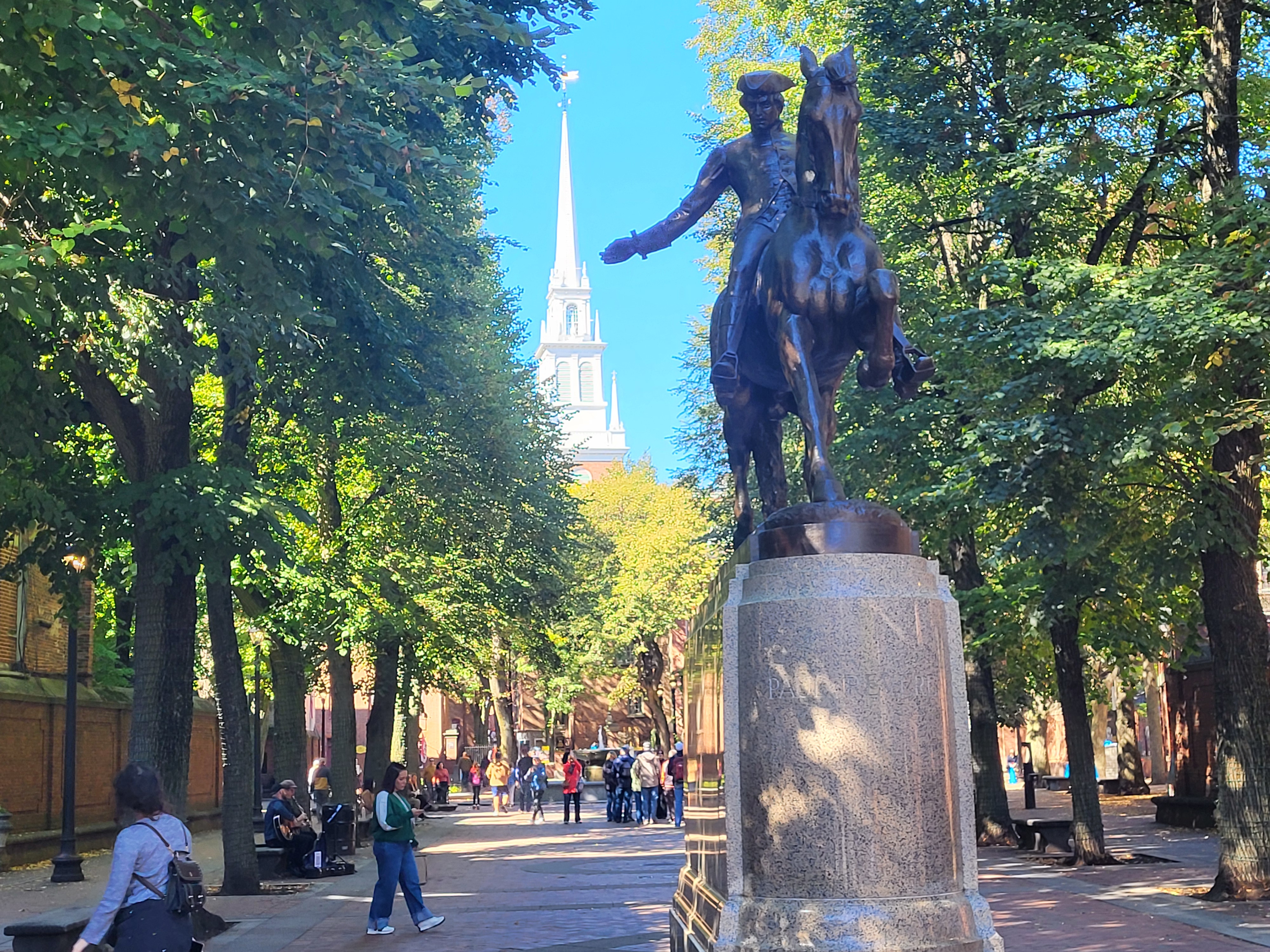
Continuing along is the Paul Revere Mall where a statue of him making his midnight ride stands. Paul Revere set out from here, alerting the country of the approaching British troops.

Behind the statue stands the Old North Church where one lantern was hung in the tower, signaling that the British would be coming by land. With this signal in place, and Paul Revere’s warning throughout the towns, the Contential army stood ready to meet the British forces when they came.


Charlestown Navy Yard & U.S.S. Constitution
Leaving the city center part of Boston, we crossed the river over to Charlestown. At the Charlestown Navy Yard, we saw the oldest commissioned warship that is still afloat. The U.S.S. Constitution, known as Old Ironsides, was first launched in 1797. Old Ironsides was one of six frigates that made up the country’s first navy. Visitors can board the ship and then go through the museum giving a more in depth history.

Also in the navy yard is a retired battleship and an old shipyard building. This entire ship yard is part of the Boston National Historic Park, and sadly was closed while we were there. We were disappointed not to get to see inside the different ships.


Bunker Hill Monument
The last stop on the Freedom Trail is the Bunker Hill Monument. Rising 221 foot tall obelisk commemorates the first major battle of the Revolutionary War. There are 294 steps to get to the top offering incredible views of the city,

From Lexington to Concord- Minute Man National Historic Park
We left Boston and went to Lexington and Concord, following the direction of Paul Revere’s ride to alert the country. This area is covered in beautiful colonial landscapes and echoes of the skirmishes between the British and Continental troops. The British forces were marching to Concord in order to destroy a stockpile of military supplies.
Battle Road Trail
Between the towns of Lexington and Concord is known as the Battle Road Trail. This trail marks the path of the British soldiers as they marched on the colonists. The path is 5.5 miles long and would be perfect for a bike ride or long walk. We started about half way through and walked towards Concord.


Capture of Paul Revere
We passed the spot where Paul Revere was captured by British troops. He was questioned and held for several hours. But when a British sergeant confiscated his horse to replace his own, Revere was released. He walked back to Lexington to continue working with Continental army where needed.


Witness Houses
Along the Battle Road are a series of recreated houses from that time. These houses were called witness houses as the residents witnessed the approach of the British soldiers. Diary entries and other writings at that time give personal accounts of watching the lines of soldiers come down the road.

Along the roads are markers designated as memorials for the British soldiers that were lost here. These memorials serve as tender reminders of the causalities of the opposing side.


The Old North Bridge & Battleground
We followed the Battle Road until it led us to the Old North Bridge, the final stop of the trail. It was here that British troops were met by the newly formed Continental Army, and where the first shot was fired—igniting the American Revolution. A statue now stands overlooking the field, a solemn tribute to the men who stood their ground in the name of independence.

The Continental soldiers were hardly an army by traditional standards—many were farmers, merchants, and tradesmen with little training and scarce supplies. Yet they faced down what was then the strongest military force in the world.

The war that followed would last for years, marked by staggering loss, sacrifice, and perseverance on both sides. In the end, from this moment on the bridge, a new nation began to take shape: The United States of America.


Concord’s American Authors
Right along the road of this part of Concord are homes of some American authors. A building named The Wayside was home for a time to Nathaniel Hawthorne and Louisa May Alcott’s family.
Louisa May alcott- Orchard House
Lousia May Alcott grew up in the Wayside House. But it was in the Orchard House where she wrote Little Women. She was inspired by the house where she lived, and it became the backdrop of her characters.

I loved seeing the Little Women garden with flowers representing the different sisters. And under the shade of a tree, a large group sat on the grass while someone read passages from the book.


Ralph Waldo Emerson
Just across from Louisa May Alcott’s home is the home of Ralph Waldo Emerson. Emerson lived here with his wife and children as he created an incredible body of work including poetry, essays, and short stories. He is known most for his writing on nature and the peaceful guidance that comes from being in it. His house is a National Historic Landmark.

Next year, the United States will mark 250 years since declaring independence. Standing in these places—where the earliest sparks of that story began—was a humbling experience. Ours is still a young nation in the grand scope of history, yet in that time it has weathered immense change, challenge, and growth. And while so many chapters have already been written, it feels clear that the story of this country is still very much unfolding.
Visit these other places connected to the American Revolution:
Yorktown- Final Battle of the Revolutionary War
Thanks for coming along on this tour along the Freedom Trail and onto Lexington and Concord. May your faith in possibility be stronger than your fear of defeat.

Coming Up Next:
Read More From:
Follow along for more adventures near and far!


Leave a Reply