The weather the week before our trip had been perfectly warm and sunny, which seemed like a good sign for a trip north to Lexington, Kentucky. We had big plans involving bike riding down the Bluegrass Parkway and maybe even a little horseback riding, since Lexington is famous for its horses.
But as we pulled into the city, we were hit with the last of the cold snaps, complete with a few inches of snow. So much for our outdoor plans.
With our bikes staying put and horseback riding looking considerably less appealing, we got online to find some other things to do. What we found turned out to make for a fantastic weekend in this beautiful Kentucky city.
Lexington is an easy city to underestimate. It is best known for horses and bourbon, but there is so much more to discover here. From aviation and presidential history to Civil War stories, museums, downtown wandering, and historic industrial spaces, Lexington offers a surprisingly diverse mix of experiences.
It is also a great size for a weekend getaway. You can experience several very different sides of the city without feeling like you are constantly rushing from one attraction to another. And if the weather changes your plans, as it did for us, there are plenty of indoor and outdoor options to fill your time.
Sometimes the best trips are the ones that don’t go according to plan.
Weekend in Lexington
- Aviation Museum of Kentucky
- Mary Todd Lincoln House
- Exploring Downtown Lexington & the Central Library
- Kentucky Horse Park
- Exploring Lexington’s Distillery District
- Camp Nelson National Monument
- Planning Your Visit to Lexington
- FAQ: Lexington


Aviation Museum of Kentucky
Our first stop was the Aviation Museum of Kentucky, located right next to Bluegrass Airport. The museum is made up of three different areas: a hangar dedicated to military aviation, another covering the history of aviation, and it includes an outdoor area where visitors can watch aircraft and air shows.

Military Aviation Hanger
We began in the military aviation hangar, where a proud eagle stood as the gatekeeper to the collection. Inside were aircraft that had been used by the military, along with displays explaining the technology and purpose behind the planes that played such important roles in American military history.
One of my favorite parts of the museum was the people. Retired veterans serve as docents, and they wander throughout the museum ready to answer questions, explain the aircraft, and share their own experiences. Having someone who had actually worked with these types of planes talking about them made the exhibits feel much more personal.

One of the aircraft on display was a Grumman F-14 Tomcat, the supersonic fighter that became the U.S. Navy’s premier air-superiority fighter and fleet-defense interceptor.
Of course, most of us probably know the F-14 for an entirely different reason- Top Gun. The movie helped turn the Tomcat into one of the most recognizable military aircraft in popular culture. The film also famously sparked a surge of interest in naval aviation, with young people inspired by Maverick and the other pilots on screen.

The museum lets visitors get a little closer to that experience. Two of the aircraft allow visitors to climb inside and get a feel for what it might be like to sit in the cockpit.
The first was an aircraft used for flight training. It is still carefully maintained and used for training and simulation purposes, so being able to climb inside gave us a fun glimpse into the world of aviation. Our daughter thought this was the greatest thing in the entire museum. We spent quite a bit of time inside the aircraft while she took everything in and apparently began preparing for her future career in the skies.

The other aircraft visitors could climb into was a military helicopter. With the crests of the different branches of the military displayed behind it, the helicopter made quite a statement among the surrounding aircraft.
There was actually a line of people waiting for their turn to climb inside, push the buttons, and pull the levers. Once we got inside, I could understand the excitement. Even sitting in a stationary helicopter made it easy to imagine what it must feel like to actually take one into the air.


Exploring the History of Aviation
The second hangar took a step back from military aviation and looked more broadly at the history of aircraft, engines, and the people who helped develop them.
One of the first aircraft visitors see is a replica of the 1908 quadruplane built by Kentucky inventor Matthew Bacon Sellers II. Sellers was an inventor who worked on several developments in aviation, including retractable landing gear. He was also acquainted with the Wright brothers and eventually served on the Naval Consulting Board established by Thomas Edison.

The collection continues through the development of aviation, with civilian aircraft showing how airplane designs changed over the years. There are also engines and other pieces of aviation technology that help explain what made these aircraft possible.
And if looking at airplanes isn’t quite enough, the museum also has flight simulators. These aren’t simply arcade-style simulators. They are used for actual flight training, and visitors have the opportunity to experience them as well. You do need to arrange this ahead of time, however, so that someone is available to help set up the simulator.
Between the aircraft, engines, simulators, and the stories shared by the veteran docents, the Aviation Museum of Kentucky turned out to be a much more interesting stop than we had expected when we walked through the doors.

Mary Todd Lincoln House
Our next stop took us into a very different part of Kentucky history: the childhood home of Mary Todd Lincoln, wife of President Abraham Lincoln.
The house was built in 1806 and originally operated as an inn before being purchased by the Todd family in 1832. Mary’s father was a successful businessman and politician, and the Todd family was prominent in Lexington society.
Mary eventually moved to Illinois to live with an older sister while continuing her education. It was there that she met Abraham Lincoln, the man who would eventually become the 16th president of the United States.
Standing in the house where Mary’s story began made it interesting to think about just how dramatically her life would change.
Abraham Lincoln was elected president in 1860, and Mary became First Lady at one of the most difficult moments in American history. Her position was complicated in ways that are easy to overlook today. She was a strong supporter of her husband and of the Union he was trying to preserve, but she also came from a Kentucky family divided by the Civil War. Her father had enslaved people, and several of her siblings supported the Confederacy, with some dying while serving in the Confederate army.
Mary found herself navigating a deeply divided country while also trying to figure out what was expected of her as First Lady. She faced political pressure, criticism from newspapers, and people seeking favors or positions through her connection to the president. At the same time, she struggled with periods of depression that made the demands of her position even more difficult.

And then, in 1865, the war finally ended. For the Lincolns, however, the relief of peace would last only a few days. While attending the theater with her husband, Mary witnessed the unthinkable as John Wilkes Booth assassinated President Lincoln.
After his death, messages of sympathy poured in from around the world. Even while grieving, Mary made an effort to personally respond to many of the letters she received.
One particularly poignant exchange was with Queen Victoria, who had lost her husband, Prince Albert, several years earlier. Mary recognized that the queen’s own experience with grief gave her a unique understanding of what Mary was going through.
The years that followed were incredibly difficult. Mary eventually returned to Illinois to be with her children. The Lincolns had four sons, but only one would live into adulthood. Mary endured the deaths of three of her children as well as the assassination of her husband.
Her grief and ongoing struggles with depression continued to affect her life, and she spent time receiving institutional care before eventually living with her sister. Mary Todd Lincoln died in 1882.
Walking through her childhood home gave us a chance to see a side of the Civil War era that can sometimes disappear behind the much larger story of Abraham Lincoln and the war itself. Mary was a woman caught in the middle of an extraordinary moment in American history, with family loyalties, political expectations, personal tragedy, and her own struggles all colliding at once.
It was fascinating to stand in the rooms where her story began and think about where that life would eventually lead her.
Exploring Downtown Lexington & the Central Library
The Mary Todd Lincoln House sits right on the edge of downtown, so after visiting her childhood home, we decided to wander through a little more of Lexington’s city center.
Lexington is the second-largest city in Kentucky, but you might not guess it from downtown. The city center felt much smaller and more relaxed than many other major cities we have visited. There were plenty of interesting buildings and places to explore, but the pace felt decidedly low-key.


Our favorite discovery, however, was inside the Central Library. As soon as we walked through the doors, we were greeted by an enormous pendulum slowly swinging back and forth beneath a glass dome. Images of horses appear to gallop around the space while the numbers of a giant clock circle the ceiling above. It was one of those places where we immediately stopped walking and just looked up.
As we stood there watching, a man came over and started telling us about the installation. He had actually been part of the crew that built it, which made his stories about the clock even more interesting.
He explained that the original design had the pendulum triggering a light in the clock above it, allowing the installation to keep and display the correct time. Unfortunately, the lighting mechanism was damaged and they were never able to get that feature working again.
Even without the light, the installation was mesmerizing. The slow movement of the pendulum, the horses circling overhead, and the enormous clock numbers around the glass dome made the entire entrance feel more like an art installation than a library.
It was certainly not what we expected to find when we walked into the Central Library, which made it one of our favorite little discoveries in downtown Lexington.
This is considered the largest ceiling clock in the world and it is absolutely mesmerizing to watch the slow and steady movement of time.

Kentucky Horse Park
You can’t come to Kentucky—and especially not Lexington—and avoid horses.
This is horse country. Everywhere we drove around Lexington, we passed enormous pastures with horses grazing in the distance. So when we started looking for things to do in the city, the Kentucky Horse Park was an obvious choice.
The Kentucky Horse Park is an international equestrian competition venue and home to the National Horse Center, which serves as the headquarters for many of the country’s major equestrian organizations. But at its heart, the park is also a working horse farm where horses from around the world are cared for, trained, and prepared for competitions and performances.
Even before we went inside, the park made it clear how important horses are to Kentucky’s history and culture. Statues throughout the grounds honor some of the most famous horses to pass through the park, including Secretariat, the legendary 1973 Triple Crown winner, shown alongside his jockey, Ron Turcotte.

Learning the History of the Horse
The park is also home to the International Museum of the Horse, a Smithsonian-affiliated museum dedicated to the long relationship between humans and horses.
The museum takes visitors through the history of horses and the many ways these animals have shaped human civilization. Horses have been used in transportation, agriculture, industry, warfare, sport, and art, and the exhibits showed just how deeply woven they have been into our history.


One of the most fascinating pieces in the museum was the skeleton of a famous thoroughbred known as Big Lex.
Big Lex was the skeleton of Lexington, one of the most accomplished racehorses of the 19th century. Lexington was one of the first horses inducted into the National Museum of Racing and Hall of Fame, and he became particularly famous for his success as a sire. Many of the horses descended from him went on to become champion racehorses themselves.
His influence eventually became so closely connected with the city that Lexington’s image can be found throughout town.
Seeing the skeleton of such a celebrated horse was a little strange at first, but it was also fascinating to see the actual animal behind so much racing history. It gave us a completely different perspective on the incredible athleticism and physical structure of these horses.

Meeting the Horses
After exploring the museum, we headed over to one of the horse barns to meet some of the park’s residents. This turned out to be one of our favorite parts of the visit.
The horses were incredibly friendly, often reaching their heads toward us and nuzzling our hands in search of a little attention. Trainers were nearby and happy to answer questions about the horses and explain more about their training and routines.

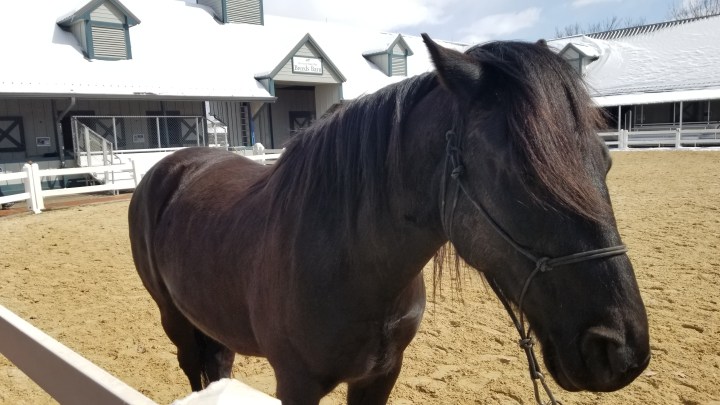
Of course, we quickly developed a favorite. His name was Brother Oh Brother, although everyone simply called him Bro. Bro was curious and affectionate from the moment we met him. We would rub his neck and he would make this soft humming sound before leaning his head even farther into our hands, apparently hoping we would continue. It was impossible not to fall in love with him.
Bro had been training at the Kentucky Horse Park for several years and was one of the park’s star performers in competitions. Knowing that made it even more special to meet him when he wasn’t performing or competing, but simply standing in his stall enjoying a little attention from visitors.
The Kentucky Horse Park ended up giving us both sides of Kentucky’s horse culture: the history and prestige of the racing world, but also the much simpler experience of standing beside a horse and realizing just how beautiful and gentle these animals can be. And, naturally, Bro was our favorite part.

Exploring Lexington’s Distillery District
Besides horses, the other thing Kentucky is famous for is bourbon. Tennessee may be known for its whiskey, but Kentucky is bourbon country, and Lexington sits right in the middle of it. The Kentucky Bourbon Trail connects visitors with distilleries throughout the state, offering a chance to learn about the history and craftsmanship behind one of Kentucky’s most famous products.
Just outside downtown Lexington is the Distillery District, a revitalized industrial area that has become home to distilleries, restaurants, bars, shops, and entertainment.
We took a walk through the district and immediately loved the atmosphere. The smell of bourbon and good food drifted through the area as people moved between the restaurants and distilleries. Music and laughter filled the streets, giving the whole place a lively but relaxed feeling.

We weren’t there specifically for a distillery tour, but there was still plenty to enjoy. We stopped for dinner at one of the pubs and then finished the evening with ice cream from the brightly colored Crank & Boom. It was a fun way to experience a different side of Lexington.
I especially love seeing cities take old industrial spaces that have outlived their original purpose and give them a completely new life. The Distillery District felt like one of those places—a little bit of Lexington’s industrial past mixed with bourbon, food, music, and a whole lot of people simply enjoying an evening together.

Camp Nelson National Monument
The next morning we ventured a little ways outside Lexington to visit Camp Nelson National Monument and learn about a lesser-known part of the Civil War.
Camp Nelson began in 1863 as a Union Army supply depot, training center, and military camp. The location was important because of its position in central Kentucky and its access to the roads and rivers that connected the area with other parts of the Union war effort. But Camp Nelson would become much more than a military installation.
Kentucky was one of four slaveholding states that remained in the Union when the Civil War began. That put the state in a complicated position throughout the war. Kentucky’s loyalty to the Union did not mean that slavery had disappeared, and Camp Nelson became an important place in the complicated transition from slavery to freedom.

From Enslavement to Military Service
After the Emancipation Proclamation took effect in 1863, its provisions did not apply to enslaved people in Kentucky because Kentucky had remained in the Union.
But Black men in Kentucky were eventually allowed to enlist in the Union Army, and military service offered them a path toward freedom. Under the system initially established in Kentucky, enslaved men could enlist with the consent of their enslavers, with compensation paid to the enslaver.
Hundreds of men came to Camp Nelson hoping to enlist and gain their freedom. For some, however, getting to the camp was dangerous. Men who arrived without the consent of their enslavers could be pursued by slave catchers and bounty hunters. Violence and intimidation became part of the reality surrounding the camp, and the requirement for enslaver consent was eventually removed.
By 1864, Camp Nelson had become one of the largest recruitment and training centers for Black Union soldiers in Kentucky. These men weren’t the only people arriving at the camp. Their wives and children came with them.

A Community at Camp Nelson
As more Black soldiers arrived, their families gathered at Camp Nelson seeking safety and a new life. The military initially treated many of these family members as refugees, and camps of tents and makeshift cabins began to appear throughout the area.
What started as a military installation became a community.
Families supported one another while their husbands and fathers were away serving in the Union Army. They built homes, established relationships, and created a life together in a place that had not existed for them before the war.
One of the stories we learned about was the Booker family.
Jim and Sarah Booker came to Camp Nelson after escaping slavery, and they eventually raised three sons there. Music became an important part of the family’s life, and the Booker family performed around the camp and later traveled throughout the country.
Their music became associated with what they called the “Camp Nelson Blues,” and members of the family continued recording and performing into the early 20th century.
I loved learning about this because it showed that Camp Nelson wasn’t simply a place where soldiers passed through. For many people, it became a community where families built something new in the middle of an incredibly uncertain time.

Walking Through Camp Nelson
After learning about the history at the visitor center, we followed the path toward the remains of the military camp. The small fortifications that remain today give an idea of how the area was used to protect the camp and the people living there.
It was difficult to stand in those quiet fields and imagine them filled with tents, cabins, soldiers, and families. The landscape looks peaceful now but during the Civil War, it would have been anything but.
After the war ended, many people continued living at Camp Nelson. For some, it had become a place of safety and home. For others, there simply wasn’t another place to go.
Camp Nelson also became an important place for formerly enslaved people as they established their lives after emancipation. The site continued to serve the community in various ways after the war, including as a place where formerly enslaved people could receive documentation of their newly recognized freedom.
For many who passed through its gates, Camp Nelson represented the beginning of something entirely new.

A Different Side of Civil War History
Camp Nelson was not the kind of Civil War site I had visited before. There were soldiers and military strategy, of course, but the story here was also about families, freedom, community, and the complicated process of trying to build a new life in the middle of a war.
It is difficult to think about what the people who came to Camp Nelson endured to get there. Some were escaping slavery. Some were risking everything to enlist in the Union Army. Families followed husbands and fathers into an uncertain future because staying where they were meant remaining enslaved.
Places like Camp Nelson are important because they make the Civil War story bigger than battles and generals. They help us see the people who were trying to survive the war and, in many cases, use the upheaval of the war to change the course of their own lives.
The Civil War was an incredibly complicated and heartbreaking period of American history, and there is rarely a simple story of heroes and villains. Camp Nelson gave us another piece of that much larger story.


Planning Your Visit to Lexington
A weekend gives you enough time to experience several of Lexington’s highlights without trying to see everything at once. You could spend your first day exploring the Aviation Museum, Mary Todd Lincoln House, and downtown before ending the evening in the Distillery District. A second day could be devoted to the Kentucky Horse Park and a visit to Camp Nelson National Monument.
If you are especially interested in bourbon or horses, you can easily adjust the itinerary to spend more time on either. Some attractions have specific hours or require advance reservations, particularly bourbon tours, so check current information before your visit.
And don’t be afraid to leave a little room in your schedule. One of our favorite discoveries was the Central Library’s incredible clock, something we never would have thought to seek out on our own.

FAQ: Lexington
- Is Lexington worth visiting for a weekend?
Absolutely. Lexington is a manageable size for a weekend trip while still offering plenty of history, culture, horses, bourbon, museums, and outdoor experiences to explore.
- What is Lexington best known for?
Lexington is best known for its horse farms, thoroughbred racing, and bourbon. But as we discovered, there are plenty of other things to see and do beyond those two famous Kentucky traditions.
- Is Lexington more than horses and bourbon?
Definitely. History lovers can visit the Mary Todd Lincoln House and Camp Nelson National Monument, aviation enthusiasts can explore the Aviation Museum of Kentucky, and downtown offers museums, restaurants, shops, and unexpected discoveries like the Central Library’s enormous clock.
- How many days do you need in Lexington?
A weekend is enough to experience several of the city’s highlights, although you could easily spend longer if you want to explore more of the Bourbon Trail, visit additional horse farms, or take your time with the city’s museums and historic sites.
- Can you visit Camp Nelson from Lexington?
Yes. Camp Nelson National Monument is an easy addition to a Lexington itinerary and makes a worthwhile day-trip or half-day stop for anyone interested in Kentucky and Civil War history.


Our weekend in Lexington certainly didn’t turn out the way we had planned. The snow put an end to our bike ride and horseback riding plans before we even got started, but in the end, I’m rather glad it did. Instead, we found ourselves wandering through aviation history, learning more about Mary Todd Lincoln, discovering a mesmerizing clock in the middle of a library, meeting horses at the Kentucky Horse Park, enjoying an evening in the Distillery District, and stepping into a deeply important part of Kentucky’s Civil War history at Camp Nelson.
It was a good reminder that sometimes the best way to experience a new place is to let the plans change a little. Lexington gave us a weekend full of history, horses, bourbon, unexpected discoveries, and a few stories we probably wouldn’t have found if the weather had cooperated. And honestly, I think that’s a pretty great way to spend a weekend in Kentucky.
If you enjoyed reading more on Mary Todd Lincoln and Camp Nelson, you may want to check out these other Civil War related places:
Stones River National Battlefield, Tennessee
Chickamauga & Chattanooga National Military Park, Georgia
Thanks for coming along to Lexington. May you find beautiful scenery combined with fascinating history and industry.

Coming Up Next:
For More Information:
Read More From:
Follow along for more adventures near and far!


Leave a Reply