
Our first day in Paris was spent checking off some of the city’s most famous landmarks. We walked along the Seine, stood beneath the Eiffel Tower, and found ourselves constantly looking up at the history and grandeur surrounding us.
Our second day felt completely different.
Instead of chasing iconic sights, we spent the day slowing down and enjoying the quieter pleasures of the city. We wandered through artist neighborhoods, lingered over pastries, admired beautiful architecture, and spent time simply being present. It was during this slower day that I began to understand the French phrase joie de vivre—the joyful enjoyment of life.
Paris may be known for its famous monuments, but it was on this day that I fell in love with the city’s smaller moments.
Joie de Vivre in Paris
- Sacré-Cœur and Views Over Paris
- Wandering Through Montmarte
- The Windmills of Montmarte and the Moulin Rouge
- Paris Through the Lens of Art Nouveau
- An Evening in the Tuileries Garden
Sacré-Cœur and Views Over Paris
We began our day at the beautiful Sacré-Cœur, perched atop the hill of Montmartre and overlooking the city below.
Even before reaching the basilica itself, the view was enough to stop us in our tracks. Paris stretched out in every direction, a sea of cream-colored buildings and rooftops fading into the distance. The broad steps leading up to Sacré-Cœur were filled with people sitting, talking, listening to music, and simply enjoying the moment. There was no rush here. Everyone seemed content to slow down and take in the view.

The basilica’s bright white domes stand out against the skyline and can be seen from many parts of the city. Construction began in 1875 and continued for nearly forty years before the church was completed. Built in a Roman-Byzantine style that differed from many of the architectural trends of the time, Sacré-Cœur remains one of the most recognizable landmarks in Paris.

While the church itself is beautiful, what I remember most is the atmosphere surrounding it. There was a sense of calm and appreciation that felt different from some of the busier landmarks we had visited the day before. Standing on the hill and looking out across Paris, it felt less like checking another attraction off a list and more like taking a moment to truly enjoy being there.


From the basilica, we followed the winding streets down into Montmartre, leaving the crowds behind and stepping into one of the most charming neighborhoods in Paris.
Wandering Through Montmarte
From Sacré-Cœur, we followed the streets downhill into Montmartre, one of the most charming neighborhoods in Paris.
Although it is one of the city’s most popular destinations, Montmartre still feels remarkably like a village. The narrow cobblestone streets wind between cafés, bakeries, artist studios, and colorful buildings, creating an atmosphere that feels entirely different from the grand boulevards and monuments of central Paris.

Artists have long been drawn to Montmartre. The neighborhood’s lower rents and inspiring surroundings attracted generations of painters, writers, and musicians, helping create the bohemian spirit that still defines the area today. Even now, local artists line the streets displaying their work while visitors linger over coffee at sidewalk cafés.


What I loved most about Montmartre was how naturally it slowed me down.
Travel often becomes a constant cycle of seeing, doing, and moving on to the next attraction. But Montmartre seemed to encourage the opposite. I found myself lingering over details that I might otherwise have missed—a weathered doorway, a row of flower boxes beneath painted shutters, the smell of fresh pastries drifting from a bakery, or the distant glimpse of Sacré-Cœur rising above the rooftops.


Instead of hurrying toward a destination, we simply wandered.
We stopped whenever something caught our attention, browsed little shops, enjoyed pastries along the way, and let ourselves get pleasantly lost among the winding streets. It was one of those rare travel moments where the neighborhood itself became the attraction.


Looking back, Montmartre wasn’t memorable because of any one landmark. It was memorable because of how it felt. For a few hours, we weren’t tourists racing through Paris—we were simply enjoying the experience of being there.
The Windmills of Montmarte and the Moulin Rouge
Montmartre is known today for its artists, cafés, and charming streets, but long before it became a creative center, the hill was covered with windmills.
At one time, more than thirty windmills stood across Montmartre, taking advantage of the hill’s elevation and steady winds. Today, only a handful remain, offering a glimpse into what this part of Paris looked like centuries ago.
One of the most famous is the Moulin de la Galette, a beautiful wooden windmill dating to 1622. Over the years, businesses and gathering places sprang up around the windmill, transforming it into a popular social destination. Artists such as Pierre-Auguste Renoir and Vincent van Gogh immortalized it in their paintings, helping preserve its place in Parisian history.
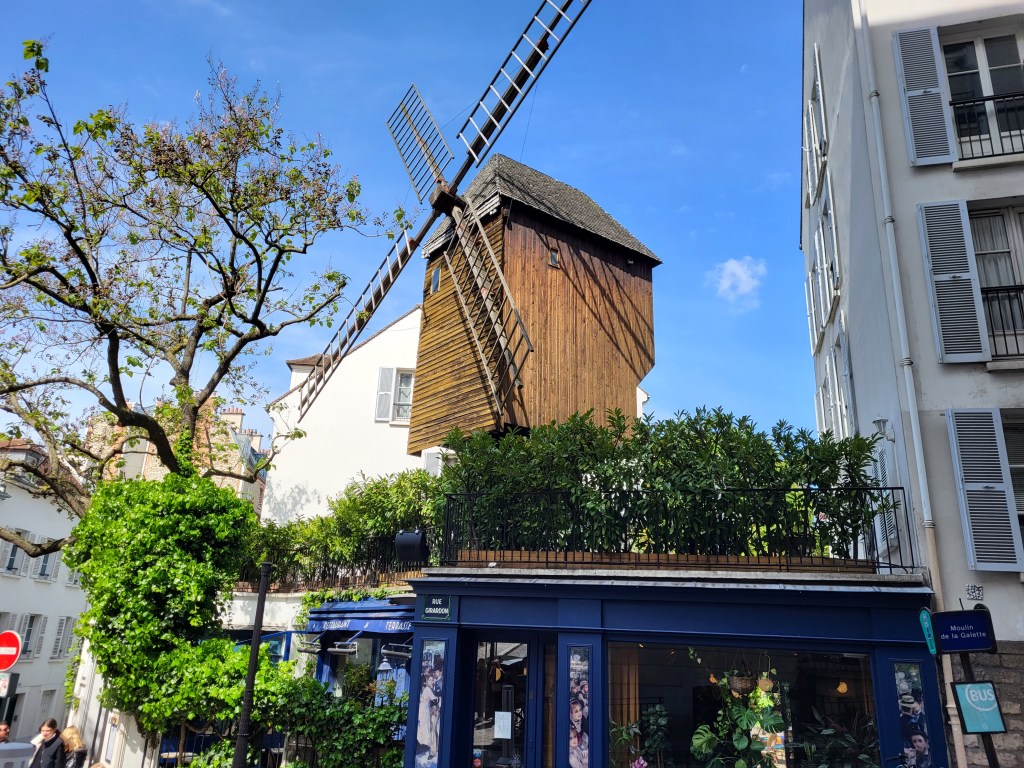
While the Moulin de la Galette represents the quieter, historic side of Montmartre, another windmill has become one of the most recognizable symbols in Paris.
The bright red windmill of Moulin Rouge stands as a reminder of the neighborhood’s lively entertainment culture. Opened in 1889, the cabaret became famous as the birthplace of the can-can dance and helped define the nightlife of Belle Époque Paris. Although the building was destroyed by fire in 1915 and rebuilt the following year, it remains one of the city’s most iconic landmarks.

What struck me most was how these two windmills tell very different stories about the same neighborhood. One speaks of old village life on the hill above Paris, while the other reflects the energy, creativity, and spectacle that would later make Montmartre famous throughout the world.
Together, they are reminders that Montmartre has always been a place where history, art, and imagination come together.
Paris Through the Lens of Art Nouveau
One of the things I quickly noticed in Paris was that beauty seemed to extend far beyond the city’s famous landmarks. Art and design appeared in places where I least expected to find them.
As we explored the city, we began spotting the elegant Art Nouveau metro entrances that have become one of the visual symbols of Paris. Designed at the turn of the twentieth century, their flowing lines, curved ironwork, and plant-inspired details were meant to celebrate a modern age while still drawing inspiration from nature. Even something as ordinary as a subway entrance felt like a work of art.


The more we walked, the more I realized that Paris treats architecture as something to be admired rather than simply used. Decorative details appeared on apartment buildings, storefronts, balconies, and public spaces throughout the city.
One of the finest examples of this artistic style can be found inside Galeries Lafayette Haussmann.
While the department store is known for its luxury shopping, the real attraction for me was the spectacular dome rising above the central atrium. Layers of stained glass, intricate ironwork, and sweeping arches combine to create one of the most beautiful interiors in Paris.

Standing beneath the dome, I found myself looking upward far more than I looked at the stores themselves. Sunlight filtered through the colored glass, filling the space with soft hues and making the entire building feel almost like a cathedral dedicated to art and design. I could have spent hours simply sitting there and admiring the craftsmanship.


It was a reminder that one of the joys of Paris is discovering beauty in unexpected places. Sometimes the most memorable moments are not the famous monuments, but the details that reveal how much care and creativity have been woven into everyday life.
An Evening in the Tuileries Garden
After a full day of exploring neighborhoods, landmarks, and hidden corners of Paris, we made our way to the Tuileries Garden, located between the Louvre and Place de la Concorde.
Originally created in 1564 by Catherine de Medici and later opened to the public after the French Revolution, the garden has long served as a place for both royalty and everyday Parisians to pause and enjoy the city. Today, it remains one of the most peaceful green spaces in central Paris.

We found chairs near one of the reflecting pools and finally gave ourselves permission to slow down.
After a day of walking through Montmartre, wandering museums and arcades, and taking in the details of the city, it felt good to simply sit. The noise of the city faded into the background as people passed through the gardens—locals, travelers, families, and artists all sharing the same space in their own quiet way.
Purple irises were in bloom, adding soft color against the symmetry of the gardens. In the distance, the Louvre rose behind the trees, anchoring the view with its familiar presence.


We ate, rested, and watched the rhythm of Paris continue around us without needing to be part of it.
There is something special about ending a day in a city like Paris in a place like this. It is not dramatic or overwhelming—it is still, grounded, and peaceful.
After so much movement throughout the day, the Tuileries gave us space to breathe.


And in many ways, it felt like the perfect reflection of what we had come to understand about Paris: that its beauty is not only in its monuments and museums, but also in its quiet, ordinary moments of rest.
Paris has a way of revealing itself slowly.
Our first day was filled with the landmarks you dream about seeing—the Eiffel Tower, the Louvre, Notre Dame. But it was our second day that showed us something deeper. It was in the quiet streets of Montmartre, the unexpected beauty of Art Nouveau details, and the stillness of the Tuileries Garden that Paris began to feel less like a list of places to see and more like a city to experience.
This is where I began to understand the idea of joie de vivre—not as something loud or extravagant, but as something woven into everyday life. It was in lingering over pastries, pausing to admire a view, wandering without urgency, and simply being present in each moment.
Paris didn’t ask us to rush. It invited us to slow down.
And in doing so, it left us with a different kind of memory—not just of what we saw, but of how it felt to be there.
If you enjoyed the art experience of Paris, then you may be interested in these other sides of the city:
Thank you for coming along on this second day in Paris. May you always have a certain ‘joie de vivre’ with everything you do.

Follow along for more adventures near and far!


Leave a Reply