One of my favorite kinds of trips is visiting a place I know almost nothing about.
There are no long bucket lists, no months of anticipation, and no expectations to live up to. Just the simple excitement of arriving somewhere new and discovering what it has to offer.
That was exactly how we felt when we set our sights on Tupelo, Mississippi.
Aside from knowing it was the birthplace of Elvis Presley, we didn’t know much about the city. But as we’ve learned time and again, some of the best travel experiences happen when you venture beyond the places everyone already know. What we found was a city filled with music history, local culture, and a few surprises that made it the perfect destination for a weekend getaway.
To make the journey part of the adventure, we chose the scenic route and followed portions of the historic Natchez Trace Parkway. The winding road, quiet forests, and historic landscapes encouraged us to slow down and enjoy the drive. By the time we arrived in Tupelo, we were ready to see what this often-overlooked corner of Mississippi had in store.
A Weekend in Tupelo
- Driving the Natchez Trace Parkway
- Tupelo National Battlefield
- Lunch at the Neon Pig Cafe
- Brices Cross Roads National Battlefield
- Exploring the Legacy of Elvis Presley
- A Quiet Evening at Tombigbee State Park
- Why Visit Tupelo?
- Know Before You Go: Tupelo
Quick Facts: Tupelo, Mississippi
- Location: Northeast Mississippi
- Known For: Birthplace of Elvis Presley
- Best For: history lovers, music fans, scenic drives, and weekend getaways
- Time Needed: 2-3 days
- Best Time to Visit: Spring and Fall
Driving the Natchez Trace Parkway
Part of the reason we chose Tupelo for this weekend getaway was that it gave us an excuse to spend some time along the historic Natchez Trace Parkway.
The parkway follows much of the route of the Old Natchez Trace, a travel corridor that has connected this region for thousands of years. Long before modern highways existed, Native Americans used the trail as they followed game and traveled between communities. Later, European settlers, traders, soldiers, and explorers would use the same route as they moved through the frontier.

There is something fascinating about knowing that the road beneath your tires follows a path that has been traveled for centuries. Thousands of people have made this journey before, each with their own destination and story. Today, visitors can still step off the parkway and walk portions of the original Trace, following in the footsteps of those who came long before us.
Even if you never leave your car, the drive itself is worth experiencing. The road winds through forests, farmland, and rolling countryside, offering a slower pace than the interstate and plenty of opportunities to simply enjoy the scenery.
As you travel the parkway, keep an eye out for the distinctive arrowhead-shaped signs. These mark historical sites, scenic overlooks, and access points to sections of the original Natchez Trace trail. Some of our favorite moments came from pulling off the road simply to see what we might discover next.

Tupelo National Battlefield
One of our first stops in Tupelo was the Tupelo National Battlefield. Tucked into the middle of town, it is easily the smallest battlefield I have ever visited. In fact, the entire site occupies roughly a single city block.
At first glance, it would be easy to overlook it.
But standing there serves as a reminder that the importance of a place is not measured by its size.

The Battle of Tupelo took place in July 1864 and proved to be an important Union victory during the Civil War. The battle helped secure Union supply lines throughout the region and weakened Confederate forces operating in northern Mississippi. The fighting was fierce, and at some points became so desperate that soldiers reportedly discarded their weapons and fought hand-to-hand.
One of the most significant parts of the battle was the role played by the United States Colored Troops (USCT). These African American soldiers fought with extraordinary bravery and determination during the battle. Their actions helped secure the Union victory and challenged many of the prejudices held at the time. One commanding officer later wrote that witnessing their courage had erased years of prejudice from his mind.


As meaningful as the battlefield’s military history is, what stayed with me most were the small white stones scattered throughout the site.
Many visitors could easily walk past them without noticing. Marked only with Roman numerals, these simple stones represent soldiers who lost their lives during the battle. Some are believed to mark Confederate graves, though the identities of many of those buried here have been lost to history.
Several of the stones had coins resting on top of them, left behind by visitors as a quiet gesture of remembrance. Standing among those markers, I found myself thinking less about who won or lost and more about the human cost of war. In such a small corner of Tupelo, there is an incredible amount of history, sacrifice, and memory preserved for future generations.


Lunch at the Neon Pig Cafe
After spending the morning exploring Tupelo’s history, we were more than ready for lunch. Fortunately, one of the city’s most famous restaurants was waiting for us.
We headed to Neon Pig Cafe, a local favorite that has earned national attention for its food. Part butcher shop, part farmer’s market, and part laid-back café, the Neon Pig has built a reputation that extends far beyond Mississippi. It is perhaps best known for its signature Smash Burger, which has been recognized as one of the best burgers in the country.
From the moment we walked in, it felt like the kind of place where locals and visitors gather equally. We were directed to any open table and encouraged to grab a drink from the long row of coolers stretching down one side of the restaurant. The walls were lined with shelves stocked with local sauces, seasonings, coffee, and other regional favorites, giving the whole space the feeling of a neighborhood market as much as a restaurant.

There is something wonderfully unpretentious about a place that focuses entirely on great food rather than fancy presentation. Our meal arrived on thick sheets of brown butcher paper instead of plates, and honestly, that felt perfectly fitting for the atmosphere.
Between the welcoming atmosphere, local character, and incredible food, it was easy to understand why the Neon Pig has become such a beloved Tupelo institution.
Brices Cross Roads National Battlefield
After lunch, we left Tupelo and drove a short distance into the countryside to visit Brices Cross Roads National Battlefield Site.
Unlike the battlefield we had visited earlier in the day, Brices Cross Roads marks a Confederate victory during the Civil War. The battle took place in June 1864 when Confederate forces under General Nathan Bedford Forrest defeated a much larger Union force. Today, the quiet fields and roads give little indication of the violence that once unfolded here.

One of the things I find most fascinating about visiting Civil War sites is seeing how different communities choose to remember their history. Having visited battlefields throughout both the North and the South, it is impossible not to notice the different perspectives that emerge. While the facts of the battle remain the same, the stories people choose to emphasize can vary greatly depending on where you are standing.
What stayed with me most at Brices Cross Roads was the cemetery.


The battle itself was fought in and around the small community cemetery, creating a striking contrast between life and death. There is something deeply poignant about soldiers fighting for survival while surrounded by reminders of mortality. Standing among the gravestones, it was easy to imagine the chaos that once swept through what is now such a peaceful place.
Looking closely, visitors can still see evidence of the battle. Some of the older headstones bear scars from the fighting, including bullet marks and broken stone that have remained for more than a century. These small details make the history feel far more tangible than any monument or plaque ever could.

Nearby, rows of white markers honor the soldiers buried here. Confederate memorials stand throughout the site, and among the graves are markers dedicated to unknown soldiers from both sides of the conflict. Seeing those memorials side by side was a powerful reminder that regardless of uniforms, allegiances, or outcomes, every battlefield ultimately represents lives lost.


As we walked through the cemetery, I found myself thinking less about victories and defeats and more about the people whose stories ended here. More than 150 years later, Brices Cross Roads remains a place not only of history, but of remembrance.
Exploring the Legacy of Elvis Presley
When most people think of Elvis Presley, their minds immediately go to Graceland in Memphis. But long before he became the King of Rock and Roll, Elvis was simply a young boy growing up in Tupelo.
No visit to Tupelo would feel complete without stopping at the Elvis Presley Birthplace to see where his story began.

Visitors can tour the small two-room house where Elvis was born and spent his earliest years. Standing beside the modest home, it is hard to imagine that one of the most recognizable figures in music history started in such humble surroundings. The simplicity of the house makes his story feel all the more remarkable.
Nearby sits the church that Elvis attended with his family. It was here that he was first exposed to gospel music, a style that would influence him throughout his life and career. Listening to the music and stories shared inside the church, it becomes easier to understand how those early experiences helped shape the performer he would eventually become.


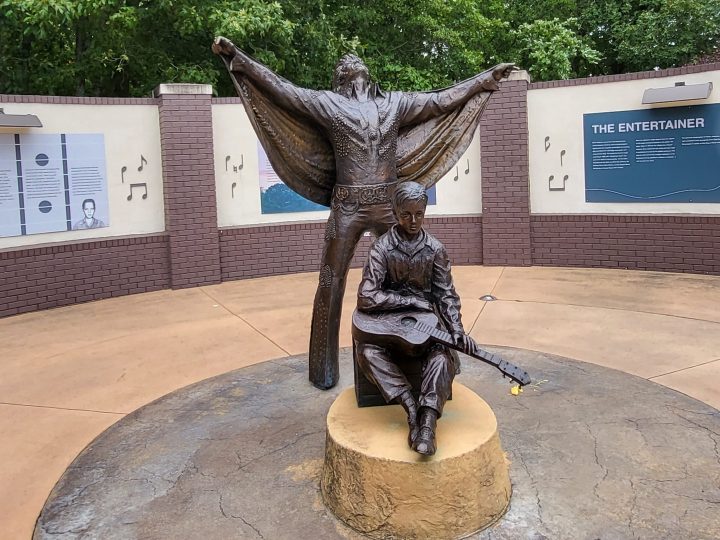
Throughout the grounds are statues and memorials dedicated to different stages of Elvis’s life. One of my favorites was the statue of young Elvis holding his first guitar—a reminder that every legend begins somewhere. At the top of the hill, a larger memorial connects the young boy from Tupelo with the global icon he would later become.

What struck me most during our visit was how much pride the city still takes in its connection to Elvis. The birthplace is beautifully maintained, and it is clear that Tupelo sees him not only as a celebrity, but as one of their own.
That connection continues throughout the city.


In downtown Tupelo, colorful guitar sculptures line the streets in tribute to its most famous son. Visitors can stop by Tupelo Hardware Company, where a marker on the floor indicates the exact spot where Elvis received his first guitar. What seemed like a simple purchase at the time would ultimately change the course of music history.

Elsewhere in the city, statues and memorials honor the many times Elvis returned to his hometown. Despite achieving worldwide fame, he never forgot where he came from and remained connected to the community that helped shape him.


Whether you’re a lifelong Elvis fan or simply curious about the story behind the legend, visiting Tupelo offers something unique. It allows you to step back before the fame, before the records, and before the crowds—to the place where it all began.
A Quiet Evening at Tombigbee State Park
After a day spent exploring battlefields, music history, and downtown Tupelo, we ended our adventure with a slower pace at Tombigbee State Park.
The park surrounds a beautiful lake framed by lush green trees and rolling Mississippi hills. As we walked along the shoreline, the water was perfectly still, reflecting the blue sky above. It was the kind of peaceful scene that makes you instinctively slow your pace and simply enjoy being outdoors.
Tombigbee State Park is a popular destination for fishing, kayaking, canoeing, and camping. During our visit, however, we were content to simply walk along the water and take in the scenery. After a day filled with history and sightseeing, it felt like the perfect place to unwind.
Sometimes the best part of a trip isn’t a famous landmark or a bucket-list attraction. Sometimes it’s ending the day beside a quiet lake, watching the water ripple beneath the trees and appreciating a place you knew almost nothing about just a few days before.

Why Visit Tupelo?
- Explore the roots of Elvis Presley
- Drive the historic Natchez Trace Parkway
- Visit Civil War battlefields
- Enjoy nationally recognized Southern food
- Discover un underrated Mississippi destination
- Experience history, music, and nature in one weekend
Know Before You Go: Tupelo
Best Time to Visit. Spring and fall are the most comfortable times to visit Tupelo, with mild temperatures that are ideal for exploring the Natchez Trace Parkway, visiting historic sites, and spending time outdoors. Summer can be hot and humid, while winter tends to be mild.
Getting Around. A car is the best way to explore Tupelo and the surrounding area. While many attractions are located within the city, sites such as Brices Cross Roads National Battlefield and portions of the Natchez Trace Parkway require a short drive.
How Much Time Do You Need? A weekend is the perfect amount of time to experience Tupelo’s highlights. Two to three days allows enough time to explore the Elvis Presley Birthplace, visit local museums and historic sites, enjoy the food scene, and spend some time outdoors.
Don’t Miss the Natchez Trace Parkway. If you’re driving to Tupelo from Tennessee or central Mississippi, consider taking part of the historic Natchez Trace Parkway. The scenic route adds a little extra time to your journey but offers beautiful views and a chance to experience one of America’s oldest travel corridors.
Come Hungry. Tupelo has an impressive food scene for a city its size. Local favorites like the Neon Pig have earned national recognition, making great food part of the experience.
Beyond Elvis. While Tupelo is best known as the birthplace of Elvis Presley, visitors will find much more than music history here. Civil War battlefields, scenic parks, local restaurants, and historic sites make it a surprisingly well-rounded weekend destination.
When we first set out for Tupelo, all we really knew was that it was the birthplace of Elvis Presley. I expected Elvis. I didn’t expect battlefields, great food, scenic drives, and a city with so many stories to tell.
By the end of the weekend, we had discovered so much more. We followed the historic Natchez Trace, stood on Civil War battlefields, enjoyed one of the best meals of the trip, explored the roots of a music legend, and ended the day beside the peaceful waters of Tombigbee State Park.
One of the greatest joys of travel is discovering a place that exceeds every expectation simply because you didn’t have any to begin with. Tupelo was that kind of destination for us. What started as a weekend getaway became a journey through music history, Civil War stories, scenic drives, and small-town charm.
It was a reminder that some of the most memorable adventures aren’t found in famous destinations, but in the places quietly waiting for someone to give them a chance. By the time we left, Tupelo felt less like a stop on a map and more like a place with stories worth returning to hear.
If you have enjoyed this visit to Tupelo, then you may be interested in some of these other southern towns:
Thanks for coming along on this visit to Tupelo, Mississippi. May you always remember where you come from and carry it with you wherever you go.

Follow along for more adventures near and far!


Leave a Reply