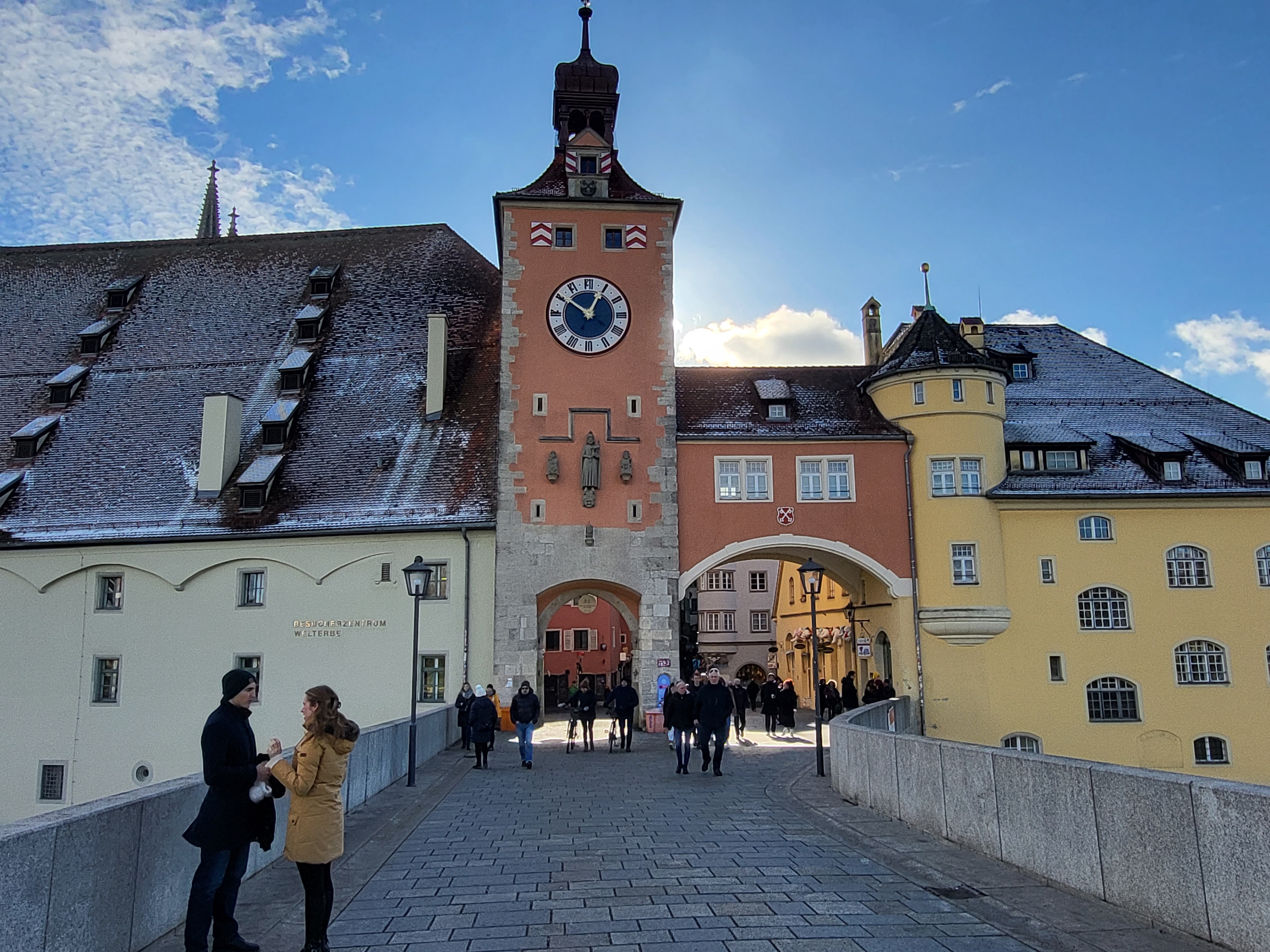
After spending several days enjoying the Christmas season in Munich, we decided to venture farther out into Bavaria to explore some of the smaller historic cities that have shaped this region for centuries.
One of the places we were most excited to visit was Regensburg.
The train ride alone felt worth the trip as the landscape shifted into quiet river valleys, church spires, and clusters of colorful buildings gathered along the water. There is something especially magical about traveling through Germany in winter, when even ordinary streets seem to carry a storybook kind of charm.
Unlike some of Bavaria’s more famous tourist destinations, Regensburg feels less polished for visitors and more like a city that has simply continued living through centuries of history. Roman influences, medieval architecture, river trade, religious conflict, and modern daily life all seem to exist together within its narrow streets.
By the time we stepped out of the train station and began walking toward the old town, we already had the feeling this was going to be one of those places that quietly stays with you long after you leave.
- Wandering Through Regensburg
- Along the Danube River
- A City of Assemblies and Empires
- St. Emmeram’s Abbey
Quick Facts: Regensburg
- Location: Bavaria, Germany
- Known For: Medieval architecture, UNESCO Old Town, Danube River
- Nearest Major City: Munich
- Best Way to Visit: Day trip by train from Munich
- Historic Highlight: 12th Century Stone Bridge


Wandering Through Regensburg
Situated at the meeting point of the Danube, Naab, and Regen rivers, Regensburg has long been an important crossroads for trade, politics, and culture. The Romans first established a fort here because of its strategic location, and over the centuries the city grew into one of the most influential centers in Bavaria.


Today, the city is best known for its remarkably preserved medieval old town, which was added to the UNESCO World Heritage list in 2006. Nearly 1,000 historic buildings are protected within the old town center, creating one of the best-preserved medieval cities in Germany.
Unlike some of Bavaria’s more heavily tourist-centered towns, Regensburg still feels very much like a living city. Students, locals, and visitors all move through the narrow streets together, giving the historic center an energy that feels both old and modern at the same time.

Along the Danube River
Much of the historic center follows the curve of the Danube River, and one of the best ways to experience the city is simply by wandering its streets and river paths.
We walked across the famous Stone Bridge, marveling at both the river below and the rows of colorful buildings lining the waterfront. Many visitors admire the bridge for the views alone, but the bridge itself is one of the city’s most important historic landmarks.


Built between 1135 and 1146, the Stone Bridge was considered a masterpiece of medieval engineering. During the Second and Third Crusades, knights crossed this bridge on their journeys toward the Holy Land. It also became a critical trade connection between Northern Europe and Venice, helping establish Regensburg as an economic powerhouse during the medieval period.

The winter air carried the smell of chimney smoke and river mist while church bells echoed softly through the old city streets. Everywhere we turned seemed to reveal another tower, courtyard, or beautifully preserved building.
A City of Assemblies and Empires
For centuries, Regensburg served as a gathering place for political and religious assemblies within the Holy Roman Empire.


One of the city’s most historically significant buildings is the Old Town Hall, where the Diet of Regensburg met in 1541 in an attempt to restore religious unity during the Protestant Reformation. The debates held here reflected the growing tensions spreading across Europe at the time.
Ultimately, the city became predominantly Lutheran, while Roman Catholics faced restrictions and limitations within civic life. Walking through these streets today, it is remarkable to think about how many political, religious, and economic decisions once shaped the future of Europe from within these walls.

St. Emmeram’s Abbey
Before catching our train back to Munich, we stopped at St. Emmeram’s Abbey.
Originally founded as a Benedictine monastery in 739, the abbey later became part of the grand Schloss Thurn und Taxis complex. We especially loved the detailed frescoes painted across the archways and the heavy old cemetery gate that seemed to hold centuries of stories behind it.
There is something about old European churches and monasteries that always feels deeply peaceful, even after centuries of history unfolding around them.


As evening settled over the city, we made our way back toward the train station, taking one last look at the medieval towers and riverfront buildings glowing softly in the fading light.
We absolutely loved our time in Regensburg. The city manages to feel historically important without losing the warmth and rhythm of everyday life. It is easy to understand why travelers have been drawn here for centuries.
So much of Europe’s history has passed through these streets, and yet Regensburg still feels wonderfully alive—less like a preserved museum and more like a city that simply never stopped being itself.


Interested in some other UNESCO world heritage places? Then you may be interested in these:
Thanks for coming along on this visit to the beautiful city of Regensburg. May you find beauty in art and architecture around every corner.

Coming Up Next:
For More Information:
Read More From:
Follow along for more adventures near and far!


Leave a Reply