With the country celebrating Independence Day this week, we decided there was no better place to be than where the story of America first began. We drove up to the coastal region of Virginia to spend a few days exploring some of the most important chapters in American history.
Our trip took us through what is known as the Historic Triangle, which includes Jamestown, Yorktown Battlefield, and Williamsburg. Together, these sites are often considered the birthplace of America, offering a living look at colonial life—from the earliest settlements to the founding of a new nation.
Parts of Jamestown and Yorktown are included within the Colonial National Historical Park, which is managed by the National Park Service. However, the experience can feel a little complex at first—some areas are federally managed and open to the public, while others are privately operated museums with separate admission fees.
Visiting the Historic Triangle offers a rare chance to experience the full arc of early American history—from settlement to independence.
Contents:
- Visiting the Historic Triangle
- Jamestown: America’s First Permanent English Settlement
- Yorktown: The End of the Revolutionary War
- Tips For Visiting Jamestown & Yorktown
Visiting the Historic Triangle
The Virginia Historic Triangle includes Jamestown, Williamsburg, and Yorktown Battlefield. These three historic areas are connected by the scenic Colonial Parkway, which winds through the Virginia Peninsula along the coast.
The peninsula has been carefully preserved to limit commercial development, creating long stretches of natural, uninterrupted views along the drive. Commercial vehicles are not allowed on the parkway, which helps keep the experience focused on the landscape and its historical significance rather than modern distractions.
Getting Around the Colonial Parkway
Driving the Colonial Parkway is part of the experience itself. The route connects all three historic sites and offers a quiet, scenic way to move between them. Many visitors choose to start their journey in Jamestown and continue through Williamsburg before ending in Yorktown.
Ticket Options for Visiting the Historic Triangle
There are several ticket options depending on how much you want to explore. You can also purchase individual admission at each site.
America’s Historic Triangle Ticket
Includes:
- Historic Jamestown
- Jamestown Settlement Living History Museum
- Colonial Williamsburg
- Yorktown Battlefield
- American Revolution Museum at Yorktown
$100/adult (16+) | $53/child (6-15), valid for 7 days
Museum Combination Ticket
Includes:
- Jamestown Settlement Living History Museum
- American Revolution Museum at Yorktown
$34/adult (13+) | $17/child (6-12), valid for 7 days
Colonial National Historic Park Pass
Includes:
- Historic Jamestown
- Yorktown Battlefield
$15/person (16+), valid for 7 days
Our Visit
For our trip, we chose to visit the National Park Service sites at Jamestown and Yorktown, and then added an extra stop at the Jamestown Settlement living history museum. This combination gave us both the preserved historic landscapes and the interactive, hands-on experience of colonial life.
Jamestown: America’s First Permanent English Settlement
Our first stop in the Historic Triangle was Jamestown, the site of the first permanent English settlement in America. Established in 1607, Jamestown offers a powerful look at the beginnings of colonial life in Virginia.
Today, the area is divided into a few different experiences, each offering a unique perspective on history.
Historic Jamestown
We began our visit where the country was first settled—on a small peninsula along the Chesapeake Bay known as Jamestown. It was here in 1607 that the first permanent English settlement in America was established when a group of ships arrived from England in search of opportunity in the New World.

The voyage was funded by the Virginia Company of England, sending three ships across the Atlantic. Some came seeking gold, others adventure, and many were simply hoping for a new life in an unknown land. After months at sea, they finally reached the shoreline. They named the settlement Jamestown in honor of King James I.


As we walked through the historic site, we saw the remains of what was once a thriving early community. Today, only the foundations of homes and buildings remain, but they still tell the story of daily life in the first permanent English colony.
Set between the bay on one side and wooded landscape on the other, the setting feels peaceful now—but it’s easy to imagine how challenging and unfamiliar it must have felt to the early settlers.


When they first arrived, the priority would have been survival: clearing land, building a fort, and establishing shelter within its protective walls. From there, the settlement slowly began to take shape.
One of the central gathering places would have been the meeting house, where colonists came together for business, worship, and community discussions. It served as the heart of early Jamestown life.

Nearby, we also saw the remains of the old tavern, another important social space where people gathered to share food, conversation, and news from across the colony.
The largest surviving structure is the remains of the Ambler Mansion. The home survived two fires but was ultimately abandoned after a third, leaving behind only traces of its former presence.


Virginia Preservation Archaeology Site
The preservation archaeology site adds an especially meaningful layer to the visit—you can actually see history being uncovered in real time, which makes the story of Jamestown feel very immediate and real.

The Glass House & Early Industry
A short distance from the main settlement, we stopped at the Glasshouse, where the National Park Service has recreated a working colonial glassblowing shop.
Here, visitors can watch demonstrations as glass is gathered, blown, and shaped using traditional methods. Skilled artisans create a variety of pieces in real time, which are then available for purchase at the opposite end of the building.
It was fascinating to watch as they formed a crest-stamped wine pitcher and a decorative bowl, explaining each step of the process along the way. The level of skill and precision was incredible to see up close.
We also learned that becoming a glassblower requires a four-year apprenticeship, highlighting just how specialized and time-intensive this craft was during the colonial period—and still is today.

Jamestown Settlement Living History Museum
Just a few minutes from the original Jamestown site is the Jamestown Settlement. Unlike the historic archaeological site, this museum is privately owned and operates with its own admission fee, offering a more immersive, hands-on look at early colonial life.
The entrance to the museum is lined with the flags of all 50 states, a striking visual reminder of how far the country has grown since those first settlers arrived in Virginia.
We chose to visit the museum in addition to the historic site because it offered a more in-depth, interactive experience of this chapter in history—and it was absolutely worth it. The museum is thoughtfully designed and could easily take several hours to explore fully.

Exhibits & Early Colonial History
Inside, the museum takes visitors through a series of exhibits that explore different aspects of the journey to the New World and the early years of settlement.
One of the most well-known figures highlighted is John Smith, often associated with the story of Pocahontas. Displays explore how their stories became intertwined in both history and legend.


Pocahontas remains an important historical figure, though often romanticized in popular culture. She was still a child when John Smith first arrived, and there is no historical evidence of a romantic relationship between them. Later in life, she married English settler John Rolfe and traveled to England, where she sadly died at a young age.
The exhibits do a good job of showing both the historical record and the way her story has been interpreted over time, highlighting her lasting cultural significance.

The Powhatan Village
After the indoor exhibits, we continued into the outdoor living history areas, beginning with a recreated Powhatan village. The Powhatan people had lived in this region long before the arrival of English settlers.

Walking through the village, we were able to step inside reconstructed homes and see demonstrations of daily life. Interpreters showed skills such as making bone needles and weaving plant fibers into rope.
Visitors are encouraged to observe and even try some of these techniques, which makes the experience feel very interactive and engaging. It’s a meaningful reminder of the deep history and culture that existed here long before colonization.


Ships at the Harbor
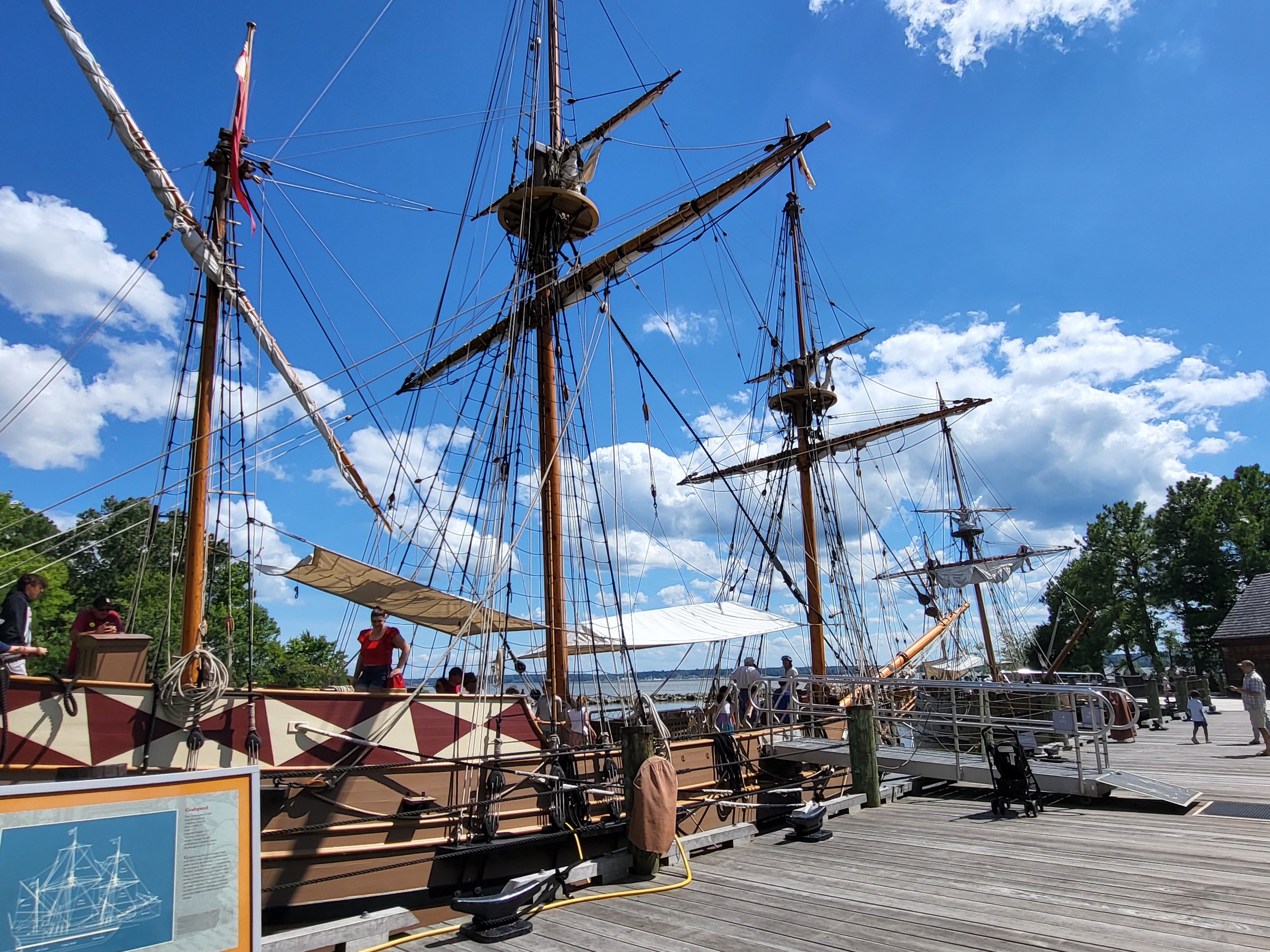
From the village, we moved to the waterfront where replicas of the original ships sit in the harbor. These ships represent the vessels that carried the first settlers across the Atlantic.

Life aboard would have been extremely cramped, with around 50 men confined together for months at sea. Exploring the ships, we were surprised by how small and confined the living spaces were.
We also watched demonstrations of sailors hoisting the sails using ropes and pulleys—and even got to see the children in our group help with the ropes, which quickly became one of their favorite moments of the day.


The Fort & Colonial Life
The final section of the museum is a recreated colonial fort and settlement. This area shows what early life in Jamestown would have looked like once the settlers established themselves within protective walls.

Here, visitors can watch demonstrations such as:
- blacksmithing and nail-making
- baking bread in a wood-fired oven
- firing a musket
- other essential colonial trades
Each demonstration helps bring the realities of survival and daily work into focus. The interpreters are knowledgeable and clearly passionate about sharing these skills and stories.


Visitors can watch the blacksmith hammer out nails used to build structures. They can learn how bread was made in a woodfire oven. Additionally, they can discover what was needed to fire a musket. The demonstrations were really interesting and the people were dedicated to sharing their skills.


Overall, the Jamestown Settlement Museum adds an important layer to understanding early American history. While the archaeological site shows what remains of the past, this museum helps bring that past back to life in a way that is engaging, interactive, and memorable.
Yorktown: The End of the Revolutionary War
Roughly 150 years after the first settlers arrived in Jamestown, the colonies were deep in revolution and war. By this point, tensions with England had reached their peak, and the people of the colonies were exhausted from being ruled from afar. They wanted independence—and a nation of their own.
Our final stop in the Colonial National Historical Park was Yorktown Battlefield, the site where the final major battle of the American Revolutionary War took place.
Yorktown National Battlefield Visitor Center & Driving Tour
The visitor center, though small, provides an excellent overview of the events leading up to the final battle. By this stage in the war, both sides had endured years of conflict and significant losses. French support also played a crucial role in helping the American colonies gain the advantage they needed.


From there, we followed the driving loop through the battlefield. There are two main routes—one that covers the primary fighting areas, and another that leads to the encampments where troops were stationed farther from the front lines.
It was striking to see how varied the landscape was, with sections of marshland and wooded areas that helped shape how the battle unfolded.

Surrender at Yorktown
One of the most meaningful stops was the open field where British forces ultimately surrendered. Standing there, it was easy to feel the weight of what had taken place on that ground.
Under General Cornwallis, the British formally surrendered, effectively ending the war. George Washington stood by as officers laid down their weapons in defeat—a moment that marked a turning point in history.


Nearby, a simple white cross honors the French soldiers who lost their lives in the battle. Visitors have placed French flags at its base, a quiet reminder of the alliance that helped secure victory for the colonies.

After the surrender, General Washington reportedly hosted a dinner for both American and British officers. It was a gesture meant to encourage reconciliation and establish a foundation for peace moving forward.
That detail added a powerful human layer to the history—reminding us that even in moments of conflict, there were efforts toward respect and closure.
Encampments & Headquarters
Driving through the encampment areas, we were surprised by how varied the landscape was—part marsh, part wooded terrain. These conditions would have shaped daily life for the soldiers stationed here.
At the far end of the encampment loop, a marker identifies the location of General Washington’s headquarters during the battle.


Yorktown Historic District
After the battlefield, we explored the nearby historic district of Yorktown. The town is filled with beautifully preserved colonial homes, many decorated with patriotic touches that reflect its significance in American history.

We also visited the large memorial overlooking the Chesapeake Bay, honoring the victory that ended the Revolutionary War. Although discussions about a memorial began shortly after the war, it would take nearly 100 years before it was finally completed.


American Revolution Museum at Yorktown
We also passed by the American Revolution Museum at Yorktown, which offers a more immersive, hands-on experience of the Revolutionary era through exhibits and living history demonstrations.
We chose to save that visit for another trip, but it’s clear that it would take a full day to explore it properly.

Walking through Yorktown brings the story of the Revolutionary War full circle. From surrender to remembrance, it’s a place that holds both historical weight and quiet reflection, marking the end of one chapter and the beginning of a new nation.
Tips For Visiting Jamestown & Yorktown
If you are planning a visit to the Historic Triangle, here are some tips for visiting James town and Yorktown:
- Plan at least half a day for each site
- Drive the Colonial Parkway for the full experience
- Decide ahead of time which ticket option fits your visit
- Combine the historic sites with one museum for a fuller perspective
- Wear comfortable shoes- there’s a lot of walking

Standing in the places where history unfolded—from the uncertain beginnings at Jamestown to the final moments of victory at Yorktown—brings a deeper appreciation for the journey that shaped the nation. These are not just historic sites, but places that still carry the weight of the past in quiet and meaningful ways.
And as we continued on through the Historic Triangle, our next stop at Colonial Williamsburg promised to bring that history even closer, stepping beyond the pages and into daily life.
If you want some more of American history, then you may be interested in these places:
Springfield Armory National Historic Site- Massachusetts
Freedom Trail and Minute Man National Historic Site- Massachusetts
Thanks for coming along today on this American history lesson in the Historic Triangle of Jamestown and Yorktown. May you have the courage to seek new lands and stand for independence.

Coming Up Next:
For Information on these places:
Colonial National Historic Park
More to Read from:
Follow along for more adventures near and far!


Leave a Reply to ourcrossingsCancel reply