With the country celebrating Independence Day this week, we decided there is no better place to be then in the area where the country first started. We drove up to the coastal area of Virginia to dive into some chapters of American history.
We went to what is called the ‘Historic Triangle.’ It includes Jamestown, Yorktown, and Williamsburg. The Historic Triangle is considered the birthplace of America. This area brings to life the colonial time period. It spans from those who first settled her to the dawning of a new country.
Parts of Yorktown and Jamestown are included in the Colonial National Historic Park maintained by the National Park Service. It gets a little confusing though. The National Park Service oversees parts of the towns. Other parts and some museums are privately owned, and there are separate fees for them.
Contents:
- Historic Triangle Visitor Information
- Jamestown- First Settlement of the Colonies
- Virginia Preservation Archaeology Site
- The Jamestown Glass House
- Jamestown Settlement- Living History Museum
- Yorktown National Battlefield- Final Battle of the Revolution
- Yorktown Historic District
- American Revolution Museum at Yorktown
Historic Triangle Visitor Information
The Historic Triangle includes Jamestown, Williamsburg, and Yorktown. These three areas are all along the Colonial Parkway that runs through the Virginia Peninsula on the coast of Virginia.
The peninsula has been carefully protected from commercial development so there are beautiful open views along the parkway. Commercial vehicles are not allowed to drive along the parkway. This was done to help visitors visually focus on the past and not be distracted by modern developments.
Most visitors will begin in Jamestown at the visitor center. There are multiple ticket packages visitors can buy depending on what they want to include. Or visitors can buy an individual entrance ticket at each place.
- America’s Historic Triangle Ticket:
- includes Historic Jamestown, Jamestown Settlement Living History Museum, Colonial Williamsburg, Yorktown Battlefield, American Revolution Museum at Yorktown
- $199/adult (age 16 and older); $53/child (age 6-15)
- ticket valid for 7 days
- Museum Combination Ticket:
- includes Jamestown Settlement Living History Museum & American Revolution Museum at Yorktown
- $34/ adult(age 13 and older); $17/child (age 6-12)
- ticket valid for 7 days
- Colonial National Historic Park ticket:
- includes Historic Jamestown & Yorktown Battlefield
- $15/ person (age 16 and older)
- ticket valid for 7 days
We opted to pay to visit the national park areas of Jamestown and Yorktown. Then we paid extra to visit the living history museum at the Jamestown Settlement.
Jamestown-First Settlement of the Colonies
We began our visit where the country first was settled- on a small peninsula off the Chesapeake Bay named Jamestown. It was here in 1607 that the first permanent community was established on the shores of the bay when a few ships from England landed in search of prosperity in the new world.

The Virginia Company of England had funded three ships to cross the Atlantic to the new world. Some were looking for gold, some were looking for adventure, and some were just looking for a new life in a new land. The journey would take many months before they reached the shores. When they landed, they named it Jamestown after their sovereign King James.


As we walked down through the park, we saw the last remains of the houses that served this first community. All that is left behind are the foundations of where they lived and worked. With the bay on one side and surrounded by trees, we couldn’t help but think what a lovely place to have called home so far away from everything they knew.


When the settlers arrived the first thing they would have done would be to clear the trees and build a fort. After that they would then build the living quarters within the fort walls. We saw the old meeting house where people would gather for business, celebrations, and conversation. This would have been the center of the town

The largest remains are those of the Ambler Mansion. This house survived 2 fires, but after the 3rd fire it was abandoned. We also saw the remains of the old tavern, the other great meeting place of the community.


Virginia Preservation Archaeology Site
Next to the national park area is a Virginia Preservation Archaeology Site where they are uncovering items from these first settlers. They have reconstructed a model of a fort and reconstructed a church.
- The cost to enter this area is an $15/ adult; $8/child.

The Jamestown Glass House
A little ways down the road is the Glasshouse where the National Park Service has recreated a glass blowing shop. Visitors can watch as the glass is blown and shaped. Different items are created and are then on sale on the other end of the building.
It was amazing to watch them create a crest stamped wine pitcher and then a decorative bowl. They told us that there is a 4 year apprenticeship program to learn how to work with glass like this.

Seeing what was left of that first settlement was fascinating. Those first settlers landed on these shores hundreds of years ago. This first glimpse into the past would be a good starting off point for the living museum.
Jamestown Settlement-Living History Museum
Just a couple minutes away from the remains of Jamestown is the Jamestown Settlement Living History Museum. This is not part of the national park site but is privately owned and comes with its own fee.
The entrance to the museum is lined with the flags of all 50 states. This display is a beautiful representation of how the country grew since those first settlers arrived here.
We had foregone paying the extra amount to see the archeology site. We decided it was worth the entrance fee for a more in-depth look at this chapter of history.
- The cost for the settlement museum is $20/adult and $10/child.

The museum takes visitors through a series of exhibits. Each exhibit looks at a different part of the story of coming to the new world. The museum is very well done. It could easily take a couple of hours to really understand the different aspects of what was happening during this time.
The Virginia Company of London funded the voyage to the new world with John Smith being appointed as the captain. He would lead three small ships across the ocean and be one of the key leaders in the new settlement.


You can’t talk about Captain John Smith without including the story of Pocahontas. She saved John Smith from being killed by the Powhatan leader. Pocahontas has become a American folk legend. An entire wall of the museum shows the many different depictions of what she looked like.
A common mistake is that there was some kind of romantic relationship between her and John Smith. However, Pocahontas was only 9 or 10 when John Smith arrived. There was never anything akin to romance between them. Years later she would fall in love with another English man named John Rolfe and would go England. Sadly her life in England would be cut short when she fell ill and died.
Pocahontas has always been part history and part legend. She remains an icon of the country and the important role she played in it.

After going through the museum, we continued outside to the living history area. The first part took us to a village of the Powhatan tribe. They have called this area home long before the arrival of the settlers. We got to go inside the homes and see a small glimpse into what daily life looked like.

There were people there giving demonstrations of sharpening bones to make needles and pulling apart plant fibers to make ropes. Visitors are invited to learn and try their hand at the skill. If only briefly, it really draws visitors in to this other world and understanding of the indigenous people.


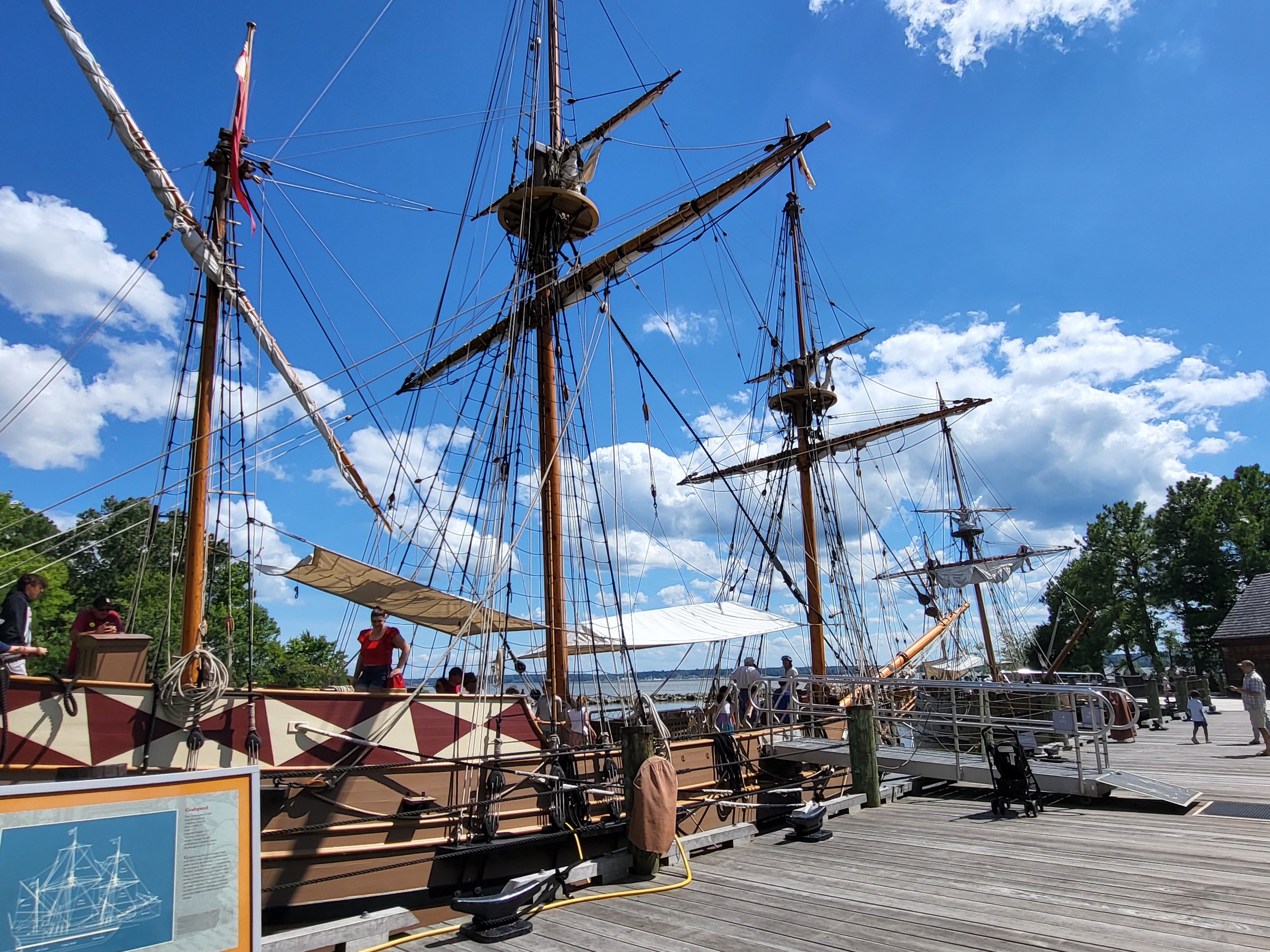
We left the tribal village and made our way to the port where two shapes waited in the water. These two are replicas of the ships that first brought settlers to Jamestown. These ships would hold about 50 men, crammed together for months at sea.

Life on board the ship was no easy voyage with limited space and safety. We were amazed at the small nooks that would make up living quarters. We got to watch the sailors hoist the mast using the complicated system of ropes and ladders. The sailors asked all the kids on board to help pull the ropes. The children thought arranging the sails was the greatest part of the day.


The final area of the museum was the recreated fort and houses. We saw the small community that they would have established within the fort. The people would have had to use the resources they had. They needed those resources to build what was necessary. They aimed to create a life here in an unfamiliar environment.

Visitors can watch the blacksmith hammer out nails used to build structures. They can learn how bread was made in a woodfire oven. Additionally, they can discover what was needed to fire a musket. The demonstrations were really interesting and the people were dedicated to sharing their skills.


The living history museum was really interesting and gave a good idea of what life was like during this time. Though a little expensive, it was well worth it to learn the history by getting to see it in part.
Yorktown National Battlefield-Final Battle of the Revolution
150 years after those first settlers arrived in Jamestown, the country was in the throes of revolution and war. By this time, the people of the colonies were exhausted from being ruled by England. They wanted to be their own country.
Our next stop in the Colonial National Historic Park was Yorktown National Battlefield. This is where the final battle of the Revolutionary War was fought.

The visitor center, though small, gives a good idea of the factors that led into this final battle. The war had been going on for years by this point and there had been great losses on both sides. Had the colonists not received help from France, they would not have been able to win the war.


We drove along the long loop through the battlefield. There are two loops through the battlefield. One is the main loop of the fighting areas. The other loop leads to the military encampments a bit farther from the central area. This is where the fighting likely occurred.

A simple white cross was set up in honor of French soldiers lost in the battle. It is a small area where visitors have left French flags at the base of the cross. These flags maintain the remembrance of the part France played in the war. They also commemorate the successful victory of the colonies.

We entered the field where the British troops finally surrendered. There was a poignant feeling of being on hallowed ground. Under General Cornwallis, the British troops surrendered and the war was deemed over. General Washington looked on as all the officers gave up their weapons in defeat.
Afterwards, General Washington ordered a big dinner. He invited the defeated officers to join the American officers for a meal of good will. They aimed to promote future peace.


We drove through the encampment area and were surprised to see that some of the area was in a marsh while another part was in the woods. At the very far end of the encampments was a sign marking where General Washington’s headquarters were.


Yorktown Historic District
After driving through the battlefield, we went for a walk through the historic old town of the city. We saw the massive memorial overlooking the Chesapeake Bay honoring the victory that ended the war. The memorial was talked about after the war, but it would be 100 years later for it to be erected.


The historic district is full of beautiful colonial homes that have been restored and updated. We loved walking through town and marveling at the old buildings, some with their added patriotic flare.


American Revolution Museum at Yorktown
We saw the American Revolution Museum at Yorktown. This is another in-depth living history museum where visitors can get an in-depth understanding of the Revolution. With daily demonstrations and events this museum visitors can spend the entire day here. We decided to save that experience for the next time we are here.
- The cost of the museum is $20/adult, $15/child.

It has been so interesting to learn more about these chapters in American history. It is quite humbling to think about how much came from these two places.
We have now visited two parts of what makes up the Historic Triangle- Jamestown and Yorktown. We will finish up the triangle by spending the 4th of July in Williamsburg.
If you want some more of American history, then you may be interested in these places:
Thanks for coming along today on this American history lesson in the Historic Triangle of Jamestown and Yorktown. May you have the courage to seek new lands and stand for independence.

Coming Up Next:
For Information on these places:
More to Read from:


Leave a Reply to grandmisadventuresCancel reply