After a few days at home and carving turns on the slopes of Brighton, we packed up and pointed the car north toward Wyoming. While most people are done with winter by this time of year—chasing sunshine and warmer temperatures—we were heading straight back into the snow. We wanted mountains dusted in white. We wanted quiet trails and crisp air. We wanted winter in its full glory.
The area around Jackson Hole and the neighboring national parks will always hold a special place in our story.
It started years ago with what can only be described as a spectacularly disastrous trip when Brad and I were first dating. The weekend unraveled into a string of mishaps—beginning with a hospital visit and ending with an unfortunate encounter involving pepper spray. And yet, somewhere between the chaos and the laughter on the drive home, something shifted. That trip became a defining moment for us.
Not long after, Brad proposed in Grand Teton National Park. We figured that if we could survive that first wild weekend, we were probably built for a lifetime of adventure together.
And if you’ve ever wondered where the name Grand Misadventures came from, it traces straight back to that snowy Wyoming trip where everything went wrong—and somehow, everything went right. (read the story behind Grand Misadventures)

Wandering Jackson Hole & Grand Teton
One of the great thrills of visiting this part of Wyoming is the possibility of spotting wildlife. It adds a layer of anticipation to every stretch of road. You find yourself scanning snowy fields and tree lines, hoping for movement.
As we drove toward Jackson Hole, we didn’t have to look hard. A large herd of elk stood just off the road, their dark bodies striking against the pale winter landscape. Steam rose faintly in the cold air as they shifted and grazed.
A few people had pulled over and were edging closer, cameras in hand, trying to capture the perfect shot. Every time I see that, I can’t help but shake my head and whisper a small prayer that everyone walks away unharmed. National parks may feel curated and scenic, but the animals are anything but tame. They are wild — strong, unpredictable, and deserving of space.
There’s something powerful about observing them from a respectful distance. It reminds you that you’re the visitor here.

Before doing anything else, we pointed the car toward Grand Teton National Park. It felt almost ceremonial — like returning to a place that holds part of your history.
But early spring in the mountains has its own rules. Both Grand Teton and Yellowstone were still in that in-between season. The interior park roads were closed, visitor centers shuttered, and the familiar trailheads inaccessible beneath lingering snow. If we had arrived just a couple of weeks later, we might have been lacing up hiking boots instead of turning the car around.
Still, we weren’t entirely shut out.
From the highway, we could see Grand Teton rising in her full winter glory — sharp, dramatic, and dusted in white. It’s easy to think the name refers to the entire range, but technically it belongs to that singular, commanding peak standing front and center. Even from a distance, she steals the show.
The view was breathtaking, but there was a quiet ache in knowing we wouldn’t be walking those trails this time. So after lingering as long as we could, we turned back toward Jackson Hole — grateful for the glimpse, even if it wasn’t the full experience.

Some of my family joined us for the day, which made it all the more special. There’s something about gathering people you love in a beautiful place that makes it feel even richer.
We wandered in and out of shops, paused to admire Western artwork in gallery windows, and soaked up that cowboy ambiance that still lingers in Jackson Hole. Leather boots, wide-brimmed hats, weathered wood storefronts — it all feels like a nod to the town’s roots.
But more than the shops or the scenery, it was simply nice to share the day together. To laugh, to linger, and to let the mountains serve as our backdrop for a few unhurried hours.

Long before ski lodges and art galleries, this valley was part of a much bigger story of exploration. The Lewis and Clark Expedition set out to find a route to the Pacific Ocean, mapping vast stretches of unfamiliar territory along the way.
One member of the expedition, John Colter, later ventured back into the region on his own as a scout and trapper. He is often credited as the first European American to see the valley that would eventually be known as Jackson Hole. Colter wrote vivid descriptions of the dramatic landscapes he encountered — rugged peaks, sweeping valleys, and geothermal wonders that seemed almost unbelievable at the time.
Standing there centuries later, it isn’t hard to understand his awe. The scale of the mountains and the openness of the land still have a way of silencing you for a moment.

Despite its fame and modern wealth, Jackson Hole still carries the feeling of one of the last true cowboy outposts of the Old West.
Tourism brought wider attention to the valley, especially as visitors began flocking to experience the dude ranches that dotted the landscape. These working ranches offered a taste of frontier life — horseback riding, wide open spaces, and evenings under expansive western skies.


Even as the town has grown and evolved, it has held tightly to that ranch-inspired aesthetic. Wooden boardwalks, antler arches, rustic facades, and Western details are woven throughout the architecture. It doesn’t feel like a theme; it feels like a deliberate effort to preserve identity.
There’s a balance here — between luxury and legacy, between modern travel and historic roots — and somehow Jackson Hole manages to hold both.


These days, tourism in Jackson Hole looks a little different than the early dude ranch era. While the ranching roots still shape the town’s character, much of the energy now revolves around world-class skiing and its role as a gateway to nearby national parks.
Jackson Hole is internationally known for its ski culture, particularly at Jackson Hole Mountain Resort. There are several ski areas in the region, each drawing winter visitors eager for deep powder and dramatic mountain terrain. Even from town, you can glance up and see chairlifts stretching up the mountainside — quiet lines tracing their way toward snow-covered peaks.
It’s a different kind of adventure than the cattle drives and wagon routes of the past, but in its own way, it still carries that same spirit of pushing into the mountains.

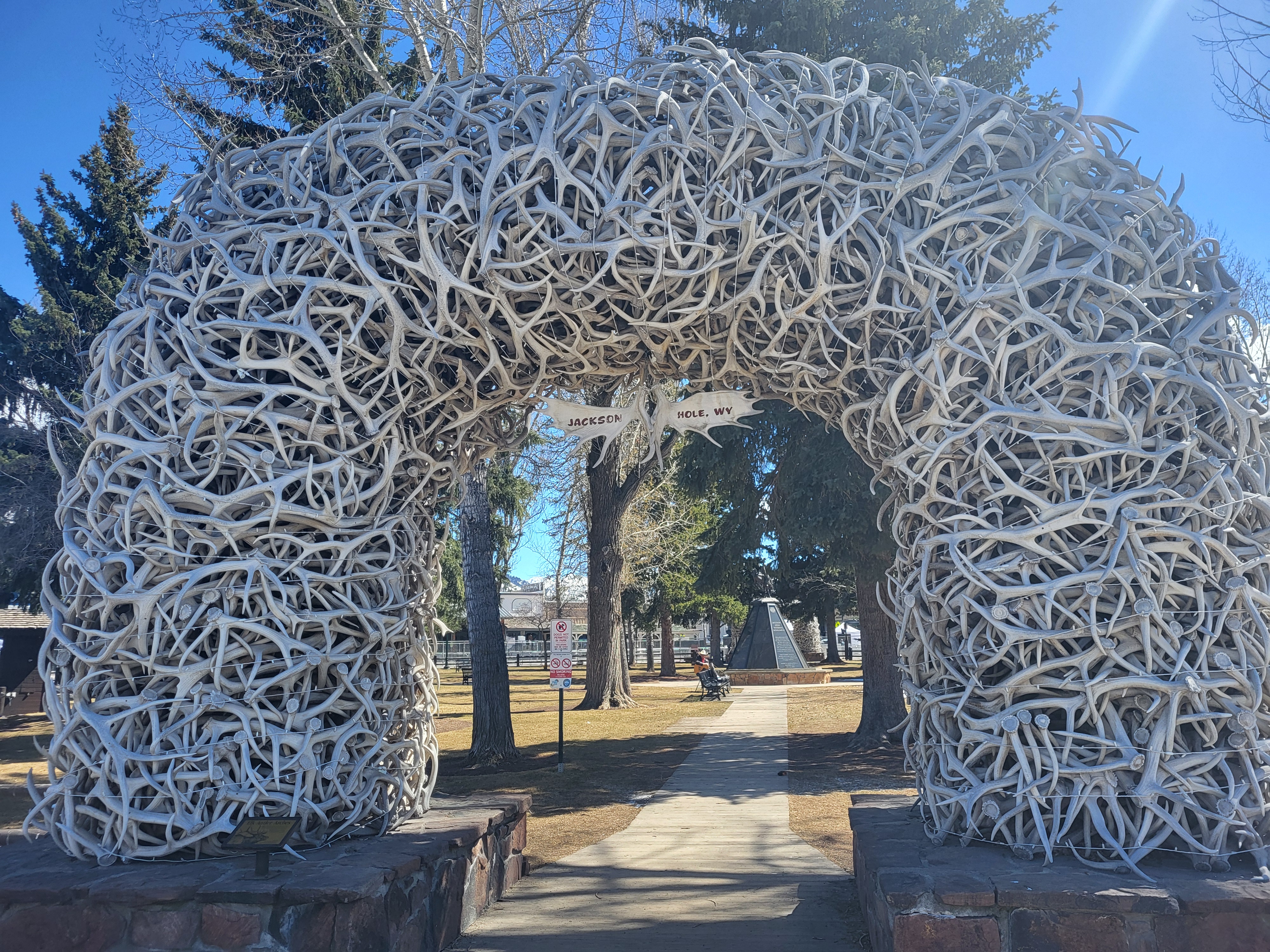
No visit to Jackson Hole is complete without stopping at the giant antler arches in Jackson Town Square.
Positioned on each corner of the square, thousands of elk antlers are bound together to form four towering archways. They’ve become the unofficial symbol of Jackson — instantly recognizable and nearly impossible to walk past without snapping a photo. The running joke is that these arches have proudly appeared in thousands upon thousands of family group pictures over the years.

The first arch was built in 1953 by the local Rotary Club and quickly became a beloved landmark. Three more were added in the following years to frame the entire square.
Over time, the arches have needed repairs and even replacement. Weather takes its toll, and—unfortunately—some visitors have tried to pocket pieces as souvenirs. Even so, they remain one of the most photographed and enduring icons of the town.
Standing beneath them, you can’t help but feel like you’ve arrived somewhere distinct — a place that knows exactly what it is.


We also loved spotting the bright marquee of the Jackson Hole Playhouse, the town’s longtime dinner theater and performance venue. The colorful sign feels almost nostalgic, glowing against the wooden storefronts around it.
The Playhouse hosts a variety of shows and performances throughout the year, offering visitors something a little different after a day of exploring the mountains or wandering town. It’s another reminder that Jackson Hole isn’t just about outdoor adventure — it’s also a place where creativity and community still take center stage.

We only had one day in Jackson Hole and the surrounding area. In peak season, one day would never feel like enough. But with the park roads still closed and winter lingering in the mountains, it felt almost fitting that this visit was slower — more about wandering than checking things off a list.
Sometimes a place doesn’t need your full itinerary. It just needs your presence.
As the sun dipped behind the Tetons, casting long shadows across the valley, we took one last look before heading back toward Utah. The mountains were quiet, still wrapped in snow, holding their stories the way they always have.

On the drive, we found ourselves retelling the story of that first trip together — the hospital visit, the mishaps, the pepper spray. What felt disastrous at the time somehow became foundational. Not long after, there was a proposal in Grand Teton National Park. A promise made beneath those same peaks.
Jackson Hole has changed over the years. It has grown, evolved, welcomed skiers and artists and travelers from around the world. The town feels polished in places, bustling in others. And yet, beneath it all, the same spirit remains — wild, resilient, quietly enduring.
We’ve been on countless adventures since that fateful first trip. But few places hold a piece of us the way Grand Teton, Yellowstone, and Jackson Hole do. They witnessed the beginning of our story. And every time we return — even for just a wandering winter day — it feels a little like coming home.
For some more national parks to enjoy, you may be interested in these:
Thanks for coming along to this quick visit to Jackson Hole. May you laugh at the mishaps that bring the best adventures.

Coming Up Next:
Read More from:
Follow along for more adventures near and far!


Leave a Reply