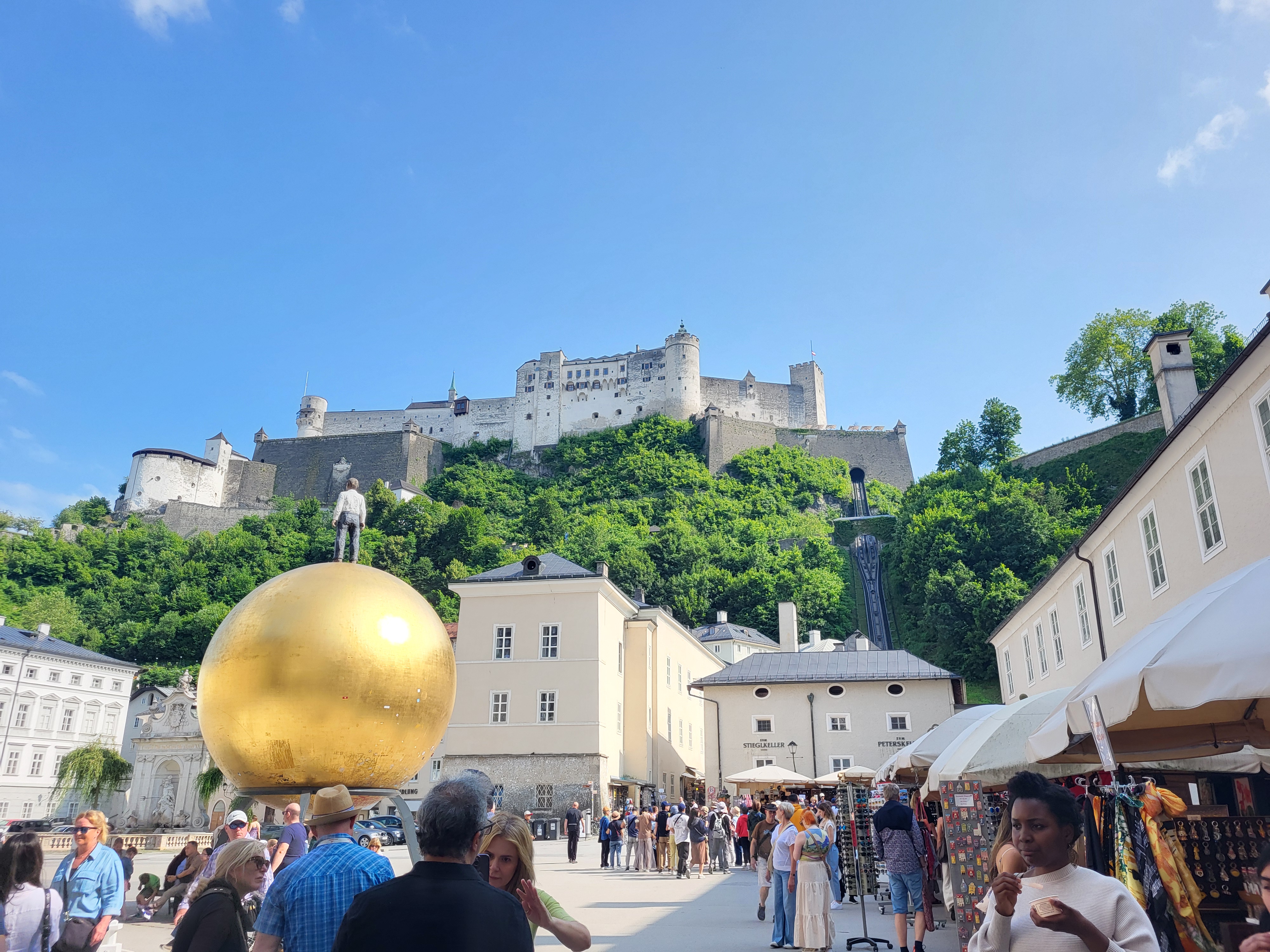
We arrived in the beautiful city of Salzburg early in the morning, dropped our bags at the hotel, and headed straight back out. With comfortable shoes and tired eyes, we set off to wander. This was the first day of our two-week trip, and because we love Salzburg so much, it felt like the perfect place to begin.
Over the years, we’ve learned that the best cure for jet lag is simple: walk. We don’t make plans. We don’t schedule tours. We just keep moving so we don’t collapse where we stand. At some point in the afternoon, we find a snack, some caffeine, and usually a playground. After that, we can rally for a few more hours before the inevitable crash.
We only had one day in the city before heading off to other adventures. So for this visit, we didn’t worry about ticking off sights or following an itinerary. We simply walked and let the city unfold around us. As it turned out, Salzburg had a few pleasant surprises waiting.
The last time we visited, the city was dressed in its holiday finery — twinkling lights, Christmas markets, and winter charm everywhere you looked. It was an incredible first impression. We wondered if Salzburg would feel as magical in the summer. Happily, it did. The city in full bloom, draped in flowers and framed by green hills, was every bit as beautiful.
We began in what is probably our favorite spot in Salzburg: Mirabell Palace and Gardens. Part of its charm, for us, is its connection to The Sound of Music — it’s impossible not to think of “Do-Re-Mi” while standing in the gardens. It remains one of the most beloved films across generations, even if Salzburg itself embraces that connection mostly for the sake of its visitors.


While wandering through the manicured lawns and blooming pathways, we veered away from the main garden and stumbled upon the Zwerglgarten, or Dwarf Garden. A circle of whimsical dwarf statues lines the paths, each one carved with distinct personality. Dating back to the 17th century, it is the oldest dwarf garden in Europe — one of those delightful details you only discover when you allow yourself to wander.


From the Dwarf Garden, we wandered below the garden wall and discovered a playground — always a welcome find when traveling with kids. Playgrounds seem to solve so many things on the road: jet lag, homesickness, pent-up energy, even patience for whatever else the day might bring.

At the far end of the playground, a hidden passage led back into the main gardens. When Mirabell Palace was still a working residence, this was likely a guard entrance or servant passage. Today, it’s simply a charming way to reenter the gardens. In summer, Mirabell is at its best.


Swirls of flowers decorate the lawns, archways are thick with greenery, and people from all over the world wander the paths. It was fun to listen to so many different languages drifting through the air.

As we crossed the bridge toward Salzburg Old Town, church bells began ringing throughout the city. Above the spires, the fortress rose against the sky, and the sound of the bells turned the moment into something quietly unforgettable.

We wandered through the main squares of Old Town, which felt entirely different from our winter visit. At Christmas, statues had been covered to protect them from the elements and crowds filled every space. Seeing them uncovered now gave us a new appreciation for their presence and impact.


This part of Salzburg was designated a UNESCO World Heritage Site in 1997, a reflection of the city’s long history as a cultural crossroads between northern and southern Europe. That blending of influences is especially visible in the city’s Baroque architecture, which appears again and again as you wander.

Eventually, we found the long staircase climbing the hillside toward the fortress. The steps were a little tough — we were tired, and the heat didn’t help — but bursts of purple flowers spilling from the rock walls made the climb worthwhile.


The higher we went, the more beautiful the views became, with the city below and green hills stretching behind it. Though honestly, in Salzburg, almost every view feels like a good one.

There was one place I especially wanted to see on this visit: Stift Nonnberg (Nonnberg Abbey). Parts of the abbey’s exterior were used as a backdrop in The Sound of Music, though the interior scenes were filmed on a set. Because it is still a working abbey, visitors aren’t allowed inside, but you can walk through the courtyard.

First established in 715 as a Benedictine monastery, it is one of the oldest continuously operating monasteries of its kind and was designated a protected monument before Old Town itself joined the UNESCO list.


We loved the simple graves marked with wrought-iron crosses and were quietly thrilled to see the gate used in the film when the von Trapp children search for Maria.


From there, we followed the path that circles the base of the fortress. We decided not to go up to the fortress this time. Instead, we lingered below, drawn to the energy of the squares — giant chess games underway, visitors snapping photos, people simply enjoying the day. There was a shared feeling of unhurried joy, as if everyone had decided to wander without an agenda.

We considered stopping at the Salzburg Museum, but it had already closed. Still, something unexpected caught our attention: the courtyard was filled with massive, colorful bubbles — an art installation impossible to ignore.

Families, couples, and solo travelers lined up to take photos beneath the floating spheres. At night, lights inside the bubbles make them glow even brighter.


There was something delightfully absurd about giant bubbles beside such a historic building. Any disappointment we felt about missing the museum quickly faded — the bubbles became one of our favorite moments of the day.

Another favorite way to wander Salzburg is by following the streets lined with ornate wrought-iron shop signs. In the Middle Ages, signs like these helped illiterate residents identify businesses by symbol rather than words. While most of today’s signs are modern, they retain the same intricate craftsmanship and whimsical charm, turning even an ordinary walk into something memorable.


With one last walk through the gardens, we made our way to the hotel for dinner and an early night in. We didn’t do much in the city today and that is alright. Sometimes you just need a strolling day around town. Salzburg is a perfect city just to wander through. There is no end to enjoying the small side streets. The architecture is captivating. The history is rich. The backgrounds of Sound of Music are enchanting.

Salzburg is beautiful no matter the season. But this summer day — slow, unplanned, and full of small discoveries — reminded us why we love the city so much. Wandering through familiar streets, seeing them anew, felt like reconnecting with an old friend.
If you enjoyed this walk around Salzburg, then you may also enjoy these other cities that we loved wandering through:
Thanks for coming along on this walk through Salzburg. May warm summer days bring joy, gardens, dwarves, and bubbles.

Coming Up Next:
Hiking the Sigmud Thun Klamm Gorge in Hohe Tauern National Park
For More Information:
Read More From:
Follow along for more adventures near and far!


Leave a Reply