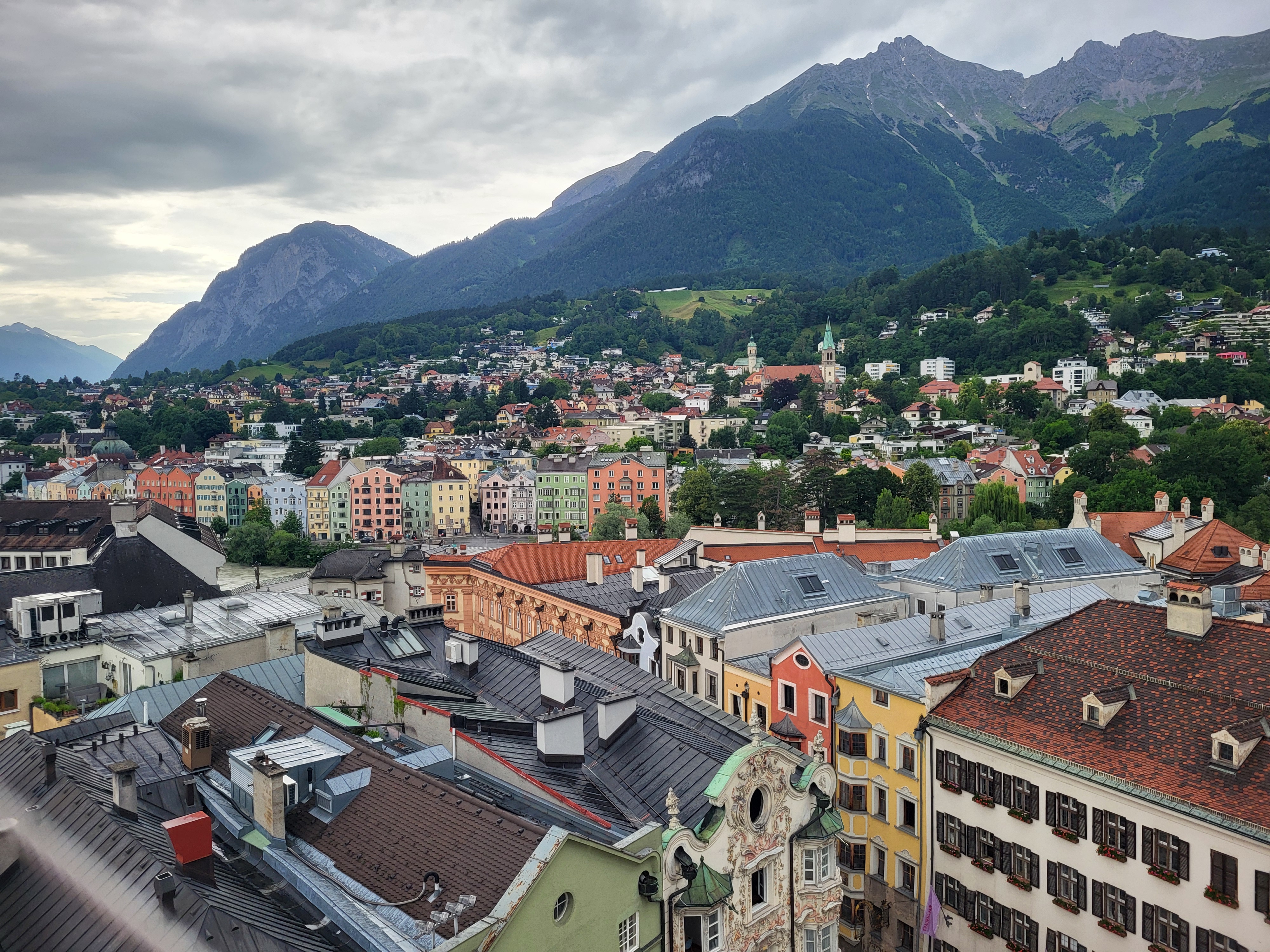
We spent a few wonderful days exploring Innsbruck, and it didn’t take long to realize it could easily become a new favorite. Elegant and interesting, the city is framed by dramatic mountain views that never feel far away, no matter where you wander.
Innsbruck’s history stretches back thousands of years, with evidence of settlement dating to the Stone Age. The town first appeared in written records around 1180 under the Latin name Oeni Pontum, meaning “bridge over the Inn.” That name reflects Innsbruck’s earliest and most enduring role — a crossing point and connector. The area has been continuously inhabited ever since, shaped by shifting rulers and empires over the centuries.
Because of its location, Innsbruck served as a major communication and transport link between northern and southern Europe. It became the capital of Tyrol in 1429 and passed through the hands of various powers, including periods under German and Italian control. Even the Habsburg dynasty left its mark here. While the city remained largely untouched during World War I, it was annexed as part of Nazi Germany during World War II and suffered significant damage.
In more recent history, Innsbruck has become closely associated with winter sports. The city hosted the Winter Olympics in 1964 and 1976 and continues to be a hub for alpine athletics. It was also the first city to host the Winter Youth Olympics in 2012 and is set to host the inaugural Winter Deaflympics in 2027 — a testament to its ongoing role in international sport.
One of the things we appreciated most about Innsbruck is how walkable it is, which made exploring feel easy and enjoyable. To make the most of our time, we used the Innsbruck City Card, which gave us access to many of the city’s top attractions and saved us a significant amount of money. Over four days, we explored at a comfortable pace, discovering just how much beauty and history this mountain city has to offer.
Innsbruck Itinerary
- Innsbruck City Card Information
- Day 1: Funicular, Top of Innsbruck, Alpen Zoo (Half Day)
- Day 2: Ambras Castle, The Court Church, Imperial Palace, The City Tower, & Old Town (Full Day)
- Day 3: Basilica, Monastery, Bell Foundry, Swarovski Crystal Worlds, & Riverwalk (Full Day)
- Day 4: Cable Car, Alpine Botanical Garden, & Stone Pine Path (Half Day)
- What We Missed

Innsbruck City Card Information
Because we were going to be in Innsbruck for a few days, we decided to get the Innsbruck City Card. The city card offers visitors transportation and entrance to the city’s favorite attractions. The cost was very reasonable, especially considering all that was included. By getting the city card, we saved a lot of money compared to buying individual tickets at each location.
- CITY CARD vs. WELCOME CARD:
- A welcome card is a discount card offered by some of the hotels to guests. The welcome card will give some select discounts around town.
- The Innsbruck City Card includes entrance fees to different museums and attractions, access to public transportation, as well as some discounts in certain places.
- WHERE TO BUY CITY CARDS:
- Visitors can purchase their city card at the tourism information office
- or, buy city cards online before you go
- WHAT IS INCLUDED:
- Transportation: The City Card gives access to all public transit through the city, includes the touring Hop-On-Hop-Bus, & bike rentals for an hour from Die Boerse Bike Rental.
- Museums & Attractions: City Card provides entrance to 22 different attractions and museums around the city.
- Discounts: Discounts available at a Tyrol dinner show and the casino
- COST: City Cards can be purchased for 24, 48, or 72 hours. The time begins with the first use of the city card at one of the attractions.
- 24 Hour- € 69,00/adult (ages 16+), € 34,50/ child (ages 6-15)
- 48 Hour- € 79,00/adult (ages 16+), € 39,50/child (ages 6-15)
- 72 Hour- € 89,00/adult (age 16+), € 44,50/child (age 6-15)
We decided on getting the 72 hour City Card so we could see as much of the city as possible. Our first use of the card was around noon on Saturday and expired around noon on Tuesday. It gave us two half days and two full days of using the card. Because of the city card, we made the most of our days in Innsbruck.


Day 1: Funicular, Top of Innsbruck, Alpen Zoo (Half Day)
the Funicular
Because the day was sunny and clear, we were told it was the perfect time to head up to the Top of Innsbruck. As soon as we picked up our Innsbruck City Cards, we set out toward the mountains.
Getting there is part of the experience. We rode the Hungerburgbahn funicular, which begins at a sleek, modern station that feels strikingly contemporary against the historic city. Once inside the glass-walled compartments, the car glided smoothly through town before beginning its steady climb up the mountainside.

It was the longest funicular ride I’ve ever taken, and surprisingly fast. The ascent was smooth and quiet, offering glimpses of the city below before the view opened fully to the mountains beyond. Even before reaching the top, it felt like an adventure — the kind that makes you pause and simply watch as the world shifts beneath you.


the Top of Innsbruck
From the funicular, we transferred to the Nordkettenbahn cable car, which carried us even higher into the mountains. As the car lifted away from the station, the city of Innsbruck spread out below us, its streets and rooftops quickly shrinking as the landscape grew more dramatic.


We reached the midway point of the journey, where visitors can step off to explore. Here, a restaurant with outdoor seating offers the chance to pause and take in sweeping mountain and city views, and a playground gives younger visitors space to burn off energy in an unforgettable setting. We lingered just long enough to look around, knowing there was still more mountain waiting above us.

Another cable car carried us onward toward the summit. Hiking trails crisscrossed the mountainside, goats rested in the shade, and climbers made their way toward the highest peak of Hafelekarspitze. At the very top, a summit cross marks the highest point — the true “Top of Innsbruck.”


Standing there, the views were nothing short of breathtaking. Jagged peaks stretched into the distance, the valley opened wide below, and the city felt both far away and intimately connected to the mountains surrounding it. It was one of those moments where everything goes quiet, and you simply take it all in.

Alpen Zoo
After making our way back down the mountain by cable car, we stopped at the Alpenzoo. If you’re expecting a flat, leisurely stroll past exotic animals, this is not that kind of zoo. Instead, the Alpenzoo focuses entirely on species native to the Tyrol region, offering a fascinating look at the wildlife that inhabits these surrounding mountains.

It’s an interesting and educational experience, but it’s not for everyone. The zoo is built directly into the hillside, and the paths are steep — very steep. Visitors with mobility limitations may want to reconsider or plan carefully before attempting the full circuit. It definitely feels more like a mountain hike with animal enclosures along the way.
We enjoyed seeing the white-headed vultures wandering lazily near their enclosure and watching the brown bear pace past the viewing window. Seeing these animals in a setting so closely tied to their natural habitat made the experience feel uniquely connected to the region.


After finishing at the zoo, we returned to the funicular station. When the car arrived, it was packed with visitors descending from the mountain. Rather than squeeze in, we decided to walk back toward our hotel instead, enjoying the slower pace and stopping along the way to find something to eat.
Day 2: Ambras Castle, The Court Church, Imperial Palace, The City Tower, & Old Town (Full Day)
Ambras Castle
The next morning, we were up early and on our way to Schloss Ambras — Ambras Castle. This Renaissance castle is often considered the world’s first museum, and that alone made it a must-see for me. While the current structure dates to the 16th century, documents referencing Ambras reach back to the 10th century, when it served as the seat of power for the Counts of Andechs.

From 1567 to 1595, the castle was the residence of Archduke Ferdinand II and his family. Ferdinand is regarded as one of history’s earliest and most significant art collectors. In fact, he commissioned a dedicated building within the castle complex specifically to house his growing collection of artwork and artifacts — a groundbreaking concept at the time.
The armory is especially impressive, filled with intricately crafted suits of armor that feel as much like sculpture as protective gear. Some pieces are considered masterworks, showcasing extraordinary craftsmanship and artistry. Remarkably, it remains the only Renaissance armory preserved in its original location.


Walking through the separate collection building felt like stepping into the mind of a 16th-century collector. Art, rare objects, cultural gifts, and even early scientific instruments fill the rooms. As someone who loves museums, standing inside what is considered the oldest purpose-built museum in the world was incredibly meaningful.


Inside the castle itself, beautifully decorated rooms feature carved wood paneling and painted walls. The most striking space is the Spanish Hall, adorned with twenty-seven full-length portraits of the rulers of Tyrol. It’s an extraordinary example of German Renaissance architecture — grand, detailed, and richly expressive of the era’s wealth and ambition.

The Court Church
After returning from Ambras Castle, we spent the afternoon wandering through Innsbruck’s Old Town. Our first stop was the Court Church (Hofkirche), home to one of the city’s most striking and unexpected monuments.

The church houses the elaborate tomb of Emperor Maximilian I. At first glance, it feels imposing and solemn — the tomb is surrounded by a silent honor guard of twenty-eight life-sized bronze sculptures, each watching over it with solemn intensity. These figures represent notable members of Maximilian’s court, heroic ancestors, and legendary rulers. Among them are his two wives, the Archduke of Tyrol, King Ferdinand of Spain, and even King Arthur of Camelot, blending history and legend in a way that feels uniquely medieval.


The tomb itself is a masterpiece of craftsmanship, richly detailed and widely considered one of the finest works of Renaissance funerary art. And yet, there is a secret hidden in plain sight: the tomb is empty.
Emperor Maximilian I is not buried here at all. He began planning this grand monument as his final resting place, but died before its completion. It would take more than thirty years after his death for the tomb to be finished — and by then, he had already been laid to rest in a small church several miles away.


Standing there, surrounded by such grandeur, the absence feels almost as powerful as the monument itself — a reminder that even the most carefully planned legacies can unfold in unexpected ways.
Imperial Palace of Innsbruck
Just across the street from the Court Church stands the Imperial Palace of Innsbruck (Hofburg). The original palace was completed around 1500, but much of what visitors see today reflects the influence of Empress Maria Theresa. She ordered the palace to be rebuilt in the Viennese late Baroque style, believing the original design had fallen behind the fashions of the time.
Walking through the palace is an impressive experience. Room after room reveals ornate details, elegant proportions, and a sense of imperial life that once unfolded within these walls. Though photography is not allowed inside, the richly decorated interiors linger in memory — gilded accents, grand halls, and carefully designed spaces that reflect both power and refinement.
Together with the nearby Court Church, the Imperial Palace offers a deeper understanding of Innsbruck’s role within the Habsburg world, grounding the city’s alpine setting in centuries of imperial history.

City Tower
After the elegance of the Imperial Palace, we headed to the City Tower for a very different kind of wonder. For nearly 450 years, this tower served as Innsbruck’s guard tower. From here, watchmen kept an eye on the surrounding land, sounding alarms if danger approached the city. The lower levels once even functioned as a prison, adding another layer to its long and practical history.


Today, the City Tower serves as a lookout point, offering some of the best views in Innsbruck. Reaching the top requires climbing a spiral staircase with 133 steps — a steady ascent that feels well earned by the time you arrive. One thoughtful detail we appreciated was the design of separate staircases for going up and coming down, a clever solution that keeps foot traffic moving smoothly in such a narrow space.

At the top, the reward is immediate. The city stretches out below, framed by rooftops, church spires, and the dramatic mountains rising beyond. It’s a perspective that ties everything together — the historic Old Town at your feet and the alpine landscape that defines Innsbruck all around.
Old Town & the Golden Roof
After climbing down from the City Tower, we slowed our pace and simply wandered through Old Town. We stopped, of course, to admire the Golden Roof — one of Innsbruck’s most recognizable and beloved landmarks.


Completed in 1500, the balcony is adorned with 2,657 fire-gilded copper tiles that shimmer softly in the light. It was built to commemorate the marriage of Emperor Maximilian I and Bianca Maria Sforza, and from this very balcony the emperor and his court would observe festivals and celebrations unfolding in the square below. Standing there, it’s easy to imagine the pageantry and spectacle that once filled the space.

Old Town itself feels like stepping into another era. Pastel-colored buildings line the narrow streets, painted scenes frame windows, and intricate architectural details reveal themselves at every turn. There’s an elegance here — not grand and imposing, but intimate and beautifully preserved.


Because Innsbruck is so compact and walkable, everything lies within easy reach. That makes wandering effortless, and with every turn comes another charming view — a quiet courtyard, a colorful façade, or the mountains rising unexpectedly at the end of a street.
Day 3: Basilica, Monastery, Bell Foundry, Swarovski Crystal Worlds, & Riverwalk (Full Day)
Wilten Basilica
The next morning, we were up early again, walking through quiet streets to visit the Wilten Basilica. Recognized as the oldest Catholic parish in the region, the site carries a remarkable sense of continuity. Archaeological excavations beneath the church suggest that an earlier place of worship stood here as early as the 5th century, placing this ground among the earliest centers of Christianity in the area.
For lovers of art and architecture, the Wilten Basilica feels almost like a pilgrimage site. While its history runs deep, it is the interior that truly takes your breath away. The Rococo design is luminous — an exquisite display of white and gold ornamentation that frames carefully painted frescoes overhead. Every curve, every flourish, every gilded detail feels deliberate and celebratory.
Standing inside, it’s impossible not to tilt your head upward and linger. The light catches the gold accents, the frescoes draw your eye heavenward, and for a few quiet moments, time seems to soften.


Wilten Monastery
Just across the street from the basilica stands Wilten Monastery, a place that has quietly shaped the area for centuries. First documented in the 12th century, the monastery has remained an important spiritual and cultural presence in Innsbruck ever since. Those who serve here continue to care for the monastery itself, as well as for the broader community in a variety of meaningful ways.

The monastery does include a museum, though visits require advance registration and a voluntary donation. We didn’t tour the museum, but we did step inside the church — and it was well worth the pause. The interior is striking, defined by dramatic contrasts of black and white accented with rich gold details. The Baroque design dates to the 17th century, a time when Innsbruck was experiencing prosperity and artistic confidence.


Standing inside, the space feels both grounded and elegant — a quieter counterpart to the exuberance of the nearby basilica, yet just as memorable in its own way.
Grassmayr Bell Foundry & Museum
Another key piece of Innsbruck’s history can be found just down the street from the churches at the Grassmayr Bell Foundry. Bells have been cast here since 1599, and the foundry has remained in the same family for generations. Today, it is one of the largest bell manufacturers in the world, with bells that have rung out across more than one hundred countries.

The small on-site museum offers a fascinating look at both the history of the Grassmayr family and the intricate process of casting bells. The work is far more involved than I ever realized. Molds must be carefully constructed, metals melted and poured with precision, and the newly formed bells buried to cool before they are finally uncovered. Every step must be done meticulously to ensure the bell will resonate with a clear, lasting tone.


One of the most enjoyable parts of the museum is the opportunity to test different bells yourself. From the tiniest chime to the deep reverberation of a larger bell, each one carries its own distinct and beautiful sound. Hearing them ring in that small space makes you appreciate just how much craftsmanship goes into something so often taken for granted.

As we left, I couldn’t help but wonder whether those who work here ever hear a bell ringing out over a distant city and recognize their handiwork in the sound. To create something that marks time, calls communities together, and echoes across generations — what an extraordinary legacy to be part of.
Swarovski Crystal Worlds
From the train station, we caught the shuttle to Swarovski Crystal Worlds, an immersive experience created by the world-renowned crystal brand Swarovski. Known globally for its jewelry and shimmering designs, Swarovski has transformed its artistry into something far more experiential here.
The entrance is unforgettable. A massive grass-covered Giant, with crystal eyes and a waterfall flowing from his mouth, guards the doorway and welcomes visitors into the eighteen Chambers of Wonder within. Each room is entirely different — transporting, surprising, sometimes playful, sometimes thought-provoking. None of them are quite what you expect.

Every chamber is the work of a different artist, using crystal, light, reflection, sound, and color to express unique ideas and themes. Even as someone who doesn’t always gravitate toward modern art, I couldn’t help but be impressed by the imagination and creativity on display. The spaces glitter and glow, but there’s intention behind the sparkle.


Outside, the experience continues. There are landscaped gardens, a lake, a whimsical carousel, walking paths, and playgrounds — making it easy to linger. Visitors could easily spend several hours exploring both the indoor exhibits and the outdoor grounds.


And of course, no visit would be complete without a stop at the expansive gift shop, filled with Swarovski crystal jewelry and glittering keepsakes for anyone wanting to take a little sparkle home.
Along the Riverwalk
It had been a full day — churches, bells, and glittering crystals — and before searching for dinner, we slowed our pace with an easy walk along the river. The air felt calmer here, the rhythm of the water a gentle contrast to the busyness of the day.
Across the river, rows of pastel-colored houses lined the bank, their façades reflected softly in the water. These colorful buildings have become iconic to Innsbruck, framed perfectly by the mountains rising behind them. It was the kind of simple, unhurried moment that reminds you why wandering is just as important as sightseeing.

Day 4: Cable Car, Alpine Botanical Garden, & Stone Pine Path (Half Day)
Patscherkofel Cable Car
On our last day exploring Innsbruck, we decided to head back up into the mountains — this time on the opposite side of the valley from our first ascent. We made our way to the base of the Patscherkofel Cable Car, ready for one last mountain adventure.
Before we even boarded, we were greeted by an unexpected welcome committee. Cows lounged lazily near the station and wandered slowly up the hillside, completely unbothered by the arriving visitors. Between their low moos and the constant clanging of cowbells, the soundtrack alone felt unmistakably alpine.

We boarded the cable car and began our gentle rise through the trees, the city slowly dropping away beneath us. It was a beautiful, peaceful ride — right up until we realized we had made a serious miscalculation.


The forecast had called for temperatures in the 90s in Innsbruck that day, and we assumed the mountain would be cooler, but manageable. What we hadn’t accounted for was how much cooler. As soon as the freezing wind hit us, we knew we were in trouble. By the time we stepped off the cable car, we were all shivering.
Other visitors passed by bundled in coats and hats, casting curious glances in our direction. We must have looked ridiculous — and honestly, we were. It was one of those moments when travel gently reminds you who’s really in charge.
Alpine Botanical Garden
Once at the top, we made a small detour to visit the Alpine Garden. Created and maintained by students from the University of Innsbruck, this mountaintop garden showcases the hardy flowers and plants native to the region.

Winding pathways lead visitors through carefully curated beds of alpine blooms, with small resting points perfectly positioned to take in the sweeping mountain views. Even with the cold wind whipping around us, the garden felt like a peaceful retreat — a reminder of how life adapts and thrives in even the harshest environments.


the Stone Pine Path
After leaving the garden, we set out along the Stone Pine Path, a trail that follows the ridgeline across the mountain. This area is crisscrossed with hiking paths and dotted with mountain huts, and it’s also where several Olympic events have taken place over the years — a reminder of how deeply this landscape is tied to both sport and everyday life.


The Stone Pine Path itself is a relatively easy hike, with few steep inclines and a mostly straight course over a rocky trail. What it lacks in difficulty, it more than makes up for in views. Below us, Innsbruck stretched out across the valley, while the mountainside around us was alive with rich greens punctuated by bright pops of pink from alpine flowers.

The trail runs for about two miles, eventually leading to another cable car station that takes hikers back down the mountain. We loved every step of it — the wide-open views, the fresh air, the feeling of being suspended between peaks and valley.


That said, consider this your friendly warning: bring a jacket, no matter how warm it feels in the city below. As much as we loved the trail, we would have loved it even more if we hadn’t been shivering the entire way. Alpine beauty, it turns out, comes with alpine temperatures.
Lunch at Stiftskeller
We made it back down the mountain just in time for our Innsbruck City Cards to expire — a fitting moment to pause and celebrate everything we had seen. To mark the occasion, we headed to lunch at Stiftskeller, the oldest restaurant in town.
This is the place to go for traditional Austrian food served with a generous side of history. Stiftskeller has watched Innsbruck grow and change around it for centuries, yet it remains a beloved gathering place for both locals and visitors. Sitting down to a hearty meal there felt like the perfect way to close out our days of wandering — grounded, satisfying, and deeply connected to the city’s past.


What We Missed
Innsbruck is an incredible city, and the City Card allowed us to see so much in a relatively short time. Even so, there was no way to fit everything in — not even with a 72-hour pass. Some places were closed during our visit, while others simply fell lower on our priority list as we paced ourselves through the city.
Rather than feeling disappointed, it left us feeling certain of one thing: Innsbruck is a place worth returning to. On a future visit, we’d love to seek out the spots we missed this time and experience the city from yet another angle.
- Bergisel Stadium & Ski Jump
- Virtual Reality Tour of Innsbruck
- Castle Hall Coin Mint
- Taxispalais Art Gallery
- City Archives & City Museum
- Golden Roof Museum
- Museum of Tyrolean Folk Art
- State Museum
- Zeughaus Armory Museum
- Anatomical Museum
We had a wonderful view of the ski jump everyday from our hotel window. It was a great way to begin and end the day with that view.

With that, we said goodbye to Innsbruck — a city that quickly earned a place among our favorites. Choosing the City Card turned out to be a great decision, allowing us to experience so much of what makes this city special while keeping things simple and affordable.
In just a few days, we moved between mountain peaks and palace halls, quiet churches and lively streets, immersive museums and peaceful walks along the river. Innsbruck offered beauty, history, adventure, and ease in a way that felt both impressive and deeply livable.
We left knowing we had only scratched the surface — and feeling grateful for that. Innsbruck is the kind of place that invites return visits, each one revealing something new. We can’t wait to come back and see what else this mountain city has waiting for us.
We’re halfway through this European vacation. Catch up on the other Austrian adventures we have had:
Thanks for coming along on this grand tour of Innsbruck. May beautiful art, interesting history, and mountain views fill your soul with wonder.

Coming Up Next:
For More Information:
Read More From:
Follow along for more adventures near and far!


Leave a Reply to WanderingCanadiansCancel reply