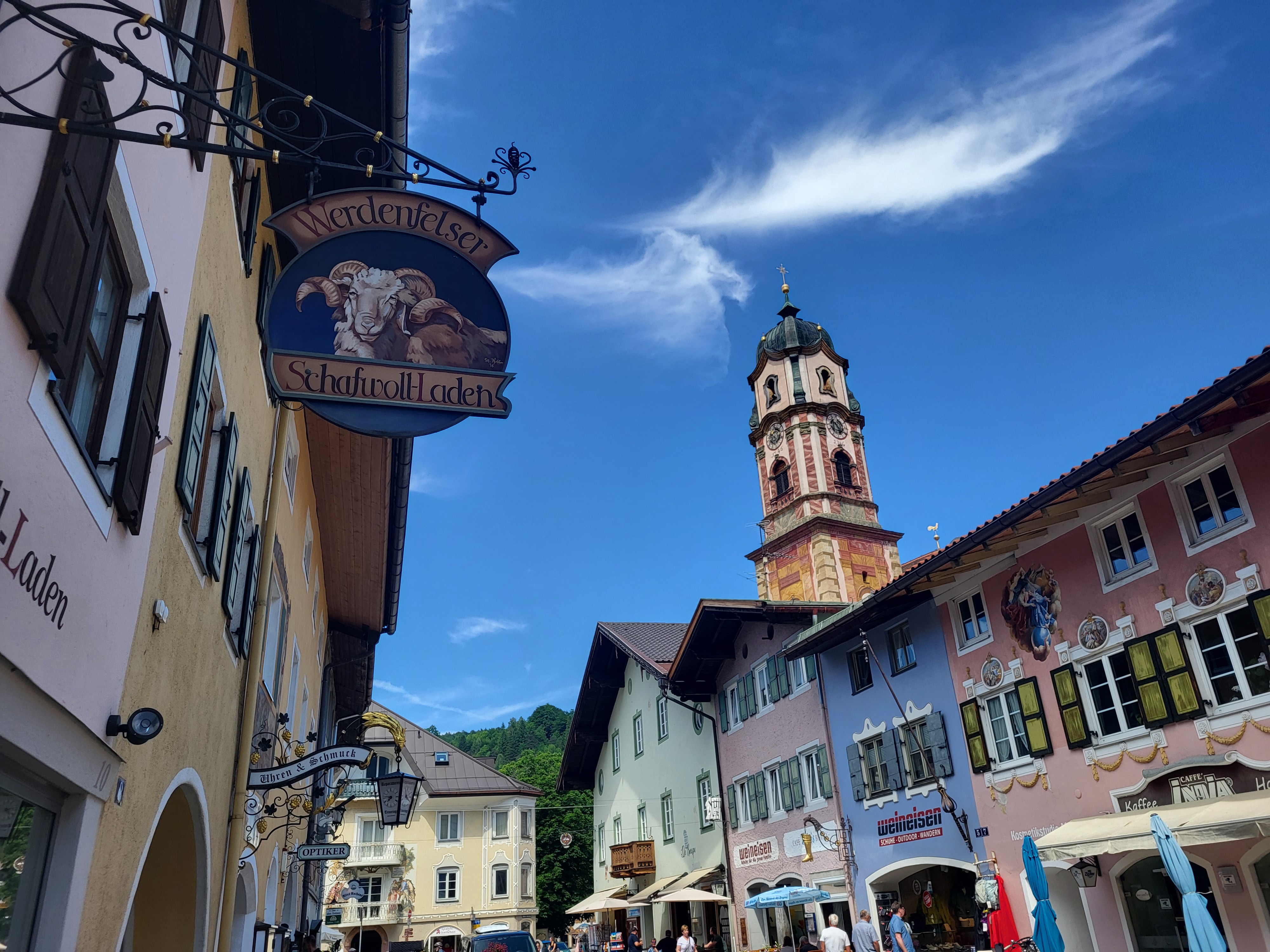
We have a soft spot for small towns and places just off the main tourist trail, and Mittenwald fits that description perfectly. Our day there was filled with all of our favorite things — wandering through a museum, lingering in a bakery, and heading out onto mountain trails. Of course, it wouldn’t be one of our trips without a few misadventures along the way, but we’ll get to those later.
We arrived in Mittenwald by train from Innsbruck, crossing the border into Germany as the mountains slowly closed in around us. With its long — and largely peaceful — history, the town carries a sense of calm that’s immediately noticeable. That timeless atmosphere, paired with its painted buildings and alpine setting, has earned Mittenwald a reputation as one of the most authentic and scenic small towns in Europe.


Mittenwald Old Town
For centuries, Mittenwald played an important role as a transit town across the mountain passes, sitting at a crossroads of trade and travel. It was once the last German town on the rail line, and in the late 14th century, the area came under the control of the Prince-Bishopric of Freising. When the region was secularized in 1802, Mittenwald was annexed to Bavaria, where it remains today.

We began our day wandering through the Old Town, and it didn’t take long for my architecture-loving heart to feel completely at home. Rows of colorful buildings line the streets, each carefully painted with scenes and stories that seem to turn the town itself into an open-air gallery. These painted façades are so characteristic of the region, and Mittenwald wears them beautifully.


Even the steeple of the 18th-century St. Peter’s Church is adorned with frescoes, its exterior just as captivating as what waits inside. Stepping into the church reveals elegant details and vivid paintings stretching across the ceiling, adding another layer to the town’s quiet artistry.


Mittenwald may be small, but every view feels thoughtfully composed. As long as you can spot the church spire, it’s nearly impossible to get lost — a comforting landmark that gently guides you back through town. We stopped at a local bakery to watch dough being kneaded by hand, then wandered through the small shops tucked throughout the historic district.

Many of the painted buildings depict biblical stories and figures, while others nod to regional life and cultural traditions. I could have easily spent the entire day moving from one building to the next, marveling at the skill it takes to paint architecture into something so alive. It’s a different kind of artistry altogether — one that blends history, faith, and everyday life into the walls of the town itself.


Violin Museum
Just off a small street near the church, we turned toward the Geigenbaumuseum — the Violin Museum — a stop that feels essential in a town so closely tied to music. Mittenwald is often called the village of a thousand violins, a name earned through its long and careful tradition of violin making.

That legacy began around 1685, when Matthias Kloz started crafting violins in his hometown. His skill was passed down through his children and grandchildren, and he also trained apprentices, teaching them not only how to build violins but how to play them as well. Music here was never just about craftsmanship; it was meant to be lived and heard.
That spirit continues today. Everyone who works at the museum also plays the instruments they share with visitors, a detail that feels deeply fitting. The museum itself is a fascinating look at the precision, patience, and artistry required to create string instruments. Having played the cello for many years, I have a soft spot for strings and the warm, resonant sounds they make, so wandering these rooms felt especially meaningful.


Then, quite unexpectedly, we entered a room lined with wooden masks — walls and cases filled with carved faces, each one expressive and striking. Alongside violins, Mittenwald became a prominent center for crafting these wooden Fasnacht masks, which have been a central part of Carnival traditions leading up to Lent for centuries throughout the region.
Originally believed to have roots in pagan rituals, later research revealed that these masks actually emerged during the medieval Christian period, with documentation dating back to the 14th century. The tradition has carried through to the present day, preserved by skilled woodcarvers who continue to honor both the artistry and cultural meaning behind each piece.
Fasnacht masks are rich in symbolism. They were traditionally used to drive away evil spirits and to tell stories rooted in history and myth. Many feature devils, witches, and animals — some carved as satire or caricature, others leaning into darker themes that reflect the more shadowed aspects of life.


The final area of the museum recreates a workshop, showing where thousands of violins and masks have been carved over generations. What makes these pieces so beautiful is that they were never mass-produced. Each one was carefully shaped by hand, given the time and attention of a true master. Seeing the violins and masks together revealed an unexpected connection — two very different art forms, united by tradition, storytelling, and extraordinary craftsmanship.

Karwendel Alpine Park
From the Old Town, we began walking uphill into the quiet residential neighborhoods that climb the hillside above Mittenwald. Along the way, we passed the town’s large violin sculpture, a fitting tribute to the musical tradition that helped shape this place. From there, we continued upward, slowly leaving the main streets behind as the path grew steeper and the town fell quieter.


The climb was worth it. With every step higher, the views opened up — colorful rooftops below us and the mountains rising steadily beyond. Mittenwald sits along the edge of Karwendel Alpine Park, one of the largest nature reserves in the Alps, and it doesn’t take long to feel how closely the town is connected to the surrounding landscape.

One of the best ways to experience the mountains here is from above. The Kranzberg Chairlift carries visitors up the side of the mountain, offering a slow, peaceful ride with uninterrupted views. Each chair fits a single rider, which makes the experience feel especially calm and reflective — just you, the air, and the scenery unfolding below.

At the top, there’s a small restaurant serving simple snacks and refreshments, a perfect place to pause and take it all in before heading back down. Visitors can return by chairlift, or, for a more adventurous option, hop into one of the dirt carts that race down the winding path. They looked like an absolute blast. Unfortunately, they were all in use during our visit, so we had to admire the fun from afar — one small misadventure to add to the day.
Hiking to Lautersee Lake
As we continued down the path, the view opened fully and the mountains stretched out before us. Below, we could see Lautersee Lake shimmering in the distance. Instead of taking the dirt carts back down, we decided to set off on foot along the mountain trail toward the lake.

A word of warning: the signs indicating distance and time are… optimistic. The sign promised about a 35-minute walk down to the lake. In reality, it took us closer to an hour and a half. Even so, it was hard to feel frustrated. The trail itself was beautiful, winding through open views and quiet stretches where the only sounds were our footsteps and the breeze. Spending a little extra time there felt like a gift rather than a setback.


When we reached Lautersee, the scene was idyllic. A path circles the lake, passing small resorts and private beach areas. Families were picnicking, children splashed in the water, and swimmers dotted the shoreline. It felt as though all of Mittenwald had gathered to enjoy a perfect summer day — and yet, despite the activity, the lake still felt peaceful and unhurried. There was space for everyone, and the mountains wrapped the whole scene in a sense of calm. It’s easy to understand why this is such a beloved local spot.


Since the lake sits a fair distance from town, we chose a different route back toward Mittenwald. This time, the posted walking time was much more accurate, and the trail took about 30 minutes. Along the way, we passed rustic wooden buildings and shaggy sheep resting in the shade, small details that felt perfectly in place in this alpine setting.


Of course, no day of wandering would be complete without a few unexpected turns…
As we made our way back through town toward the train station, I was hit hard with heat exhaustion. I’m especially prone to it, and after a few long summer days of walking and pushing myself a little too far, my body finally made its point. I needed to cool down immediately, so we ducked into a small grocery store along the way.
Inside, there were a few chairs tucked into the corner near the sandwich counter. We grabbed food and water and settled in, grateful for the break. An older couple was sitting nearby, and before long we struck up a conversation. When they learned we were from Tennessee, their faces lit up. One of their daughters, they told us, had been an exchange student years ago in Nashville. It was one of those wonderful small-world moments you never expect.
We ended up talking and laughing together for over an hour. The places we visit while traveling are often incredible, but it’s moments like this — unplanned, unremarkable on paper — that truly make a day special. Thank goodness for heat exhaustion, which led to new friends and a shared laugh in a grocery store.
But the misadventures weren’t quite finished yet.
Back at the hotel, our daughter hopped into the shower. A few minutes later, we heard a panicked yell from the bathroom. When I rushed in, the floor was completely covered in water — a full-on flood. The culprit? The walk-in shower had felt slippery, so she’d thoughtfully placed a towel on the floor to stand on… unknowingly blocking the drain. With nowhere else to go, the water had spread everywhere.
We used every towel in the room to mop up the mess. Our daughter apologized over and over, but all three of us were laughing far too hard to be upset. We hung the towels up as best we could and sheepishly explained the situation at the front desk, still giggling at the absurdity of it all.
These are the moments that make the best stories.
Mittenwald gave us not only a wonderful day of exploring, but also memories we’ll laugh about for years to come. We loved our time in this border town of Germany and Austria — the mountain views were stunning, the painted buildings felt like works of art, and the violin museum was fascinating. What more could you want from a day of wandering?
If you’re like me and can’t get enough of colorful houses, then you may be interested in these places:
Thanks for coming along on this visit to the beautiful mountain town of Mittenwald. May the days misadventures create the best memories.

Follow along for more adventures near and far!


Leave a Reply