On our last day in Germany, we boarded the train and headed toward the alpine resort town of Garmisch-Partenkirchen. As we passed snow-covered mountains and icy rivers, it immediately felt like stepping into the kind of winter landscape you imagine when you think of Christmas in Europe. There is something about snow in the mountains that makes the season feel complete.
- Christmas in Garmisch-Partenkirchen
- Walking Along the River
- Olympic History in the Bavarian Alps
- Partnach Gorge in Winter
- Painted Streets of Partenkirchen
- Bavarian Christmas Market
Quick Facts: Christmas in Garmisch-Partenkirchen
- Location: Bavaria, Germany
- Known For: Alpine scenery, skiing, Olympic history, Bavarian architecture
- Best Time to Visit: Winter and Christmas season
- Nearest Major City: Munich
- Unique Feature: Traditional Lüftlmalerei painted buildings
- Getting There: Easy day trip by train from Munich

Christmas in Garmisch-Partenkirchen
The cold mountain air carried the smell of chimney smoke and roasting food through the streets, while church bells echoed softly between the painted buildings. Everywhere we turned felt postcard-worthy in that quiet Bavarian winter way.
Garmisch-Partenkirchen was once two separate towns—Garmisch and Partenkirchen—located a short distance apart. The two were merged in 1935 in preparation for the 1936 Winter Olympics, creating the unified town that exists today. Because of this history, each half of the town still has its own distinct old-world charm and character.


Walking Along the River
We began our visit in the Garmisch side of town, starting at the tourist information center where we were given a walking map highlighting the best route through the area. From there, we followed a peaceful path along the river, which reflected a steel-blue winter color that looked almost too cold to touch.

Along the walkway, small displays of rocks and minerals from across Europe were set out with plaques explaining their origins. Farther along, the river splits, and visitors can see the mechanisms used to control water flow between the branches. A small overlook offers a view of the split itself, where the current moves in two different directions through the valley.


Olympic History in the Bavarian Alps
The path continues past quiet neighborhoods, covered bridges, and views of the surrounding Bavarian Alps. In the distance, the ski slopes rise dramatically up the mountainside. Even though the season had not fully opened yet, it was easy to see why this area is so beloved by winter sports travelers.

This region also carries Olympic history. 1936 Winter Olympics were held here, followed by the Summer Games in Berlin the same year—making it the last time both Winter and Summer Olympics were hosted in the same country during the same year.

Walking near the Olympic sites today, even when closed for the season, still carries a sense of scale and history.


Partnach Gorge in Winter
Just beyond the Olympic grounds lies one of Bavaria’s most famous natural attractions, Partnach Gorge. This dramatic limestone gorge is especially known for its winter beauty, but it was closed during our visit as the area prepared for the upcoming season. Even so, standing nearby and imagining the frozen waterfalls and narrow canyon walls made it easy to see why it is such a popular hiking destination.

Painted Streets of Partenkirchen
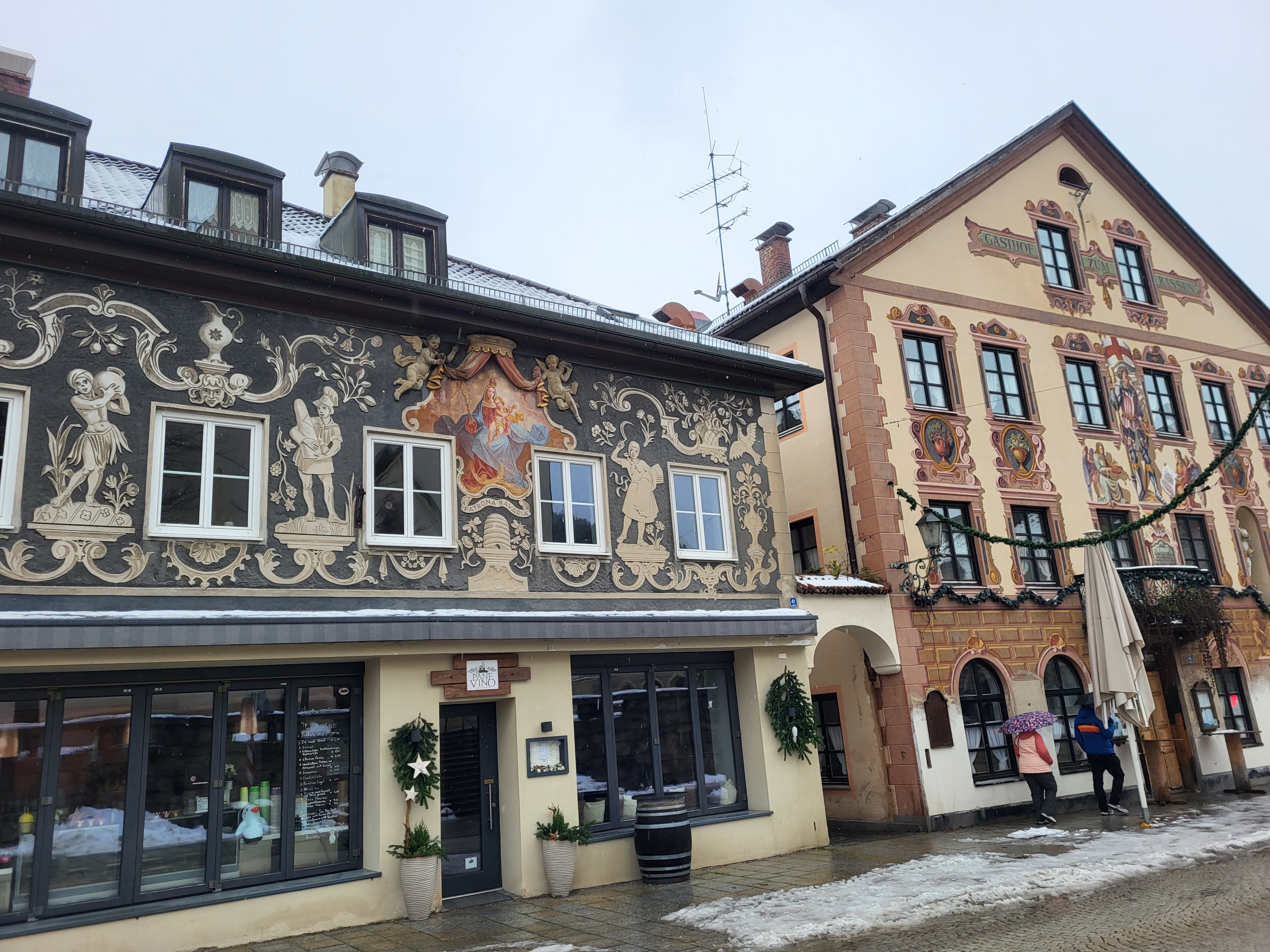
From there, we made our way into the Partenkirchen side of town, the older of the two original villages. This area is known for its charming streets and traditional Bavarian architecture, especially the painted building facades called Lüftlmalerei.

These murals are an art form unique to this region, originally inspired by religious frescoes and later expanded to include folk tales, cultural scenes, and local storytelling.


Walking through these streets felt like moving through an open-air gallery. Many of the murals seen today are restorations or recreations, especially after damage from time and fires, but the tradition itself has been carefully preserved.

Some of the original meanings behind the paintings have been lost over time, which only adds to their quiet mystery and charm.


Bavarian Christmas Market
Eventually, we found our way back to Garmisch just in time to stumble upon a small Christmas market in the town square. Snow gathered on rooftops and trees, and holding a warm drink while walking through the market made the entire scene feel like something out of a holiday postcard.


As the evening came to a close, we boarded the train back toward Munich, ready to pack up and head home the next day. Our time in Austria and Germany had been unforgettable—full of history, landscapes, and quiet winter moments that stayed with us long after we left.
There was a certain ache in leaving, the kind that only comes from places you wish you had more time to explore. But in many ways, this journey felt like one of the greatest Christmas gifts we could have given ourselves.
If you love the winter Olympics as much as I do, then you may want to see these other Olympic parks:
Thanks for coming along on this wintery visit to Garmisch-Partenkirchen. May the season be filled with snow and color and holiday cheer.

Coming Up Next:
For More Information:
Read More From:
Follow along for more adventures near and far!


Leave a Reply