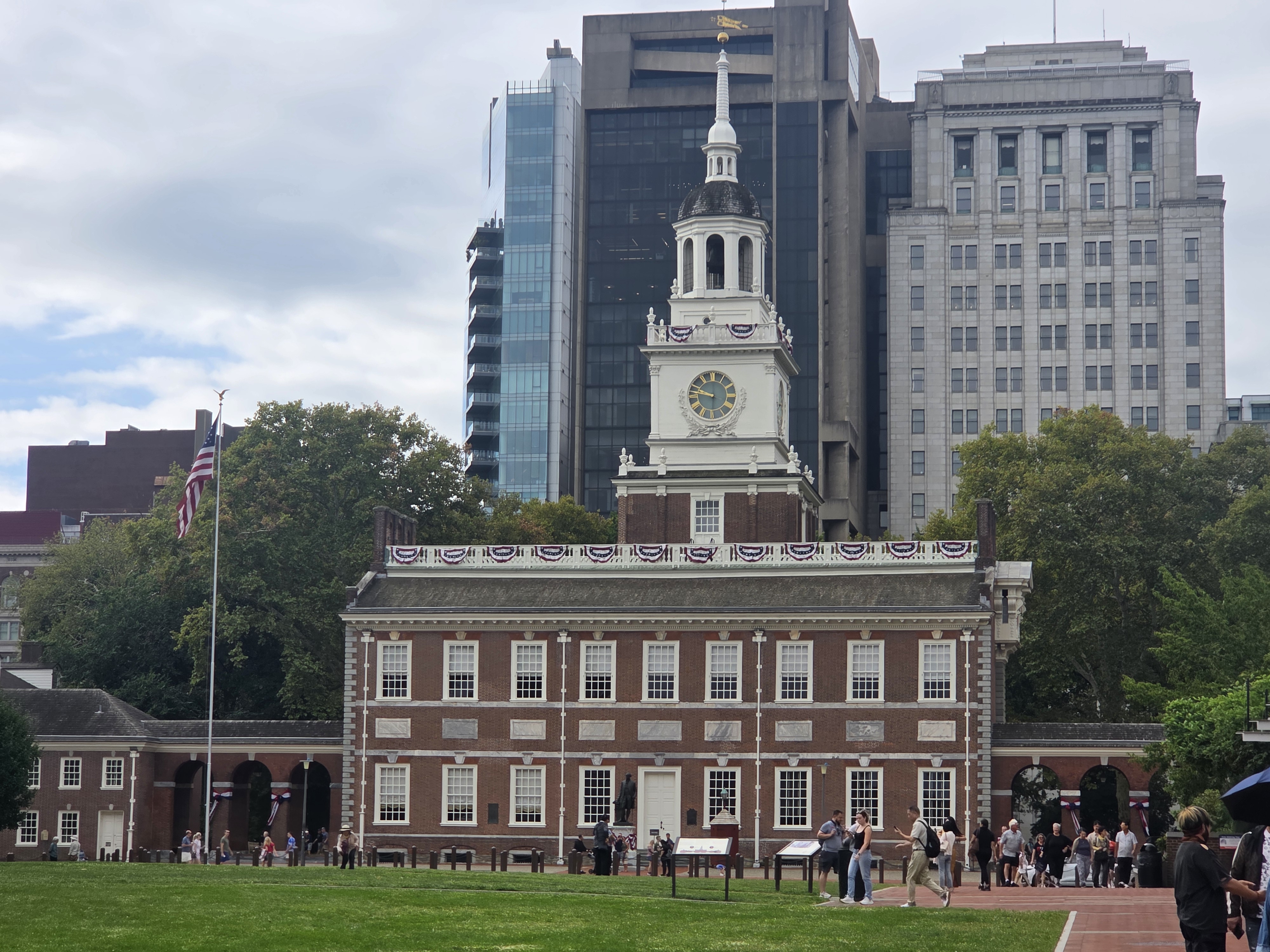
We were supposed to go to Philadelphia in June- that was the plan, anyway. But when we couldn’t get tickets to Independence Hall, we decided not to force it. Instead, we pushed the trip to September and started looking at the change as an unexpected gift. By then, the World Cup would be over, July 4th crowds would be long gone, summer travel would be winding down, and the weather should be a little cooler—perfect for wandering through a city where so much of American history happened on foot.
There was just one thing we weren’t willing to leave to chance a second time- Independence Hall. Tickets to tour the building where the Declaration of Independence was debated and adopted, and where the U.S. Constitution was later debated and signed, can disappear quickly. So this time, we marked the date on the calendar. We knew exactly when tickets would become available, and we were ready.
So in September, we finally made our way to Philadelphia, with Independence Hall at the top of our list and an entire historic city waiting beyond it. We spent the day wandering through Independence National Historical Park, exploring the places and stories surrounding the birth of the United States, walking down one of the oldest residential streets in the country, peeking inside the U.S. Mint, and stepping into the National Constitution Center.
It was the kind of day where history wasn’t tucked away in a textbook or behind a glass case. It was all around us—in brick streets, old buildings, courtyards, alleyways, and the places where people once argued, planned, protested, compromised, and ultimately helped shape a new nation. And after waiting an extra three months to get there, Philadelphia felt very much worth the wait.
A Day in Philadelphia
- Exploring Independence National Historical Park
- Walking Down Elfreth’s Alley
- Visiting the Betsy Ross House
- Seeing How Coins are Made at the Philadelphia Mint
- The National Constitution Center
- A Stop at the Edgar Allan Poe National Historic Site
- Why Philadelphia Surprised Us
- Planning Your Visit to Philadelphia


Exploring Independence National Historical Park
If Independence Hall was the reason we moved our Philadelphia trip from June to September, Independence National Historical Park was where we really began to understand why we had wanted to come.
The park brings together many of the places connected to the founding of the United States, all within Philadelphia’s historic district. We decided to spend the day walking from one site to another, and it quickly became one of those experiences where the history felt much bigger than the buildings themselves.
The Liberty Bell
Our first stop was the Liberty Bell. There is something powerful about seeing it in person, particularly with Independence Hall standing behind it. The bell has become such a familiar symbol that it can almost feel like something you already know before you ever arrive. But standing there and seeing the famous crack for yourself made it feel different.
The crack struck me as strangely symbolic. The creation of the United States was anything but simple. The people gathered in Philadelphia disagreed, argued, negotiated, and struggled over what this new country should become. The documents they eventually produced were the result of debate and compromise, not some perfectly unified moment of agreement.
Looking at that crack in the bell, I couldn’t help thinking about all of those divisions and disagreements. It seemed like an oddly fitting symbol for a country whose founding was itself full of fractures, arguments, and compromises.
And then there was Independence Hall behind it. That combination—the Liberty Bell in front and Independence Hall in the background—made the moment feel particularly significant.

Touring Independence Hall
Of course, seeing Independence Hall from the outside wasn’t enough. We had waited months and carefully watched the calendar so we could get tickets, and finally we were going inside.
The Assembly Room was the part that stayed with me most. This is the room where the Declaration of Independence was debated and adopted and where the Constitution was later debated and signed. Standing inside it, I expected to be interested in the history, but I wasn’t quite prepared for how quietly powerful the room would feel.
There was nothing particularly dramatic about it. It was simply an old room. And yet, standing there, it felt almost as though the walls themselves were remembering what had happened within them. The delegates had sat in this room and argued over ideas that would shape an entirely new nation. They didn’t walk in already knowing what the final documents would say. There were disagreements, competing interests, difficult decisions, and plenty of compromise along the way.
One detail we found especially interesting was the arrangement of the tables. The delegates’ tables were positioned geographically, roughly from north to south, with the representatives from the states seated according to their place on the map. It was such a simple detail, but learning about it made the room feel more tangible. The geography of the new country was literally represented in the way the delegates sat and interacted with one another.
It was a reminder that these weren’t just names in a history book. They were people from different places, bringing different interests and perspectives into the same room and trying to figure out how those pieces could fit together. After everything we had read about the founding of the country, actually standing where those conversations took place made the history feel remarkably close.

Carpenter’s Hall and the First Contentiental Congress
Before there was a Declaration of Independence, before there was a Constitution, and before the United States was a country, there was a group of colonial delegates trying to figure out what to do about their increasingly difficult relationship with Great Britain. They met at Carpenters’ Hall.
We stopped to see the building where the First Continental Congress gathered in 1774. The Hall was completed just that year and was chosen as the meeting place partly because it was privately owned, giving the delegates a little more freedom to discuss their grievances than they would have had in the British-owned State House.
Twelve of the thirteen colonies sent delegates, with 56 men eventually participating in the Congress. They came together in response to the British Parliament’s increasingly restrictive measures, including the laws passed after the Boston Tea Party that colonists called the “Intolerable Acts.” Rather than immediately calling for independence, the delegates debated how to respond and ultimately agreed on measures including a boycott of British goods and a petition to King George III.
That distinction makes Carpenters’ Hall especially interesting when you visit it after learning about the Declaration of Independence. Independence wasn’t the starting point. There was a long period of argument, uncertainty, negotiation, and attempts to find a solution before the colonies ultimately decided to break away from Great Britain.
Standing outside Carpenters’ Hall, knowing that those conversations happened inside, gave us another piece of the story we were following throughout Philadelphia. The people who met here didn’t know where those discussions would eventually lead. They were trying to respond to the problems immediately in front of them.
A couple of years later, the conversations would be happening in the Assembly Room at Independence Hall, where the Declaration of Independence would be debated and adopted. That made Carpenters’ Hall feel less like another historic building to check off our list and more like the beginning of a story we were following through the streets of Philadelphia.


The First and Second Banks of the United States
From Independence Hall, we continued wandering through the historic district, stopping at the First Bank of the United States and the Second Bank of the United States. They aren’t necessarily the places that immediately come to mind when you think about a visit to Philadelphia’s founding-era sites, but they helped broaden the story beyond the Declaration and Constitution.
The early United States wasn’t only figuring out how to govern itself. It was also trying to figure out how this new country would actually function. The buildings themselves were a reminder of that larger story—the debates over government, money, commerce, and the role of a national government that continued long after independence had been declared.
By this point in the day, we were beginning to appreciate how much history is packed into just a few blocks of Philadelphia.


Benjamin Franklin’s Grave
We also stopped to see the grave of Benjamin Franklin. Franklin’s name seemed to follow us throughout the day. He was one of the many figures whose life connected so many different parts of Philadelphia’s story, from the founding of the country to printing, science, invention, and civic life.
Seeing his grave added another unexpectedly personal moment to the day. After spending hours learning about the people who shaped the founding of the United States, there was something different about standing in front of the place where one of those people was laid to rest. It made the history feel human again.


Benjamin Franklin’s Printing Shop
We saved one of our favorite stops for the end of the day: Benjamin Franklin’s printing shop. This was one of those places that could easily have been a quick stop, but we ended up lingering because a volunteer was demonstrating how the printing press worked.
Watching the process was fascinating. The demonstration gave us a glimpse into just how physical printing once was. There was the press itself, the individual pieces, the process of arranging and printing the words—it was a world away from sitting down at a keyboard and clicking “print.”
The volunteer also talked about some of the terminology that came from those early days of printing and has somehow survived into the language we still use today. That was one of the details I loved most. We tend to think of modern writing and typing as completely separate from the world of hand-set type and printing presses. But some of the language we use today has roots in those much older processes.
Standing in Franklin’s printing shop and watching the press operate made that connection surprisingly easy to see. And somehow, ending our day with printing felt fitting. We had spent the day walking through the places where a new nation was debated and defined. At the end, we were standing in a place where words were physically assembled, pressed onto paper, and sent out into the world.
In a way, that is what so much of this part of Philadelphia is about. Ideas became words. Words became documents. And those documents helped shape a country.

Walking Down Elfreth’s Alley
After spending so much of the day around the monumental places of American history, one of my favorite stops was surprisingly simple: walking down a narrow little street.
Elfreth’s Alley dates back to 1703 and is one of the oldest continuously inhabited residential streets in the United States. Today, it is still a real neighborhood, with most of the historic homes privately owned. Only two of the houses, numbers 124 and 126, have been turned into the Elfreth’s Alley Museum. That fact made the street even more fascinating to me. These aren’t just historic buildings preserved behind ropes and glass. People actually live here.
We loved walking along the stone-and-brick walkway and looking at the beautiful historic homes packed closely together. Every house seemed to have its own personality, from the architecture to the doors and windows to the decorative knockers that caught our attention as we wandered. It was easy to imagine how different this little street must have looked centuries ago, but it was just as interesting to see how much of it has survived.
After spending the morning thinking about presidents, delegates, declarations, and constitutions, Elfreth’s Alley offered a different glimpse into Philadelphia’s past. This was a street where ordinary people lived and worked. The Elfreth’s Alley Association specifically focuses on telling the stories of the artisans and working-class residents who called the street home. And somehow, seeing those homes still standing—and still being homes—made the history feel wonderfully alive.

Visiting the Betsy Ross House
We also stopped at the Betsy Ross House, tucked into the historic neighborhood just a short walk from the other sites. Betsy Ross is one of those names most Americans grow up knowing, usually accompanied by the familiar story of the woman who supposedly sewed the first American flag. But visiting the house adds some important layers to that story.
The house explores both the legend surrounding the flag and the life of Betsy Ross herself, including her work as an upholsterer, business owner, widow, and mother. Historic interpreters help bring the 18th-century setting to life, including a portrayal of Betsy at work in her upholstery shop.
What I appreciated was that the experience doesn’t simply ask you to accept the famous story as unquestioned fact. The house acknowledges the ongoing historical question of whether Betsy Ross actually made the first Stars and Stripes, while also telling the story of the woman behind the legend.
That felt particularly fitting in Philadelphia. So much of the city’s history exists somewhere between the stories we learned as children and the much more complicated reality behind them. Walking through these old buildings gave us the chance to look at both.

Seeing How Coins are Made at the Philadelphia Mint
I wasn’t entirely sure what our daughter would think about visiting the U.S. Mint. I shouldn’t have worried- she loved it.
The Philadelphia Mint offers a free, self-guided tour where visitors can look down onto the production floor from about 40 feet above and learn about the process of making coins. The facility also includes historic artifacts and information about the history of the Mint.
For our daughter, watching the process was the part that made the visit come alive. There was something fascinating about seeing something as ordinary as the coins in our pockets being made on an enormous scale.
And then she got to design one herself. Well… sort of. There was a kid-friendly kiosk where she could create her own coin design, and she had a great time putting it together. Unfortunately, there was one small problem with her masterpiece: The Mint was not actually going to make her coin.
She was a little disappointed by this revelation. Honestly, I understood. If you’re given the opportunity to design a coin at the U.S. Mint, it seems perfectly reasonable to assume that your beautiful creation might someday emerge from one of those enormous machines and land in someone’s pocket.
It doesn’t quite work that way. Actual U.S. coin designs go through a much more involved process, including review and approval before Mint artists create the sculptural models used to produce the dies. Still, watching her take the experience so seriously was one of my favorite parts of the visit.
The Mint ended up being a great reminder that history isn’t always about famous speeches and monumental moments. Sometimes it’s about understanding the ordinary objects we use every day—and discovering the surprisingly complicated story behind them.


The National Constitution Center
Our final stop of the day was the National Constitution Center. After spending hours walking through the places where the Constitution was actually debated and created, it felt like a natural place to end. Independence Hall had allowed us to stand in the room where those conversations happened; the Constitution Center gave us a chance to step back and look more closely at what came out of them.
The museum is dedicated entirely to the U.S. Constitution and uses interactive exhibits, artifacts, theater, and hands-on experiences to explore the document and its continuing story. One of the highlights is Signers’ Hall, where 42 life-size bronze statues represent the delegates who signed the Constitution. Visitors can actually stand among them rather than simply looking at names on a wall. That felt like a fitting contrast to our morning at Independence Hall.
Earlier, we had stood inside the actual Assembly Room and looked at the tables where the delegates sat. Here, we could see those people represented individually and begin to think about them not simply as “the Founding Fathers,” but as people who had different backgrounds, interests, beliefs, and ideas about what this new country should become.
The Constitution Center also broadens the story beyond the convention itself, exploring the Constitution’s continuing history and the ways Americans have argued over its meaning and promises. Its exhibits include the founding of the Constitution and Bill of Rights, the system of checks and balances, and later constitutional struggles involving issues such as slavery, freedom, and women’s suffrage.
After a full day of walking through Philadelphia, that felt like an appropriate place to finish. We had started with a bell that has become a symbol of liberty, stood inside the room where the Declaration and Constitution were debated, walked a street where ordinary Philadelphians lived, visited the home associated with one of America’s most famous legends, watched coins being made, and finally spent time thinking about the document that helped establish the framework for the country.
It was a lot of history for one day. But that was really what made Philadelphia so interesting. The history wasn’t all concentrated in one building or one monument. It was layered into the streets, the houses, the objects, the stories, and the places we were walking through all day.

A Stop at the Edgar Allan Poe National Historic Site
Philadelphia has a way of making history feel close. Sometimes that means standing in the room where the Constitution was debated. Sometimes it means walking down a street that has been home to people for more than 300 years. And sometimes, it means standing outside a small brick house and thinking about a writer whose stories have haunted readers for generations.
We made a stop at the Edgar Allan Poe National Historic Site, although unfortunately, we couldn’t go inside. The house has been closed for an extended rehabilitation and improvement project, so all we could do was see the building from the outside. The National Park Service currently lists the site as closed, with no official reopening date.
At first, that was disappointing. We had come all this way and would have loved to see the rooms where Edgar Allan Poe actually lived. But somehow, standing outside the house still gave the story a different kind of weight. This is the only surviving Philadelphia home where Poe lived. He rented the house at 532 North 7th Street from 1843 to 1844, living there with his young wife, Virginia, and his mother-in-law, Maria Clemm.
And this wasn’t simply an address where a famous writer happened to live. Poe’s six years in Philadelphia are considered by the National Park Service to have been his happiest and most productive period. During his time in the city, he published some of the works that would become central to his literary legacy.
Yet the more I read about his life during those years, the more complicated that description became. Poe was struggling financially and personally, while Virginia was suffering from tuberculosis. The family lived in a modest rented house on what was then the edge of Philadelphia. At the same time, Poe was producing some of his most influential writing. That contrast really struck me.
We often encounter famous writers through their finished work. We read The Black Cat or The Tell-Tale Heart or The Gold-Bug and know the stories as these polished, enduring pieces of literature. But standing outside Poe’s house made it easier to picture the person behind the words. He wasn’t yet the literary legend we know today. He was a working writer trying to make a living, living in a small house with his family, dealing with illness and uncertainty, and somehow continuing to create.
Even though we couldn’t step through the front door, seeing the house and then learning more about what was happening in Poe’s life during that period made the visit feel surprisingly real. Maybe that’s one of the things I love most about visiting historic places. You don’t always need to walk through the front door to feel connected to the story. Sometimes you just need to stand there for a moment and imagine the person who once stood in the same place.

Why Philadelphia Surprised Us
I knew Philadelphia was going to be full of history- that wasn’t exactly a surprise. What surprised me was how much history we could experience simply by walking through the city.
We spent much of the day moving from one place to another on foot, and the stories kept changing. One moment we were standing in the room where the Declaration of Independence and Constitution were debated and signed. Then we were walking down a residential street that has been home to Philadelphians for more than 300 years. A few blocks later, we were watching coins being made at the U.S. Mint or learning about Benjamin Franklin’s printing press.
It wasn’t just that Philadelphia had historic buildings. It was the way those places were woven into the city itself. And I think that’s what surprised us most. The history didn’t feel like something we had to go find. We kept stumbling into it. Even the smaller details stayed with us—the decorative door knockers on Elfreth’s Alley, the view of the Liberty Bell with Independence Hall behind it, the old brick and stone beneath our feet, the idea that people still live inside some of these centuries-old houses.
Our daughter surprised us, too. We expected her to enjoy Independence Hall and the Liberty Bell, but we weren’t sure how she’d feel about the U.S. Mint. Instead, she was fascinated by the process of making coins and happily designed her own imaginary coin at the kids’ kiosk. She was only slightly disappointed when she discovered that the U.S. Mint was not, in fact, going to take her design and turn it into an actual coin.
And then there was everything we didn’t have time to see. We had hoped to visit the Philadelphia Museum of Art, run up the famous Rocky Steps, and explore Eastern State Penitentiary. All three remain high on our list for our next visit. The museum alone could easily take much more time than we had, with its enormous collections spanning thousands of years of art, while the Rocky Steps and Eastern State Penitentiary offer completely different sides of Philadelphia than the historic district we explored this time.
Honestly, I’m glad we didn’t try to cram everything into one day. Philadelphia gave us enough to explore without leaving us feeling like we had simply checked attractions off a list. We had time to stop, look around, listen to the stories, and let some of the places sink in. And now we have a very good reason to come back. There are still steps to climb, art to see, prison walls to wander, and an entirely different side of Philadelphia waiting for us.
For a city we originally postponed because we couldn’t get one set of tickets, Philadelphia ended up teaching us something we already know pretty well-sometimes changing the plan just gives you a reason to come back.


Planning Your Visit to Philadelphia
Philadelphia is one of those cities where you could spend days exploring and still leave with a list of things you didn’t get to see. Our visit focused primarily on the historic heart of the city, and even with a full day, we had to make some choices about what to include. If you’re planning your own visit, here are a few things I’d keep in mind.
Start With Independence Hall Tickets
If seeing Independence Hall is important to you, plan this part of your visit first. Tickets to tour Independence Hall are limited and can go quickly, particularly during busy travel periods. We originally planned to visit Philadelphia in June but couldn’t get tickets, so we moved the entire trip to September. The second time around, we marked the ticket-release date on our calendar and were ready when they became available. That little bit of planning made all the difference. Check the National Park Service’s official Independence National Historical Park website for the current ticket-release schedule, tour times, entrance requirements, and any seasonal changes before your trip.
Give Yourself Plenty of Time to Walk
The historic district is wonderfully suited to exploring on foot. Many of the sites we visited are close enough together that walking between them became part of the experience. Rather than constantly getting in and out of the car, we could wander through the streets, stop when something caught our attention, and gradually make our way from one historic site to the next. Wear comfortable shoes. You’ll be walking more than you probably realize, and part of the fun is looking around while you’re doing it.
Don’t Try to See Everything in One Day
This may be the most important advice I can give. Philadelphia has a lot to see. We spent an entire day exploring Independence National Historical Park and nearby historic sites, and we still didn’t make it to the Philadelphia Museum of Art, the Rocky Steps, or Eastern State Penitentiary. And that’s okay. Instead of trying to squeeze every famous attraction into one day, choose the experiences that matter most to you and give yourself enough time to actually enjoy them. For us, Independence Hall was the priority. That decision shaped the rest of our day, and I’m glad it did.
Think About Your Interests When Choosing Stops
Philadelphia works particularly well for travelers with different interests because its attractions cover such a wide range of history and culture. Our day included the founding of the United States, historic homes, Benjamin Franklin, printing, the history of money and coin-making, and the Constitution. Families may especially enjoy adding interactive experiences such as the U.S. Mint and National Constitution Center. History lovers could easily spend an entire day just in the historic district, while art and pop-culture fans may want to build their visit around the Philadelphia Museum of Art and Rocky Steps. There isn’t really one right way to experience Philadelphia.
Be Prepared for a Lot of History
Philadelphia’s historic district isn’t the kind of place where you visit one attraction and then move on to something completely unrelated. The stories overlap. You’ll hear the same names again and again. Benjamin Franklin might appear in one place as a printer, another as a statesman, and somewhere else as a Founding Father. The Declaration of Independence leads naturally into the Constitution, which leads into the ongoing debates about how the new government should work. I actually think that’s one of the best things about visiting Philadelphia. Give yourself permission to slow down enough to notice those connections.
Check Current Hours and Closures
Historic sites and museums can have different operating schedules, seasonal hours, ticket requirements, and temporary closures. This mattered during our visit to the Edgar Allan Poe National Historic Site, which was closed while work was underway on the building. We were still glad we stopped, but knowing ahead of time which sites are open can help you make the most of your day. Before visiting, check the official websites for the National Park Service and each attraction you’re planning to visit for current hours, tickets, closures, parking information, and special events.
Plan for a Return Visit
And finally, don’t be discouraged by the things you don’t get to see. We left Philadelphia having experienced an incredible amount of history, but we also left with a new list for next time. The Philadelphia Museum of Art, the Rocky Steps, and Eastern State Penitentiary are all still waiting for us. Sometimes that’s the best kind of trip. You see enough to fall in love with a place—and leave just enough unexplored to give yourself a reason to return.


We originally planned to visit Philadelphia in June but instead we waited for September. We waited for another chance to get inside Independence Hall, waited for a quieter time of year, and eventually found ourselves walking through Philadelphia in September with the whole day ahead of us. I’m glad we did.
There was something special about standing in the Assembly Room where the Declaration of Independence and Constitution were debated, looking at the Liberty Bell with Independence Hall behind it, and walking the same streets where people who shaped the country once lived and worked. But what I loved most was how much of the history felt unexpectedly human.
We walked down Elfreth’s Alley and admired the doors and decorative knockers on houses that are still homes. We stood outside Edgar Allan Poe’s house and thought about the complicated life behind the stories he wrote. We watched a printing press work at Benjamin Franklin’s printing shop. We watched our daughter become completely fascinated by the process of making coins—and then mildly heartbroken that her own design wasn’t going to be minted.
Philadelphia reminded us that history isn’t just made in grand moments. It’s made by people. People who argue and compromise. People who write and print. People who build homes and businesses. People who create things, raise families, make mistakes, and leave behind stories that somehow survive long after they are gone.
We didn’t see everything we wanted to see. And that’s okay. If anything, leaving Philadelphia with a list for next time feels like the perfect ending. We waited three months to make this trip happen, and in the end, Philadelphia was worth the wait—and gave us plenty of reasons to come back.
Looking for others cities full of American Revolution history? Then you may be interested in these:
From Boston to Concord, Massachusetts
Thanks for coming along on this day in Philadelphia. May you find layers of history throughout the city.

Coming Up Next:
Buck’s County, Pennsylvania
For More Information:
Read More From:
Pennsylvannia
Follow along for more adventures near and far!

Leave a Reply