This week, people across the United States will celebrate Thanksgiving — a day rooted in gratitude. The holiday began with the pilgrims who crossed the Atlantic and found a new home on unfamiliar shores. Their survival depended on the generosity and guidance of the Native Americans who helped them through that first harsh winter.
Over the years, Thanksgiving has grown to include football games, parades, shopping, and an abundance of pies. Yet at its heart, it remains a reminder to pause and give thanks — for the people, opportunities, and blessings in our lives.
As I think about gratitude and what it truly means, my mind goes back to Brazil, where I learned a profound lesson in thankfulness during my visit to the Cathedral Basilica of the National Shrine of Our Lady of Aparecida.
- The Basilica of our Lady of Aparecida
- History of Our Lady Aparecida
- Mother Basilica & New Basilica
- Hall of Miracles

The Basilica of our Lady of Aparecida
The Basilica of Our Lady of Aparecida is the second largest Catholic church in the world, second only to St. Peter’s Basilica in the Vatican. Built in the Romanesque Revival style, its soaring domes and graceful arches create a striking presence on the horizon. Inside, the vast space can hold up to 30,000 worshippers. Every corner seems alive with color — vibrant murals, intricate tiles, and radiant details that fill the church with light and life.


The clock tower is home to church offices, including a special office for the Pope when he comes to visit. At the very top is an observatory where visitors can look out over the valley and the river.


History of Our Lady Aparecida
From the observatory, you can see the very river where the statue of the Virgin Mary — Our Lady Aparecida — was discovered. The story dates back to 1717, when the small fishing communities in the Paraíba Valley were struggling. Day after day, fishermen cast their nets only to return home empty-handed, fearing the river had run out of life.
Then, one morning, a fisherman pulled up his net and found something unexpected — first the small, dark clay body of a statue, and then, on the next cast, its head. As they carefully placed the pieces together, the previously empty nets suddenly came up overflowing with fish. The people believed their prayers had been answered through this miraculous sign, and devotion to Nossa Senhora Aparecida — the “appeared” Virgin — began to grow rapidly throughout Brazil.

The statue of the saint found in the fisherman’s net was first kept safely in his home, where it became a cherished symbol for the local community. Over time, neighbors would gather there to pray and give thanks to the Lady who had blessed their river. As devotion to Our Lady Aparecida grew, a small chapel was built in 1732 to house the statue and provide a place for public worship.
Mother Basilica & New Basilica
Word of the miracle spread quickly beyond the valley, drawing pilgrims from neighboring towns who came to honor the saint who had appeared to simple fishermen. With the growing crowds and deepening devotion, it was decided that a larger church should be built. In 1745, construction began on what became known as the Old Basilica — later lovingly called the Mother Basilica.
An expansion in 1888 gave the church the graceful lines and rich details still seen today. Though its interior remains dimly lit, it exudes the warmth and character of its Colonial-era architecture — a quiet, sacred space that continues to welcome the faithful more than two centuries later.

Stretching out from the Old Mother Basilica is a long concrete walkway connecting it to the New Basilica. Spanning nearly a mile, this path is more than just a bridge between two sacred spaces — it’s a powerful symbol of faith and gratitude. It’s common to see pilgrims making the journey on their knees, offering this act of devotion in thanks for blessings received or prayers answered.
Many begin their pilgrimage at the Mother Basilica, then slowly follow the path — step by step, or knee by knee — until they reach the towering Basilica Nova. There, they light candles, whisper prayers, or attend a service in quiet reflection. To watch people travel that distance in such humble reverence is an unforgettable reminder of the depth of gratitude and faith that fills this holy place.


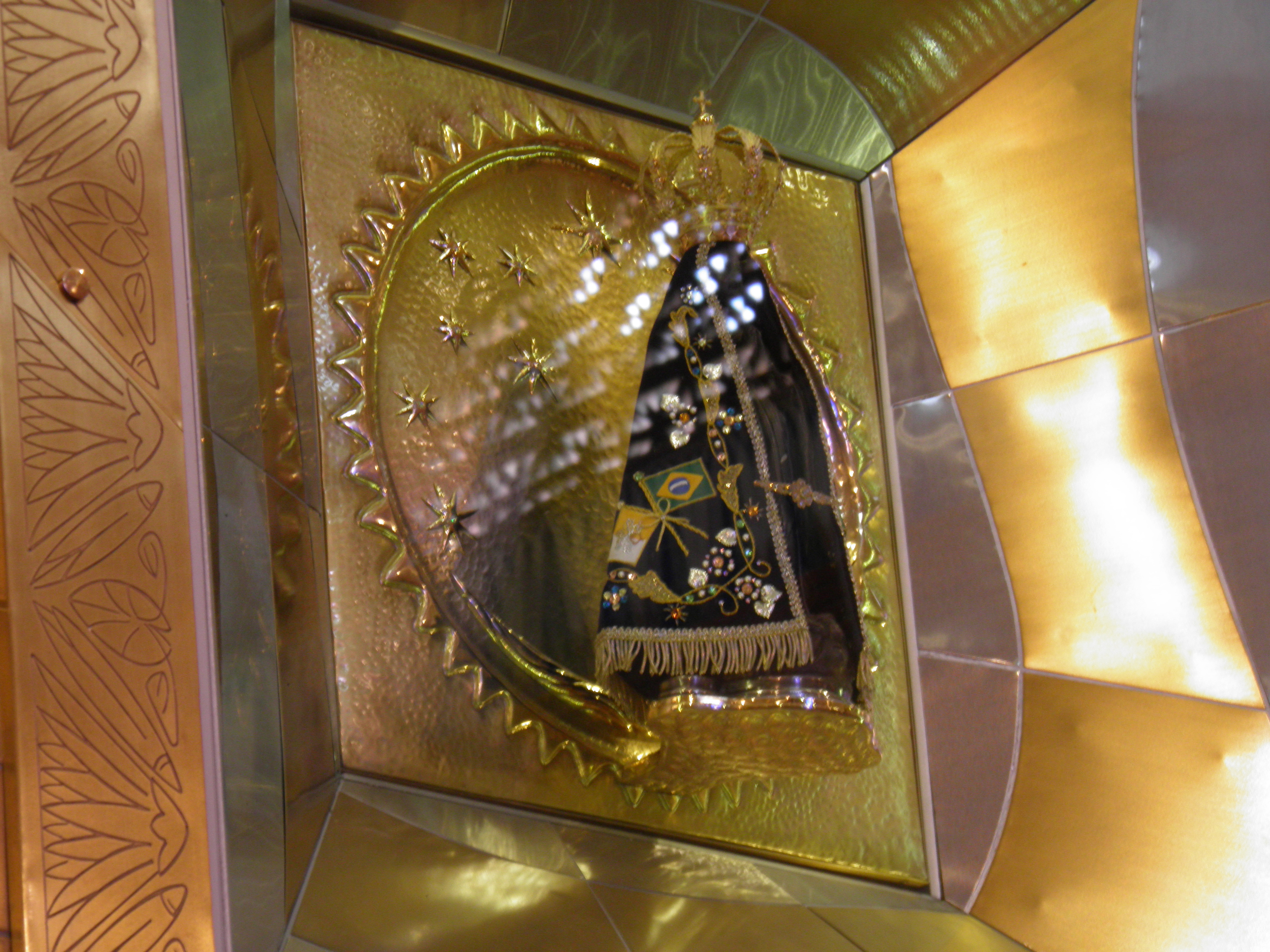
Visitors to the Basilica Nova are greeted at the entrance by the statue herself — Our Lady of Aparecida. Encased in a golden shrine crafted with care and devotion, she stands as the same figure once lifted from the river centuries ago. Her surface bears the faint marks and fingerprints of countless pilgrims who have come to touch, to pray, and to give thanks. From her place above the altar, she seems to gaze out over the people gathered below and across the valley beyond, a quiet guardian watching over her faithful.
Within the basilica, a museum displays countless renderings and tributes to the Lady — paintings, sculptures, and offerings made in her honor. Yet nothing compares to the profound sense of peace and power that radiates from the original statue itself — the heart and soul of Aparecida.

Hall of Miracles
While the entire basilica is breathtaking, the true treasure for me was the Hall of Miracles. Tucked beneath the church, this space feels both sacred and deeply human. Every inch of the ceiling is covered with photographs — faces of people who have received miracles. Rows of plastic arms, legs, and heads symbolize the hundreds who have been healed. Shelves are lined with objects representing gratitude in all forms: books and tools, farming equipment, wedding and birth announcements, uniforms of those who serve, and even pieces of machinery that helped families build a better life.
Each case tells a story — a life changed, a prayer answered, a hope restored. Standing there, surrounded by these tokens of faith, I was struck by how easily we can overlook the everyday blessings in our own lives. The things we take for granted — our homes, our health, our work, our loved ones — might be the very miracles someone else is praying for. Seeing all those offerings laid before the Lady of Aparecida filled me with a profound sense of gratitude and a clearer understanding of what truly matters.


When I think about the fisherman who was blessed with an abundance of fish when hope seemed lost, or the people who, out of pure gratitude, walk a hard mile on their knees to give thanks, or the countless offerings left in the Hall of Miracles — each one a testament to faith and love — I’m reminded to realign my own heart with that same spirit of gratitude. To see the people, experiences, and opportunities in my life not as givens, but as miracles in themselves.
So in this season of giving thanks, I hope you know, dear reader, how grateful I am for you — for the time you spend here, for your kindness, and for sharing in these journeys and reflections with me. I am thankful for the opportunities that have taken me near and far, and for the ways each one continues to shape and teach me.
Happy Thanksgiving to you and yours, wherever you may be.
If you have enjoyed reading on the Basilica Aparecida, then you may enjoy reading on these other beautiful religious places:
Thank you for coming along on this tender memory of a visit to The Basilica of Our Lady Aparecida and the Hall of Miracles. May you find yourself surrounded by every day miracles.

Coming Up Next:
For More Information:
Read More From:
Follow along for more adventures near and far!


Leave a Reply to leightontravelsCancel reply