There is something wonderful about wandering through a city without having to be in a hurry to get anywhere.
On a weekend trip to the foothills of North Carolina, we spent a few hours exploring downtown Asheville along the Asheville Urban Trail. This self-guided walking trail winds through the heart of the city, connecting visitors with Asheville’s history, architecture, public art, and plenty of unexpected little treasures.
And that turned out to be exactly what I loved about it.
Asheville is an artsy, eclectic city with interesting shops, great food, colorful buildings, and plenty of things tucked into corners that you might otherwise walk right past. The Urban Trail gave us a reason to slow down and actually look around.
Asheville kept asking us to look up at its buildings, then look down at the sidewalk, and then look around the corner to see what we might find next.
Asheville Urban Trail
- Why Walk Asheville’s Urban Trail?
- Exploring Pack Square Park
- Asheville’s Veterans Memorial
- Following Asheville’s Literary History
- The Woodfin House
- Asheville’s Historic Churches
- Look Up- and Then Look Down
- Stop For Lunch at Pack’s Tavern
- What We Loved About Asheville’s Urban Trail
- Planning Your Visit to Asheville’s Urban Trail
- FAQ: Asheville’s Urban Trail

Why Walk Asheville’s Urban Trail?
The Asheville Urban Trail is a great way to get an introduction to downtown Asheville because it brings together so many of the things that make the city unique.
Along the route you can find historic buildings, public art, memorials, churches, literary history, restaurants, shops, and plenty of little surprises.
I probably could have spent the entire day simply wandering through the different shops and looking at all of the beautiful things people have created.
One shop in particular caught my attention because its windows were filled with colorful stars. It wasn’t necessarily something we had come downtown specifically to see, but it was exactly the kind of unexpected discovery that made the walk so much fun.
That’s one of the things I liked most about the Urban Trail. You aren’t simply checking things off a list. You’re walking through the city and letting the city surprise you.

Exploring Pack Square Park
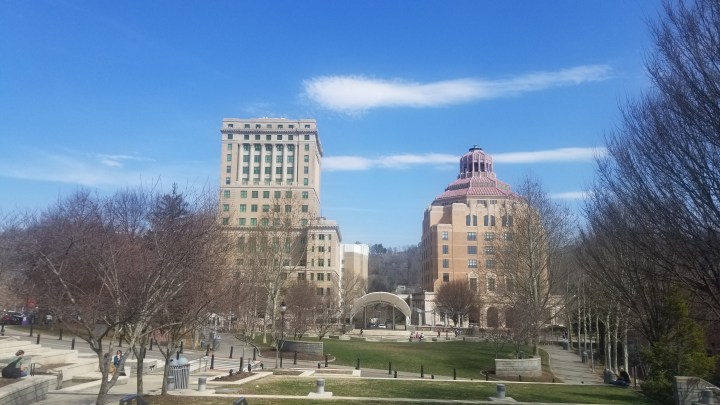
One of the main areas along the Urban Trail is Pack Square Park, a green space surrounded by some of Asheville’s most notable government buildings.
The square was full of people and pets enjoying the warm weather and blue skies when we visited. It was a relaxed gathering place right in the middle of downtown.
The architecture around the square immediately caught my attention.

The Buncombe County Courthouse initially looked a little stark and imposing, but the green accents around the windows softened the building considerably. On the right day, you can even catch the mountains reflected in its windows.
Next to the courthouse is Asheville’s City Building, which was one of my favorites. The purple and green details at the top of the building and the unusual slanted windows along the upper floor give it a distinctive Art Deco feel.
Just these two buildings show how different architectural styles come together throughout Asheville.


Asheville’s Veterans Memorial
Near Pack Square is a veterans memorial honoring those who have served in the military. When we visited, the memorial was covered with hand-knitted scarves.
This wasn’t part of the permanent memorial itself. A local knitting store had invited area veterans and their families to participate in a “knit-in.” The veterans learned to knit together, and some of the finished scarves were placed at the memorial as a tribute to those who had served. Hundreds more were donated to charities around Asheville.
I loved seeing this little piece of community life become part of the city we were exploring. It was another reminder that Asheville’s story isn’t just found in its old buildings. It is also found in the people who live here today.

Following Asheville’s Literary History
Asheville has another connection that I hadn’t expected to find on our walk: it was the hometown of American author Thomas Wolfe. Wolfe drew heavily from Asheville and the people he knew growing up here. His most famous novel, Look Homeward, Angel, is a fictionalized account of his childhood and family.
Walking through Asheville gave us a chance to see some of the places and streets that helped shape the world Wolfe wrote about. I always enjoy when a city gives you the opportunity to see a place through the eyes of someone who actually lived there. Suddenly the buildings and streets aren’t just scenery anymore. They become part of someone’s story.

The Woodfin House
A little farther along the trail, we came across one of the more unusual pieces of the Urban Trail: a small replica of the Woodfin House built right into the sidewalk.
The original house was built in 1840 by Nicholas Woodfin, a prominent lawyer and farmer. It stood for about 130 years and served several purposes over its history, including as a residence, tuberculosis clinic, and YMCA facility. The house itself is no longer standing, but the small replica gives visitors an idea of what it once looked like.
I thought this was such a clever way to preserve a piece of Asheville’s history. Instead of putting the history behind glass in a museum, the city incorporated it directly into the sidewalk where people are already walking.

Asheville’s Historic Churches
The Urban Trail also brought us past some of Asheville’s beautiful historic churches.
The First Baptist Church caught my attention with its colorful tile roof. The church was built in 1925 and was later added to the National Register of Historic Places.
But my favorite architectural stop was the Basilica of Saint Lawrence.
The basilica was completed in 1905 and is known for its distinctive architecture, including its unusual windows, detailed reliefs, and statues decorating the exterior. Of all the architectural gems we saw while wandering downtown, this was the one I found myself wanting to stop and look at the longest.
There was something about the curves and details of the building that made it feel completely different from the other architecture we had seen along the way.


Look Up- and Then Look Down
One of my favorite things about walking through Asheville was how often the city made me look in different directions.
Look up and you’ll find elaborate buildings, colorful architectural details, statues, and mountain views reflected in windows. Look down and you’ll find something completely different.
Along the streets are tiny doors built into the sidewalks, creating an entire little neighborhood at street level. Each one appears to have been carefully designed and decorated, with tiny figures and scenes hidden behind the windows. They are easy to miss if you’re rushing through downtown.
But that’s really the beauty of walking Asheville’s Urban Trail. The city keeps encouraging you to pay attention.

Stop For Lunch at Pack’s Tavern
Of course, all that walking eventually made us hungry.
One of the restaurants we passed near Pack Square was Pack’s Tavern, and it was difficult to miss. An old yellow truck with a giant barrel in the back sits outside the restaurant, while live music and the smell of food drift out from inside.
It was exactly the sort of place that made us want to stop. We had lunch there and enjoyed the lively atmosphere before continuing our walk through downtown.
One of the advantages of exploring the Urban Trail is that you can easily make the walk your own. Stop for lunch when you’re hungry, wander into a shop when something catches your eye, or take a break in one of the downtown parks. There’s no need to hurry.

What We Loved About Asheville’s Urban Trail
We only spent a few hours walking through downtown Asheville, but the Urban Trail gave us a much better feel for the city than we would have gotten simply driving through. We found beautiful architecture, fascinating history, public art, unexpected little details, and a few places where we simply stopped and enjoyed watching the city around us.
And that’s what I think makes Asheville’s Urban Trail so worthwhile. It’s not just about reaching the next stop. It’s about noticing what is around you between the stops.
Asheville is a city full of hidden treasures. Some are enormous buildings that have been standing for more than a century. Others are tiny doors tucked into a sidewalk. Some are pieces of art, while others are stories about the people who called this place home. You just have to slow down enough to find them.


Planning Your Visit to Asheville’s Urban Trail
The Urban Trail is a great addition to a day spent exploring downtown Asheville. Because it winds through the city rather than following a traditional hiking path, you can easily combine it with shopping, restaurants, museums, parks, and other downtown attractions.
Allow several hours. You can technically walk the route fairly quickly, but that misses much of the fun. Give yourself time to stop for photographs, read the historical markers, explore shops, and grab something to eat.
Wear comfortable shoes. You’re walking on city streets and sidewalks rather than a wilderness trail, but you’ll still be on your feet for a while.
Don’t rush. Some of the best discoveries aren’t necessarily official Urban Trail stops. Keep an eye out for murals, architectural details, public art, tiny doors, and interesting storefronts.
Bring your camera. Asheville is incredibly photogenic, particularly if you enjoy architecture and colorful details.
Make it part of a larger Asheville day. The Urban Trail works especially well as a way to explore downtown between other activities. You can easily stop for lunch or coffee, visit a museum, shop, or simply spend some time wandering.
FAQ: Asheville’s Urban Trail
- How long does it take to walk Asheville’s Urban Trail?
The amount of time depends on how much exploring you do along the way. You can walk the route relatively quickly, but I’d plan on a few hours if you want time to stop, take pictures, explore downtown, and grab a meal.
- Is Asheville’s Urban Trail free?
Yes. Walking through downtown and following the Urban Trail is free.
- Is the Urban Trail a hiking trail?
Not in the traditional sense. The Asheville Urban Trail is a self-guided walking trail through downtown Asheville, using markers and public art to tell the story of the city.
- Is Asheville’s Urban Trail kid friendly?
Yes. The walk is accessible to families, and the tiny doors and unusual artwork can make it especially fun for children.
- What else can I do in downtown Asheville?
Downtown Asheville is filled with restaurants, shops, galleries, historic buildings, public art, and cultural attractions, making it easy to combine the Urban Trail with other activities during your visit.

I love cities that reward curiosity, and Asheville definitely falls into that category. You can spend your day looking up at the grand architecture, looking down at tiny works of art, and turning a corner to discover something you weren’t expecting.
Our few hours walking Asheville’s Urban Trail gave us just a small glimpse of the city, but it left me wanting to wander a little farther and stay a little longer.
Sometimes the best way to experience a city isn’t to have a long list of things you need to see. Sometimes you just need a good pair of walking shoes, a little time, and a willingness to see what you find.
If you enjoyed this post, here are some other corners of North Carolina you might be interested in:
Thanks for coming along on a walk through Asheville on the Urban Trail. May you find beauty and surprises looking up and looking down.

Follow along for more adventures near and far!


Leave a Reply