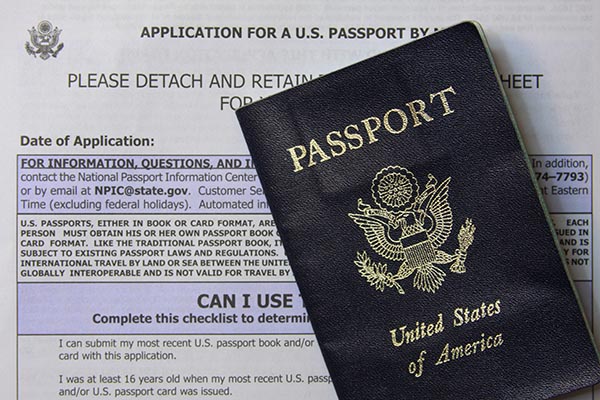
We’re gearing up for our international trips this fall. Between flipping through travel books and finalizing itineraries, we’re also making sure all of our travel documents are in order. And if I’m being honest, the biggest hurdle in our planning has been renewing our daughter’s passport.
If you thought getting an adult passport was complicated, the process for a child’s passport adds a few extra hoops. It can feel overwhelming at first — appointments, paperwork, signatures — but it’s absolutely worth it to experience international travel as a family.
Here’s a clear breakdown of the steps to get a passport for a minor, along with a few helpful things to know along the way.
(This guide is based on applying for a U.S. passport. For the most up-to-date information, visit the U.S. Department of State website.)
How To Get a Passport for a Minor
- Completing the Application for a Minor
- Evidence of US Citizenship
- Parent Identification Requirements
- Show Parental Relationship
- Show Parental Consent
- Passport Photo Requirements
- Passport Fees & Processing Times
- When the Passport Arrives
- Quick Checklist: Child Passport Appointment
Completing the Application for a Minor
The first step is filling out the passport application for your child. Unlike adult renewals, you cannot mail in a child’s application. Both the child and parent(s) must appear in person for a passport appointment.
Be sure the application is completed using the child’s information, since they are the applicant — not the parent.
Here are a few important things to keep in mind:
- Use Form DS-11
- Children must apply using form DS-11. Answer all questions as they apply to your child
- Passport Validity
- Adult passports are valid for 10 years. Passports for minors under age 16 are valid for only 5 years. Child passports can not be renewed- you must apply for a new passport each time it expires.
- Address Format
- When listing the mailing or physical address, include ‘In Care Of’ with the parent’s name on the second line
- Example: Child’s name, In Care of Parent’s Name, Street Address
- Social Security Number
- You must provide your child’s Social Security number on the application.
- If your child has not been issued a Social Security number, include a signed statement that reads: “I declare under penalty of perjury under the laws of the United States of America that the following is true and correct: (child’s full name) has never been issued a Social Security number by the Social Security Administration.”
- Do Not Sign Yet
- Do not sign the application before your appointment. You will be instructed to sign it in front of the passport acceptance agent.
- Restricted Countries
- The U.S. Department of State maintains a list of restricted destinations. If you plan to travel with a minor to one of those countries, additional documentation may be required, including certified approval from a U.S. Embassy or Consulate. Always check current travel requirements before finalizing plans.
Evidence of US Citizenship
You must provide one proof of U.S. citizenship for your child. This must be either the original document or a certified copy issued by the appropriate government agency. Photocopies and digital versions are not accepted.
Acceptable Documents include:
- previous U.S. passport (even if expired)
- certified U.S. birth certificate
- Consular Report of Birth Abroad (CRBA) or Certification of Birth
- Certificate of Citizenship
Be sure the document is in good condition and legible. The original will be submitted with your application but will be returned to you separately by mail.
Parent Identification Requirements
Parents or legal guardians must present at least one valid form of identification when submitting their child’s passport application.
Acceptable forms of identification include:
- valid or expired U.S. passport
- valid in-date driver’s license
- Certification of Citizenship
- Government employee ID
- Military ID or military dependent ID
- U.S. Permanent Resident Card (Green Card)
In addition to presenting identification, parents must also provide a photocopy of the front and back of the ID. The copy must be clear and legible.
If you are using an out-of-state driver’s license, you may be asked to provide an additional form of identification.
Show Parental Relationship
You must submit documentation that lists the parents or legal guardians of the child. These documents must be original or certified copies issued by the appropriate government agency. Photocopies are not accepted.
Acceptable documents include:
- U.S. birth certificate listing both parents
- Adoption decree (if applicable)
- Divorce decree or custody order (if applicable)
The name(s) on the parental relationship document must match the name(s) on the parent identification provided.
If there have been name changes due to marriage or divorce, you may need to provide supporting documentation to show the connection.
Show Parental Consent
This step can feel a little complicated, especially if both parents cannot attend the passport appointment.
Ideally, both parents or legal guardians should be present when applying for a child’s passport. If that isn’t possible, additional documentation is required depending on your situation.
If One Parent Has Sole Legal Authority:
You must provide one of the following:
- court order granting sole legal custody (such as a divorce decree or custody order)
- court order specifically permitting you to apply for your child’s passport
- certified birth certificate listing you as the only parent
- certified adoption decree listing you as the only parent
- certified judicial declaration of incompetence for the non-appearing parent
- certified death certificate of the deceased parent
If One Parent is Unable to Appear:
The non-appearing parent must complete Form DS-3053 (Statement of Consent)
- The form must be signed and notarized
- You must bring the notarized original to the appointment
If the Other Parent Cannot Be Located:
The applying parent must complete Form DS-5525 (Statement of Exigent/Special Family Circumstances)
- Include as much detail as possible
- Provide any supporting documentation that helps explain why the other parent cannot be located
Approval in these cases is determined by the passport agency.
If Neither Parent Can Appear (Third Party Applying):
A third party may apply on behalf of the child with:
- Form DS-3053 completed by both parents, OR
- a notarized statement from both parents giving the third party permission to apply
The notarized statement must:
- Include photocopies of the parents’ identification
- Be dated within the last 3 months
If your situation feels complicated, it’s always best to review your specific circumstances on the official State Department website or contact the passport acceptance facility ahead of your appointment.
Passport Photo Requirements
You must provide one passport photo of your child, but do not attach it to the application. The passport acceptance agent will review and attach it during your appointment.
You can have the photo taken ahead of time or at the passport office. Many passport acceptance facilities offer photo services for an additional fee.
If you choose to take the photo yourself or have it taken elsewhere, make sure it meets current passport photo requirements (size, background, expression, etc) to avoid delays.
Passport Fees & Processing Times
At the time of writing, the cost for a new child passport is $135. This includes:
- $100 passport application fee
- $35 execution (acceptance) fee
The $100 passport fee must be paid by check or money order made payable to U.S. Department of State.
If you would like to expedite service, there is an additional $60 fee. If you choose expedited return shipping, there is an additional $18.32 fee for 1-2 day delivery.
The passport application fee, expedited fee, and return shipping fee can all be combined into one check or money order payable to the U.S. Department of State. The $35 execution fee is paid separately to the passport acceptance facility and can typically be paid by check or card (check with your specific location for accepted payment methods).
Processing times can flucuate depending on demand. Be sure to check current timelines before applying and plan accordingly. Even with expedited service, it may take serveral weeks to receive your child’s passport.
And then…you wait. There is something both exciting and nerve-wracking about watching the mailbox for the first passport to arrive.
When the Passport Arrives
Your child’s passport will arrive separately from the original documents you submitted with the application. Those documents (such as birth certificate) are typically returned in a different mailing.
Once the passport arrives, it must be signed.
If your child is old enough to sign their own name, have them sign on the signature line.
If your child is too young to sign, a parent should print the child’s name and the line and then write their own signature with the relationship in parentheses. Example: Child’s printed name, Parent’s signature (mother)
Be sure to store your child’s passport in a secure place along with other important documents. Consider keeping it in a protective sleeve and storing it somewhere easily accessible but safe.
Quick Checklist: Child Passport Appointment
Bring to Your Appointment:
- Completed Form DS-11 (unsigned)
- Child present in person
- Parent(s) or legal guardian(s) present
- Proof of U.S. citizenship (original or certified copy)
- Proof of parental relationship
- Parent identification (plus photocopy of front and back)
- Any required parental consent forms (DS-3053 or DS-5525, if applicable)
- One passport photo (if not taken onsite)
- Check or money order payable to U.S. Department of State
- Payment method for the $35 execution fee
Applying for a child’s passport can feel like a lot of paperwork and a lot of details. There are forms to complete, documents to gather, and appointments to schedule. It’s not the most glamorous part of planning an international trip — but it is one of the most important.
Once that passport arrives in the mail, though, something shifts. It becomes more than a government document. It represents possibility. It represents new places, new experiences, and new memories your family will make together.
Yes, there are hoops to jump through. But each step moves you closer to stepping onto a plane, crossing a border, and showing your child just how big and beautiful the world is.
So gather the documents. Make the appointment. Double-check the checklist. And when that little blue book arrives, know that you’ve opened the door to something incredible.

Coming Up Next:
For More Information:
Read More From:
Follow along for more adventures near and far!


Leave a Reply to The Chronicles of HistoryCancel reply