Our final day in New England brought us to Hartford, Connecticut, where we visited two homes that once belonged to some of America’s most influential writers. After spending the weekend discovering the people who shaped the country through innovation, art, and conservation, it seemed only fitting to end our trip with two authors whose words helped shape American history.
The Mark Twain House and the Harriet Beecher Stowe Center sit side by side on one quiet Hartford street. Long before they became museums, they were neighbors, friends, and two of the most recognizable literary voices of the nineteenth century. Today, visiting both homes offers a fascinating glimpse into not only their individual lives but also the ideas and conversations that helped influence a nation.
Even before we stepped inside, we found ourselves slowing down to admire the neighborhood. The tree-lined streets, beautiful gardens, and historic homes made it easy to imagine what Hartford must have looked like during its literary heyday.
Then we looked up.
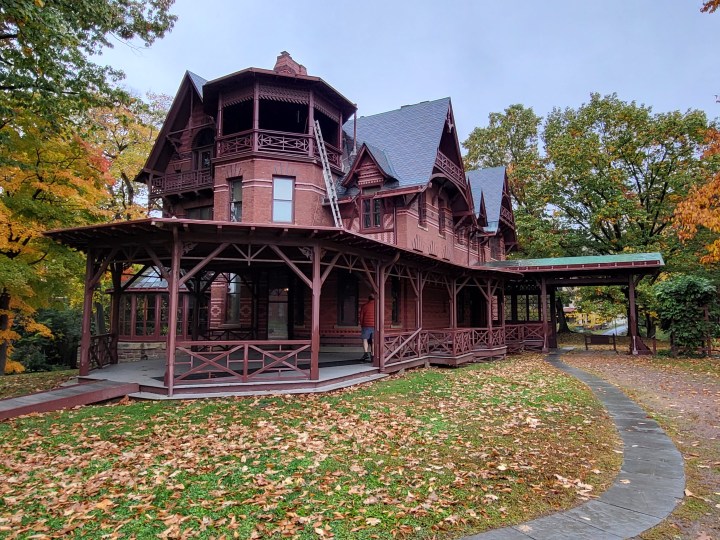
The striking architecture of one house perched on the hill immediately stopped our conversation. With its colorful brickwork, elaborate woodwork, and towering chimneys, it looked almost like something pulled from the pages of a storybook. There was no mistaking it—we had arrived at the Mark Twain House.
It’s easy to think of historic homes as simply old houses filled with antique furniture. But these homes are much more than that. They tell the stories of people whose ideas helped shape American literature, public opinion, and history itself. Walking through the rooms where Mark Twain and Harriet Beecher Stowe lived makes their books feel more personal, reminding us that behind every classic is a real person with hopes, struggles, triumphs, and heartbreaks.
Hartford Literary Houses
- Touring the Mark Twain House
- Visiting the Harriet Beecher Stowe House
- Katherine Seymour Day and the Legacy of Preservation
- Know Before You Go: Hartford Literary Landmarks
- FAQ: Hartford Literary Landmarks
At A Glance: Hartford Literary Houses
- Location: Hartford, Connecticut
- Landmarks Visited: Mark Twain House & Museum, Harriet Beecher Stowe Center, Katherine Seymour Day House
- Time Needed: 3-5 hours
- Best For: literature lovers, history enthusiasts, architecture fans
- Guided Tours: Mark Twain House; Stowe Center offers guided and self-guided experiences depending on programming
Touring the Mark Twain House
Our first stop was the Mark Twain House, the beautifully restored Victorian home where Samuel Langhorne Clemens—better known by his pen name, Mark Twain—lived with his wife, Olivia, and their three daughters from 1874 to 1891.
Even from the outside, the house is unforgettable. Its colorful brickwork, ornate wood detailing, and soaring chimneys make it unlike any other home in the neighborhood. It has famously been described as part steamboat, part medieval fortress, and part cuckoo clock—a fitting description for a house as imaginative as the man who designed it.

Stepping inside felt like stepping into another era. While photography isn’t permitted during the tour, the richly decorated rooms, intricate woodwork, and elegant furnishings offer a wonderful glimpse into the height of the Gilded Age. Some have even compared the home’s grandeur to an American version of Downton Abbey.

More importantly, this was the place where Mark Twain did some of his greatest work. Within these walls he wrote many of the books that would become classics of American literature, including The Adventures of Tom Sawyer, Adventures of Huckleberry Finn, The Prince and the Pauper, and A Connecticut Yankee in King Arthur’s Court. Walking through the rooms where those stories were imagined made the house feel less like a museum and more like the birthplace of ideas that continue to influence readers today.
After touring the home, we spent time exploring the museum, which tells the story of the man behind the famous pen name. Long before becoming one of America’s best-known authors, Samuel Clemens lived a life full of adventure. He worked as a printer, riverboat pilot, journalist, and traveler, experiences that later found their way into his writing. Twain often spoke about what he called his “vagabond instinct,” a restless curiosity that carried him across the country and eventually around the world. It’s easy to see how those experiences gave his stories their sense of humor, adventure, and keen observations about human nature.


As someone who loves road trips and discovering unexpected places, I couldn’t help but smile at Twain’s description of himself. That restless curiosity to see what lies beyond the next bend in the road felt surprisingly familiar.
Twain was also known for his sharp wit and willingness to challenge accepted ideas. His writing often blended humor with social commentary, offering thoughtful criticism of injustice, hypocrisy, and human behavior. Even today, many of his quotes and observations remain surprisingly relevant.


Like many lives, however, his story was marked by both remarkable success and profound heartbreak. Financial difficulties following several unsuccessful business investments forced Twain to embark on an international lecture tour to rebuild the family’s finances. While he traveled through Europe with Olivia and their eldest daughter, tragedy struck when their youngest daughter became ill. The loss devastated the family, and they never again lived in the Hartford home that had once been filled with so much happiness.
Standing in the house, it was impossible not to think about the contrast between the joy of Twain’s stories and the personal hardships he endured. The home is certainly an architectural masterpiece, but it is also a reminder that behind every beloved book is a very human story. Visiting the Mark Twain House gave us a much deeper appreciation not only for one of America’s greatest writers, but for the life experiences that shaped the words he left behind.

Visiting the Harriet Beecher Stowe House
Just next door to the Mark Twain House stands another home that helped shape American literature—and, in many ways, American history.
Harriet Beecher Stowe’s modest Victorian cottage is a striking contrast to the grand home of her famous neighbor, yet the influence of the woman who lived here was every bit as significant. Stowe is best known as the author of Uncle Tom’s Cabin, a novel that brought the realities of slavery into the homes of readers across the United States and around the world.

Although she wrote Uncle Tom’s Cabin years earlier while living in Maine, this Hartford home became the place where she spent the final twenty-three years of her life. Here she continued writing, welcomed guests, enjoyed her family, and became an active member of the Hartford community until her death in 1896.


Touring the home offers a more personal look at Stowe beyond her most famous work. The rooms are thoughtfully preserved and tell the story of a woman whose words challenged many readers to think differently about slavery, justice, and human dignity. While Uncle Tom’s Cabin did not single-handedly cause the Civil War, it became one of the nineteenth century’s most influential novels, helping shape public opinion about slavery at a time when the nation was becoming increasingly divided.


Next to the house, the Harriet Beecher Stowe Center continues her legacy by encouraging conversations about history, justice, and civic engagement. Rather than serving only as a historic museum, the center invites visitors to consider how Stowe’s ideas still connect to important conversations today.
After the grandeur of the Mark Twain House, I appreciated how different this experience felt. Stowe’s home is quieter and more understated, but it carries an equally powerful story. It reminded us that lasting change doesn’t always begin in government buildings or on battlefields. Sometimes it begins with one person willing to write the truth as they see it and readers willing to listen.

Katherine Seymour Day and the Legacy of Preservation
Before leaving, we made sure to stop and appreciate one more home on this remarkable corner of Hartford—the Katherine Seymour Day House.
While her name is not nearly as well known as Mark Twain or Harriet Beecher Stowe, Katherine Seymour Day played a vital role in ensuring that their stories could continue to be told. A grandniece of Harriet Beecher Stowe, Day was a passionate preservationist who recognized the historical importance of these homes long before historic preservation became common practice.
As development began to threaten the neighborhood, Katherine Seymour Day quietly purchased properties surrounding the Stowe House, including her own residence, to protect them from demolition. Her vision eventually laid the foundation for preserving both the Harriet Beecher Stowe House and the neighboring Mark Twain House, allowing future generations to experience these remarkable places much as they appeared during the authors’ lifetimes.
Her own home is a beautiful example of early twentieth-century architecture and reflects the elegance of Hartford’s historic neighborhood. Yet perhaps its greatest significance is not its design, but what it represents—a reminder that history survives because someone chooses to protect it.
As we finished exploring this unique corner of Hartford, I couldn’t help but feel grateful for Katherine Seymour Day’s determination. We often celebrate the writers, artists, and leaders who change history, but just as important are the people who preserve those stories so they are not forgotten. Without her foresight, one of America’s most remarkable literary neighborhoods might have disappeared forever.

Know Before You Go: Hartford Literary Houses
- Reserve Mark Twain House tickets in advance, especially during busy seasons.
- Photography is generally not permitted inside the Mark Twain House.
- Allow plenty of time to explore both museums.
- Wear comfortable shoes for walking between the historic homes.
- Check current tour schedules before visiting, as they can vary seasonally.
FAQ: Hartford Literary Houses
- Can you visit the Mark Twain House and the Harriet Beecher Stowe House in the same day?
Yes! The Mark Twain House and Harriet Beecher Stowe House are located next to each other in Hartford, Connecticut, making it easy to visit both during the same trip. Plan several hours to fully enjoy the tours, museums, and surrounding historic neighborhood.
- Is the Mark Twain House worth visiting?
Absolutely. The Mark Twain House offers much more than a look at a beautiful Victorian mansion. The guided tour provides insight into Samuel Clemens’ life, his family, his writing process, and the experiences that influenced some of his most famous works. The architecture alone makes it a memorable stop, but learning about the person behind the books makes the visit even more meaningful.
- Is the Harriet Beecher Stowe House worth visiting?
Absolutely. The Mark Twain House offers much more than a look at a beautiful Victorian mansion. The guided tour provides insight into Samuel Clemens’ life, his family, his writing process, and the experiences that influenced some of his most famous works. The architecture alone makes it a memorable stop, but learning about the person behind the books makes the visit even more meaningful.
- Is the Harriet Beecher Stowe House worth visiting?
Yes. While smaller and quieter than the Mark Twain House, the Harriet Beecher Stowe House provides an important look at one of America’s most influential writers. Visitors can learn about Stowe’s life, the impact of Uncle Tom’s Cabin, and how her writing contributed to national conversations about slavery, justice, and social change.
- Did Mark Twain and Harriet Beecher Stowe know each other?
Yes. Mark Twain and Harriet Beecher Stowe were neighbors in Hartford and lived just a short distance apart. Both were influential literary figures during their lifetimes, although their writing styles and subjects were very different. Visiting their homes together offers an interesting look at two people who used storytelling to influence American culture.
- How long does it take to visit the Mark Twain House?
Most visitors should plan around 1.5 to 2 hours for the Mark Twain House and Museum, depending on the tour selected and how much time is spent exploring the exhibits. The guided tour provides the best experience for understanding the history of the home and the Clemens family.
- Can you take photos inside the Mark Twain House?
Photography is not permitted inside the Mark Twain House during tours. However, visitors are welcome to photograph the exterior of the home and the surrounding historic neighborhood. The museum provides additional opportunities to learn about the interior spaces and collections.
- What else is there to do near the Mark Twain House and Harriet Beecher Stowe House?
Hartford offers many opportunities to explore American history, art, and culture. Nearby attractions include museums, historic neighborhoods, and other landmarks. The literary homes also make a great addition to a larger New England road trip, especially when combined with other historic sites throughout Connecticut and the surrounding states.
As we left Hartford, I found myself thinking less about the beautiful houses we had toured and more about the people who had lived within them.
Mark Twain entertained generations through stories that still make us laugh and think. Harriet Beecher Stowe challenged readers to confront injustice through the power of words. Katherine Seymour Day ensured that their homes—and the stories they represent—would still be here for future generations to experience.
It was a reminder that there are many ways to leave a legacy. Some people change the world by creating, some by inspiring, and others by preserving what matters.
Looking back on our long weekend in New England, I realized that every stop had told the story of someone whose ideas, talents, or determination helped shape the country. It was the perfect way to celebrate turning forty—not just surrounded by beautiful fall landscapes, but by the people and places whose influence continues to echo long after they are gone.
If you enjoyed this post, you may be interested in these:
Nathaniel Hawthorne- Massachusetts
New England Road Trip: Historic Sites & Fall Colors
Celebrating America 250: Places, History, Cultures, & People
Thanks for joining me on this visit to the Mark Twain and Harriet Beecher Stowe homes. May your words be filled with power and compassion.

Coming Up Next:
Read More From:
Follow along for more adventures near and far!


Leave a Reply