We had family come to Tennessee to celebrate a big milestone in my life—graduating with my master’s degree. Between finishing my final paper, presenting my research, hosting family, managing a major event at work, and even battling a terrible case of pink eye, it was a hectic season that I was more than ready to put behind me.
But in the middle of all that busyness came one of my favorite memories since moving to Tennessee. We spent those weeks showing our family around some of the places that have made us fall in love with our adopted home state.
From music landmarks and historic battlefields to waterfalls, cultural sites, and hidden gems, we covered a wide variety of places across the state. Looking back, it became a wonderful reminder of just how much Tennessee has to offer.
These places are spread across Middle and East Tennessee, making them perfect for road trip exploring. If you’re planning a trip through Middle Tennessee—or simply looking for inspiration for your next weekend adventure—these are some of our favorite places to visit in Tennessee.
Places to Visit in Tennessee

Rock City Gardens
Our first outing with family took us south to Lookout Mountain on the Tennessee-Georgia border. Whenever we have visitors in town, Rock City Gardens is one of our favorite places to share because it feels equal parts natural wonder and storybook adventure.
Rock City celebrated its 90th anniversary not long ago, having first opened in 1932 when Garnet and Frieda Carter transformed the unique rock formations atop Lookout Mountain into a public attraction. What began as a network of natural pathways winding through massive boulders has become one of the most iconic destinations in the Southeast.
One of the things we love most about Rock City is that there is always something interesting around the next bend. The trail winds through narrow rock passages, across stone bridges, and between towering cliffs before opening onto sweeping views of the valley below. Visitors can squeeze through the famous Fat Man’s Squeeze, cross the suspension bridge, wander through Fairyland Caverns, and explore Mother Goose Village.
Of course, the highlight for many people is standing atop Lover’s Leap and looking out across the landscape. On a clear day, Rock City claims visitors can see seven states from the overlook. Whether or not you count all seven, the panoramic views stretching across the mountains and valleys are absolutely breathtaking.
Rock City is one of those classic Tennessee attractions that we never seem to get tired of visiting, and it was the perfect place to begin our family’s tour of some of our favorite spots in the state.
{read more: Exploring Rock City Gardens }


Tennessee Walking Horse National Museum
One of Middle Tennessee’s unique claims to fame is being the birthplace of the Tennessee Walking Horse. This distinctive breed is known for its smooth four-beat running walk, a gait that made it especially popular as a riding horse on Southern plantations. Over time, the breed gained national recognition and became one of the most well-known show horse breeds in the world.
The history of the Tennessee Walking Horse is deeply rooted in this part of the state, particularly around the communities of Shelbyville and Wartrace. Today, visitors can learn more about that history at the Tennessee Walking Horse National Museum in downtown Wartrace.
The museum showcases the development of the breed, its influence on the region, and the people who helped establish its reputation. Exhibits include photographs, memorabilia, trophies, and stories highlighting the horses and riders that helped shape the breed’s legacy.
For those visiting during the summer, the nearby Tennessee Walking Horse National Celebration in Shelbyville offers an opportunity to see these remarkable horses in action. Even if you’re not a horse enthusiast, the museum provides an interesting glimpse into a tradition that has played an important role in the culture and history of Middle Tennessee.
It may not be one of Tennessee’s most famous attractions, but it is one of those small local museums that helps tell the story of the region and the people who call it home.


Jack Daniels Distillery
No list of favorite Tennessee places would feel complete without a visit to the famous Jack Daniel’s Distillery in Lynchburg. Tennessee is whiskey country, and few names are more closely tied to the state’s identity than Jack Daniel’s.
Even for those who don’t drink whiskey, the distillery tour is fascinating. The experience is as much about Tennessee history and culture as it is about the whiskey itself. Visitors learn about the life of Jasper Newton “Jack” Daniel, the growth of the company, and the unique process that transformed a small local operation into one of the most recognized brands in the world.
One of the highlights of the tour is seeing the spring that provides the iron-free cave water used in every bottle of Jack Daniel’s. This fresh spring water, along with the charcoal mellowing process known as the Lincoln County Process, helps give Tennessee whiskey its distinctive character.
One of the more surprising facts about Lynchburg is that the distillery is located in a dry county. Despite producing millions of bottles of whiskey each year, alcohol sales were historically prohibited in the area. Today, visitors can participate in tastings thanks to a unique exception in Tennessee law, creating one of the more amusing contradictions you’ll find in the state.
Whether you’re interested in history, business, craftsmanship, or Tennessee culture, the Jack Daniel’s Distillery offers a fascinating look at one of the state’s most iconic success stories.
{read more: Visiting the Jack Daniels Distillery}


Stones River National Battlefield
One of the places we always recommend to visitors is the Stones River National Battlefield and National Cemetery in Murfreesboro. It is a beautiful and peaceful place today, but it also serves as a powerful reminder of one of the most important battles of the Civil War.
Fought between December 31, 1862, and January 2, 1863, the Battle of Stones River was one of the bloodiest conflicts of the war. More than 23,000 soldiers were killed, wounded, or missing after the fighting ended. While the battle came at a tremendous cost, the Union victory provided a much-needed boost to Northern morale after a series of setbacks and helped strengthen support for President Lincoln’s recently issued Emancipation Proclamation.
Walking the battlefield today, it is difficult to imagine the chaos and sacrifice that once unfolded across these fields. Trails wind through the historic landscape, allowing visitors to better understand the events that shaped both Tennessee and the nation.
For me, the most moving part of the site is the National Cemetery. Row after row of white markers stretch across the hillside, each representing a life forever changed by the war. Many visitors leave pennies on top of the headstones with Lincoln’s face turned upward. It is a simple gesture of remembrance, but seeing those small copper coins resting in the sunlight creates a powerful visual reminder of the sacrifices made to preserve the Union.
Stones River is more than a historic battlefield. It is a place of reflection, remembrance, and a reminder of the tremendous human cost of war.


Wat Lao Buddharam
Just a short drive from Stones River National Battlefield is one of the most unexpected and fascinating places in Middle Tennessee—Wat Lao Buddharam.
During the 1980s, many refugees and immigrants from Laos settled in Tennessee, bringing with them their traditions, culture, and faith. This Buddhist temple serves as both a place of worship and a cultural center for the local Lao community, preserving a connection to the homeland many families left behind.
The moment you arrive, it feels like stepping into another world. Golden dragons stand guard at the entrance, colorful details decorate the buildings, and the peaceful grounds create a sense of calm that feels far removed from the busy roads nearby. Monks carefully maintain the property, and visitors are welcome to explore the grounds respectfully.
One of the things we appreciate most about Wat Lao Buddharam is the opportunity it provides to learn about a culture that many people know very little about. Visitors can enter the gathering hall, admire the beautiful artwork and statues, and learn more about the beliefs and traditions that shape the community.
It may not appear in many Tennessee guidebooks, but places like Wat Lao Buddharam help tell the full story of the people who call Tennessee home. It is a reminder that the state’s history is still being written by communities from around the world who have made this place their own.
{ read more: Wat Lao Buddharam}


Ryman Auditorium
Of course, no visit to Tennessee would be complete without spending time in Nashville. And if you’re looking for the place that best tells the story of the city, there is no better place to start than the Ryman Auditorium.
Often called the “Mother Church of Country Music,” the Ryman is one of the most iconic music venues in the United States. While Nashville may be filled with famous stages and recording studios, the Ryman is where much of the city’s musical legacy was built and where it truly earned its reputation as Music City.
Originally constructed as a church in 1892, the building quickly became a gathering place for far more than religious services. Over the years it hosted concerts, political rallies, public speakers, community events, and some of the most influential performers of their time. Its most famous chapter began in 1943 when it became the home of the Grand Ole Opry, helping launch the careers of countless country music legends.
Walking into the auditorium today, it is impossible not to feel the history surrounding you. The wooden pews, stained-glass windows, and remarkable acoustics create an atmosphere unlike any other performance venue. From presidents and civil rights leaders to musicians and entertainers, the list of people who have stood on the Ryman stage reads like a who’s who of American history.
Even for those who are not country music fans, the Ryman offers a fascinating look into the culture, history, and spirit of Nashville. It remains one of our favorite places to take visitors because it tells the story not only of Tennessee’s music heritage, but of the city itself.
{read more: Visiting the Ryman Auditorium }


Tennessee State Capitol
Another favorite stop in Nashville is the Tennessee State Capitol. Perched on a hill overlooking downtown, the Capitol serves as both the center of state government and a fascinating place to learn about Tennessee’s history.
One of the features we enjoyed most was the black marble timeline that traces important events and milestones in Tennessee’s past. Nearby, a giant map of the state helps visitors appreciate just how diverse Tennessee is, from the Appalachian Mountains in the east to the Mississippi River in the west. Throughout the Capitol grounds and exhibits, there is a clear sense of pride in the people, places, and events that have shaped the state.
The Capitol itself is an important historic landmark. Completed in 1859, it was designed by renowned architect William Strickland and is considered one of the finest examples of Greek Revival architecture in the country. The building has witnessed some of Tennessee’s most significant moments, from the Civil War to the modern day.
What makes this area especially worthwhile is that the Capitol is surrounded by several outstanding museums, including the Tennessee State Museum, Tennessee State Library and Archives, and the Tennessee Military Museum. Together, they provide an excellent introduction to the history, culture, and people of Tennessee.
For anyone wanting to better understand the Volunteer State beyond the music and famous attractions, this is one of the best places to begin.
{read more: Visiting Bicentennial Capital State Park}


Nashville Parthenon
One of the most surprising things about Nashville is that it is home to a full-scale replica of the Parthenon.
Long before Nashville became known as Music City, it earned the nickname “Athens of the South” because of its emphasis on higher education and its reputation as a center of learning. To celebrate the city’s centennial in 1897, Nashville constructed a replica of the Parthenon as part of the Tennessee Centennial Exposition. While many of the exposition buildings were temporary, the Parthenon proved so popular that it was eventually rebuilt as a permanent structure.
Today, the Parthenon stands in the middle of Centennial Park and remains one of Nashville’s most unique landmarks. Designed to replicate the original temple in Athens at full scale, it offers visitors a glimpse of what the ancient structure may have looked like during its height. Detailed relief sculptures line the exterior, showcasing scenes from Greek mythology and history.
Inside stands an impressive 42-foot-tall statue of Athena, covered in gold leaf and inspired by the lost original that once stood in the Parthenon in Greece. Seeing the statue rise above visitors inside the temple is an unforgettable sight and one of the most unexpected experiences in Tennessee.
The Parthenon perfectly reflects Nashville’s identity. It is a city that values education, culture, history, and creativity just as much as it values music, making this one of our favorite stops to share with visitors.
{read more: Visiting the Nashville Parthenon}


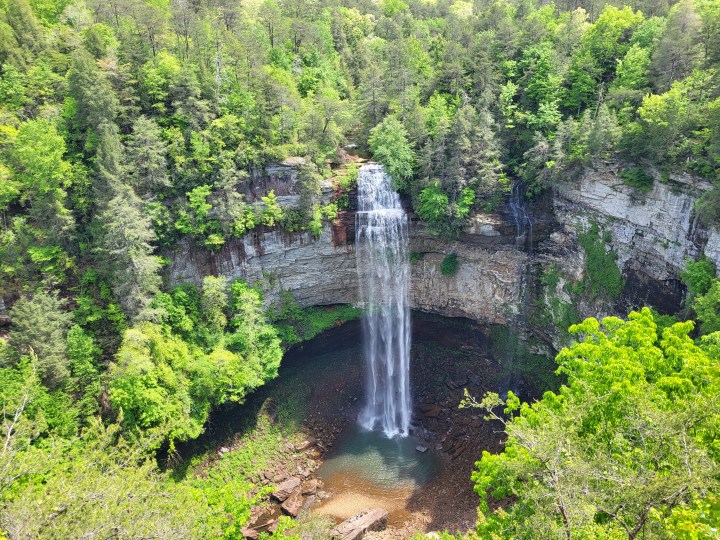
Fall Creek Falls State Park
The last favorite spot we shared with family was Fall Creek Falls State Park. We have visited this park in every season—spring greens, summer heat, fall colors, and even the quiet of winter—and it never loses its beauty. No matter how many times we return, it always feels like seeing it for the first time again.
We began at the overlook, where the waterfall drops dramatically into the gorge below. From there, we made our way down the trails and rocks to reach the base of the falls, where the perspective completely changes. Standing at the bottom and looking up at the towering cliff walls and rushing water gives you a completely different appreciation for just how powerful and beautiful the landscape is.
Even though we have made it a goal to visit more of Tennessee’s state parks, we always seem to get happily distracted by returning to this one. There is something about Fall Creek Falls that keeps pulling us back—it is both peaceful and awe-inspiring at the same time.
Established in 1937, Fall Creek Falls was Tennessee’s first state park and remains one of its most visited. With its waterfalls, hiking trails, overlooks, and forested scenery, it is easy to understand why.
It was the perfect final stop to share with our family and a fitting reminder of the natural beauty that makes Tennessee such a special place to explore.
{read more: Hiking at Fall Creek Falls State Park}


Tennessee Travel Tips
Tennessee is one of those states that surprises people with just how much variety it offers. From mountains and waterfalls to music history, whiskey distilleries, and cultural landmarks, it really helps to plan your trip by region so you’re not spending all your time driving between destinations.
If you’re planning a trip to Tennessee, it helps to think in terms of regions rather than trying to see everything at once. The state is more spread out than it first appears, and many of the best experiences are clustered within specific areas.
Nashville makes a great starting point for most visitors, especially for those flying in. From here, you can easily explore nearby attractions like the Ryman Auditorium, Tennessee State Capitol, Parthenon, and Stones River National Battlefield. These sites are all within a short drive of the city and offer a great mix of music, history, and culture.
For a unique experience outside the city, Lynchburg and the Jack Daniel’s Distillery offer a look at one of Tennessee’s most iconic industries. While it is a bit of a drive, it is one of the most memorable stops in the state.
If you enjoy the outdoors, Tennessee state parks like Fall Creek Falls are worth building into your itinerary. The scenery is especially beautiful in spring and fall, and the hiking trails and waterfalls make it easy to slow down and enjoy nature.
Chattanooga and Lookout Mountain are also great additions if you’re heading toward East Tennessee, especially for attractions like Rock City Gardens.
Overall, Tennessee is best enjoyed at a slower pace. Distances between destinations can take longer than expected, so giving yourself extra time between stops allows you to enjoy each place without feeling rushed.
FAQ: Places to Visit in Tennessee
- What are the best places to visit in Tennessee?
Some of the best places include Nashville, Fall Creek Falls State Park, Rock City Gardens, Jack Daniel’s Distillery, and Stones River National Battlefield.
- Is Tennessee good for a road trip?
Yes—Tennessee is ideal for road trips because it offers mountains, waterfalls, music history, and cultural landmarks all within a few hours of each other.
- What is Tennessee most known for?
Tennessee is best known for country music in Nashville, whiskey production in Lynchburg, and its natural scenery in the Smoky Mountains and state parks.
- How many days do you need to visit Tennessee?
A long weekend works for one region, but 5–10 days is ideal if you want to explore multiple parts of the state.
- What is the best time of year to visit Tennessee?
Spring and fall are the most popular times due to mild weather and beautiful scenery, especially in the state parks.

Looking back on those weeks with family in town, it really felt like a reminder of why we love living in Tennessee. In just a short amount of time, we were able to share waterfalls, historic battlefields, music landmarks, cultural sites, and some of our favorite hidden gems across the state.
What makes Tennessee so special is its variety. You can spend one day exploring the history and music of Nashville, the next standing beside a waterfall in a state park, and another learning something completely unexpected in a small museum or cultural center. It is a state that offers both big, iconic experiences and quiet, meaningful moments in between.
We packed a lot into those days, but more than anything, it was the time together—and seeing these places through fresh eyes—that made it memorable. Tennessee continues to surprise us, and it is a place we are always grateful to explore a little more each time.
For more of our favorite places in Tennessee, check out these:
Visiting Every National Park Site in Tennessee
Tennessee State Parks: Our Family Journey to Visit All the Parks
Thanks for coming along with us as we shared some of our favorite places with our family. May country roads take you through Tennessee.

For More Information:
Tennessee Walking Horse National Museum
Stones River National Battlefield
Read More From:
Follow along for more adventures near and far!


Leave a Reply