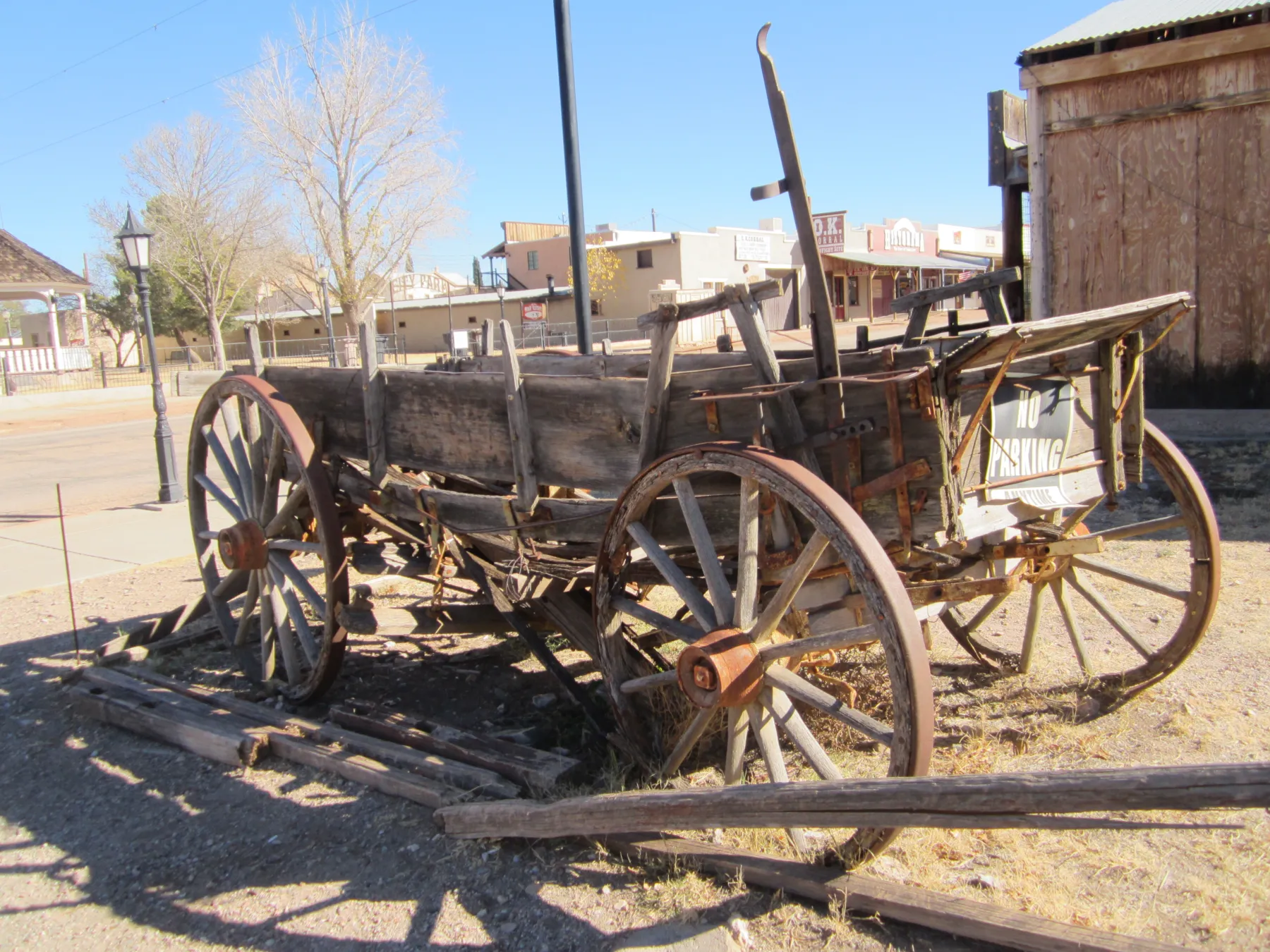
There’s something endlessly captivating about the stories of the American Old West. It was a time when anything west of the Mississippi River was considered untamed territory—where cowboys and outlaws crossed dusty streets, saloons echoed with laughter and tension, and boomtowns could rise and fall almost overnight.
These are the stories that have shaped how we imagine the West—of shootouts and survival, of opportunity and uncertainty, of people carving out lives in places that were as unpredictable as they were beautiful.
The American Old West is still alive in historic towns, ghost towns, and monuments across the United States. From preserved streets to quiet ghost towns, there are countless places where the spirit of the Old West can still be felt. Here are five of our favorite places where those stories come to life.
- Tombstone {Arizona}
- Silver City {New Mexico}
- The Alamo {Texas}
- Goldfield Ghost Town {Arizona}
- Crazy Horse Memorial {South Dakota}

Tombstone {Arizona}
Anyone interested in the Old West has likely heard of Tombstone—“the town too tough to die.” Originally settled in 1877, it quickly grew into one of the most famous silver mining boomtowns in the American West. Drawn by the promise of silver, thousands of people arrived hoping to strike it rich.
But with rapid growth came rising tensions. It was here that Wyatt Earp, along with his brothers and Doc Holliday, became part of the famous gunfight involving the outlaw “Cowboys.” While often referred to as the gunfight at the O.K. Corral, the actual confrontation took place in a narrow lot near Fremont Street, just outside the corral area.
Only about a decade after Tombstone’s boom began, a fire destroyed the city’s vital water pumping station, a major setback for the mining operations. Combined with declining silver production, the town’s population began to shrink.
Despite this, Tombstone survived—partly because it remained the county seat. Today, it stands as one of the best-preserved Old West towns in the country, drawing visitors who come for reenactments, historic buildings, and a glimpse into frontier life.

Silver City {New Mexico}
Silver City has gone through a remarkable transformation over time. Long before it became a mining town, the area was used as a seasonal encampment by the Apache people. Later, Spanish explorers and settlers moved through the region, and it eventually developed into a key area for mining—especially copper and other minerals.
The town as it is known today began to take shape in the post–Civil War era, when prospectors flooded into the area after reports of rich mineral deposits. Like many boomtowns of the Old West, rapid growth brought both opportunity and hardship, along with an increase in crime and lawlessness.
While Silver City is often associated with Old West legends, its connections to famous outlaws like Billy the Kid and Butch Cassidy are more part of regional folklore and the broader history of the frontier era than confirmed residence. Still, the town remains deeply tied to the stories and spirit of the Wild West.
Today, visitors can explore its historic downtown and nearby sites that reflect its mining past and frontier heritage.

The Alamo {Texas}
In 1821, the mission known as The Alamo in San Antonio came under Mexican control following Mexico’s independence from Spain. It later served as a military garrison during a period of growing tension between the Mexican government and settlers in the region of Texas.
As unrest grew, Texas moved toward revolution. Early conflicts led many to believe negotiations might resolve the situation, and for a time, rebuilding and occupation of the Alamo continued. However, tensions soon escalated again.
In February 1836, Mexican General Antonio López de Santa Anna led a siege on the Alamo as part of an effort to reassert control over San Antonio. A small group of Texian defenders held the fort for 13 days, cut off from reinforcements and supplies.
On March 6, 1836, the Alamo fell after a final assault, and the Mexican forces were victorious. The battle became a defining moment in the Texas Revolution. The rallying cry “Remember the Alamo” would later inspire Texian forces in subsequent battles, including the decisive victory at San Jacinto in April 1836, which secured Texas independence.

Goldfield Ghost Town {Arizona}
Goldfield Ghost Town is a reconstructed 1890s mining town that offers a glimpse into what life was like during the boom days of the Old West. Located in what was then Arizona Territory, Goldfield grew rapidly after gold was discovered in the nearby Superstition Mountains, drawing prospectors eager to strike it rich.
At its peak, the town was home to around 4,000 residents, complete with shops, saloons, and a bustling mining economy. But like many boomtowns of the era, its success was short-lived. When the mine began to fail in 1897, the economic foundation of the town collapsed almost overnight.
With no work and no reason to stay, residents moved on in search of new opportunities. Goldfield quickly emptied out and became one of the many ghost towns left behind when the mining era faded.
Today, it has been rebuilt as a historic attraction, allowing visitors to step back into the look and feel of a classic Old West mining town.

Crazy Horse Memorial {South Dakota}
In the Black Hills of South Dakota, not far from Mount Rushmore, stands the Crazy Horse Memorial. Carved directly into the granite mountainside, it is an enormous monument honoring Crazy Horse, an Oglala Lakota war leader who resisted U.S. government expansion into Native lands.
He is remembered as one of the most significant Native American leaders in history, and the memorial was commissioned in 1948 by sculptor Korczak Ziolkowski. It remains an ongoing project today, still far from completion, yet already striking in its scale and presence.
On site is also the Indian Museum of North America, which holds one of the most extensive collections of Native American artifacts in the country. The museum offers insight into the diverse cultures, histories, and traditions of Indigenous peoples across North America, making it a powerful complement to the memorial itself.
It is important to note that the carving is a symbolic representation rather than a precise portrait of Crazy Horse. This is partly because he was known to oppose having his image recorded or photographed, adding to the meaning and interpretation behind the monument.
Set against the landscape of the Black Hills, the memorial is both visually dramatic and deeply reflective—a tribute not just to one leader, but to a much larger and ongoing history.

Looking back across these places, it’s striking how many different versions of the Old West still remain—some preserved streets, some reconstructed towns, and some places carved directly into memory and landscape. From the silver boom and gunfights of Tombstone to the quiet echoes of Silver City, from the enduring story of the Alamo to the recreated streets of Goldfield Ghost Town and the powerful presence of the Crazy Horse Memorial, each place tells a different part of the same larger story.
These are not just destinations, but reminders of how quickly communities can rise, change, and fade—and how stories, whether rooted in history or shaped by legend, continue to draw us back. There is something deeply human about standing in these places and imagining the lives that once filled them.
And maybe that’s why the Old West still feels so compelling today. It isn’t just about the past—it’s about the way those stories continue to live on in the land, and in us as we keep going back to find them.
If you enjoyed this post, then you may be interested in these:
Thanks for coming along today to some of my favorite places of the Old West. May desert skies and outlaw tales bring you out west.

Coming Up Next:
Follow along for more adventures near and far!


Leave a Reply to Little Old WorldCancel reply