We first visited France last year, and ever since, we’ve talked about returning. So when we decided to come back just as the Christmas markets were beginning to open, the trip felt even more special—something we had been quietly looking forward to for months.
Our journey began in Paris, a city that seems to inspire strong opinions. People tend to either love it or leave wondering what the fuss was about. We fall firmly on the side of loving it.
With only a short time in the city, we chose not to fill our days with a long list of sights. Instead, we leaned into a slower rhythm—wandering through the streets, lingering along the river, and stopping often for pastries whenever the moment called for it.
Rainy Day in Paris
A week before our arrival, Paris had been covered in snow. By the time we arrived, the snow had melted into steady rain. But even then, there was something undeniably beautiful about the city. Walking along the Seine with umbrellas overhead and lights reflecting off the wet pavement, it felt like Paris was easing us into the season in its own quiet way.

The Louvre
We stopped to say hello to the Louvre Museum, but this time, we didn’t go inside.
Rainy days are perfect for museums, but the long lines of umbrellas waiting to enter told a different story. The Louvre is a place that could easily take weeks to fully explore, and on this visit, it didn’t quite fit the slower, more wandering pace we had chosen.
Still, even from the outside, it’s a place of beauty.
There’s something about the scale of it—the long stretches of historic architecture paired with the glass pyramid—that feels just as impressive without ever stepping through the doors. We lingered for a moment, taking it in, before continuing on our way through the city.

Tuileries Garden
We wandered through the Tuileries Garden, where rows of bare trees lined the pathways in quiet symmetry.
On most days, the gardens are filled with people, but with the steady rain, it felt almost empty—like the city had softened for a moment. A few people lingered by the fountains, bundled in coats and seemingly unbothered by the weather, content to sit and watch the rain fall across the water.

We stepped carefully around puddles, unhurried, letting the rhythm of the walk carry us forward. In the distance, just beyond the line of trees and along the Seine, we caught glimpses of the Eiffel Tower rising quietly into the gray sky.

Grande Roue de Paris
At the edge of the Tuileries Garden, we could see the massive Grande Roue de Paris rising above the trees. Even in the gray light of the rainy day, it stood out—its slow, steady movement adding a quiet sense of motion to the stillness of the garden.
Ferris wheels have long been part of Paris’s story. One was first installed here for the Exposition Universelle 1900, offering visitors a new way to see the city from above. This modern version carries on that same spirit, even as its future remains uncertain, with plans for it to be removed and the possibility of it returning in another form.
For now, it felt like a fleeting part of the skyline—something to notice, to remember, and to quietly wonder how long it might remain.

Christmas in the Tuileries
Just beyond the Grande Roue de Paris, we found one of the city’s most beloved Christmas markets, set alongside the Tuileries Garden.
Paris isn’t as well known for Christmas markets as other parts of Europe, but there are still a few scattered throughout the city—and this one is often considered the largest.
Even in the rain, we wandered slowly through the rows of wooden stalls, peeking in to see what each one held. With fewer people out, it felt a little quieter than expected, giving us space to take it all in at our own pace.

We warmed our hands with cups of hot chocolate and mulled wine as we walked, grateful for the small comforts against the cold.
And then, of course, there was the food.
One of our favorite parts of any Christmas market is simply watching it being made. We stopped at a stall where large wheels of cheese were set under heaters, slowly melting into something rich and golden before being poured generously over bread, potatoes, and chicken. It was impossible to resist.
Standing there in the rain, balancing cheesy potatoes in one hand and a warm drink in the other, we finally began to thaw.


But what we didn’t expect was the shift in atmosphere just beyond the food stalls.
Mixed in among the traditional market huts were bright lights, carnival games, and rides—flashing and buzzing in a way that felt completely different from the quiet charm we had just experienced. It was an unexpected contrast, the old-world feel of the market blending into something more modern and energetic.
There were even two multi-level fun houses. And somehow, my daughter convinced me to go through one with her. It turned out to be… less fun than advertised.
The four-story structure was filled with glass walkways, twisting staircases, slides, and moving floors—all made even more challenging by the rain, which left everything slick and unpredictable. We made our way through carefully, laughing a little, slipping a lot, and both quietly agreeing that once was more than enough.

Montmarte & Sacre-Coeur
The next morning, we made our way to the Montmartre area of the city.
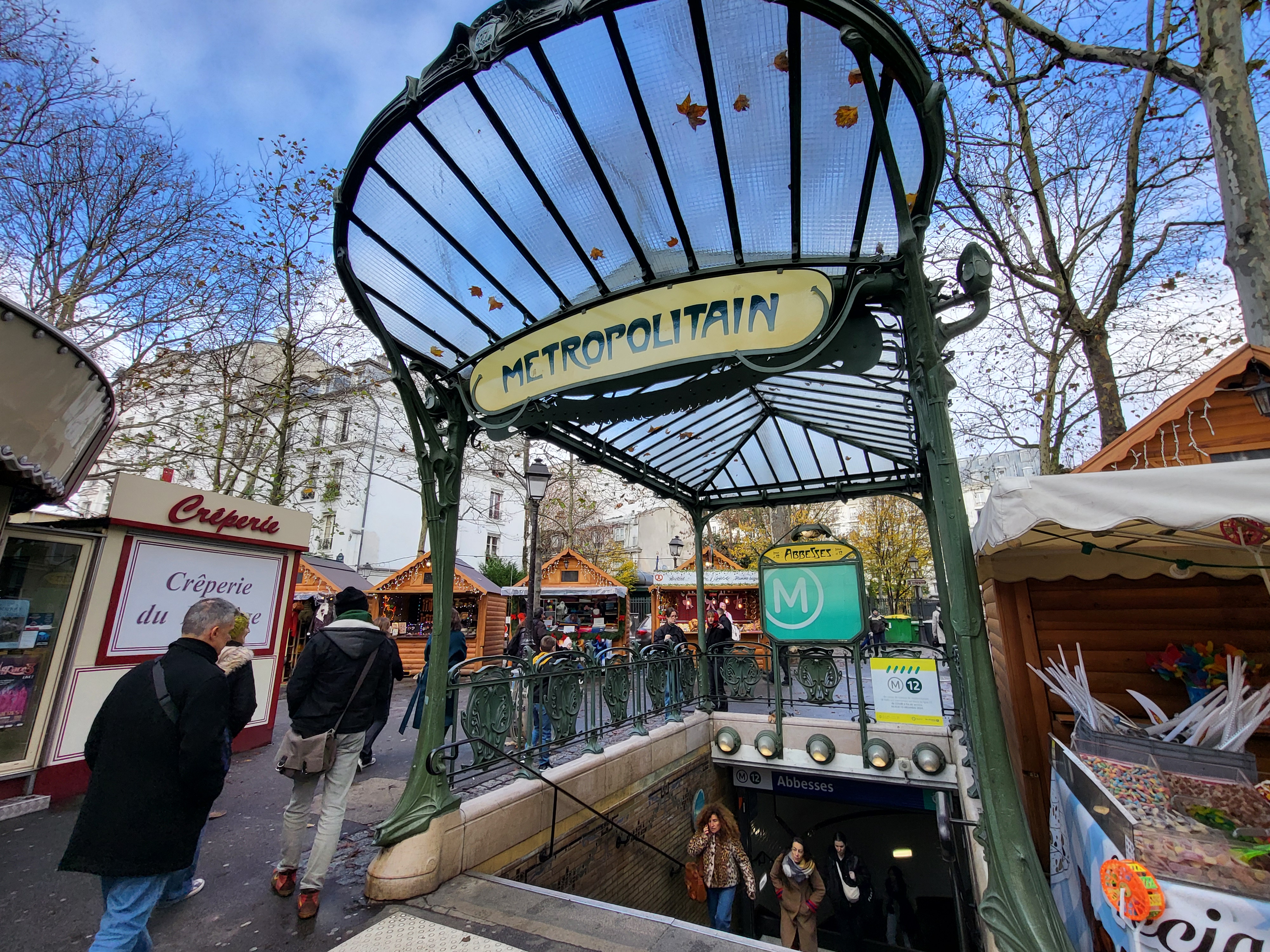
Stepping off the train, we were immediately greeted by one of Paris’s charming art nouveau metro entrances—those iconic green iron signs that feel like little gateways into another era.
Right beside the station, we came across a small Christmas market tucked between the streets. Wooden stalls lined the narrow walkways, their lights glowing softly against the gray morning.
We wandered through slowly, taking it all in, but didn’t linger too long. It felt more like a passing glimpse of the neighborhood’s festive side before continuing on our way through Montmartre’s winding streets.

Sacre-Coeur Cathedral
No visit to Montmartre feels complete without making your way up to the Sacré-Cœur Basilica, where the view opens up across the city below. Perched high above Paris, it offers one of the most iconic panoramas in the city—rooftops stretching out in every direction, fading into the distance.

At the base of the hill sits one of our favorite carousels in Paris, the Carrousel de Saint-Pierre. With its double-decker design and old-world details, it feels like something pulled from another time. Of course, we couldn’t resist a ride—or two—so we could experience both levels.
It was a lively spot, and like many popular places in Paris, it came with a bit of chaos. A few visitors were staging photos at the top level, holding up the line of kids waiting to climb the stairs. It was one of those moments where the energy of the place felt a little out of sync with itself—part wonder, part frustration—but it passed quickly as everyone eventually made their way through.


Sacré-Cœur itself was completed in 1914, built in a Romano-Byzantine style that gives it a sense of looking much older than it is.

But the history of this hill stretches far beyond the basilica. Long before its construction, Montmartre was a place of worship—first for the Gauls, then the Gallo-Romans. Archaeological evidence suggests there were once temples dedicated to Mercury and Mars here, making it a site of significance long before Paris existed as we know it today.


Art & Christmas in Montmarte
After taking in the views from Sacré-Cœur Basilica, we continued wandering deeper into the artistic heart of Montmartre.
The square was alive with artists working in real time—easels set up, sketches in progress, and portraits taking shape as visitors paused to watch. This neighborhood has long been associated with Paris’s artistic community, and even now, that creative spirit still feels very present in the streets.

Around us, the buildings were decorated for the season in subtle but striking ways. Some shopfronts carried simple touches of greenery and light, while others leaned into something more dramatic.
One that stood out in particular was the restaurant La Bohème, where gold ornaments and silver peacocks were displayed above the entrance—unexpected, a little whimsical, and completely eye-catching.


We didn’t hesitate for long before deciding it was the perfect place to stop for lunch.
Inside, the atmosphere was warm and inviting, the kind of place that feels like a pause in the middle of a busy day. The food was excellent, but just as memorable was the feeling of sitting there after wandering through Montmartre—resting, watching, and soaking in the energy of the neighborhood around us.


History Through the City
Sorbonne University
As we continued wandering through the city, we passed by the historic Sorbonne University. It’s one of those places in Paris that carries quiet weight just from its name—centuries of learning, ideas, and people passing through its doors.
Among its many notable figures was Marie Curie, who studied in Paris after leaving Poland at a time when higher education opportunities for women were extremely limited. She eventually became the first woman to win a Nobel Prize, and later went on to receive a second—an extraordinary achievement that still stands out in scientific history.
We had hoped to visit the Musée Curie during our time in Paris, but unfortunately it was closed while we were there. Still, even passing through this part of the city felt like brushing against a bit of that history—quiet, layered, and deeply woven into the streets around us.

The Pantheon
As we continued wandering through the city, we passed by the Panthéon, its grand dome rising above the surrounding streets. Originally built as a church and later transformed into a secular mausoleum, it has become one of the most important resting places in France.
Inside lie many of the country’s most influential figures, including Victor Hugo, Voltaire, Jean-Jacques Rousseau, and Marie Curie—the first woman to be honored here on her own merit.
The architect behind this monumental space was Jacques-Germain Soufflot, whose vision shaped its striking neoclassical design. We didn’t go inside on this visit, but even from the outside, it carries a quiet sense of permanence—like a reminder of how deeply history is layered into the city around you.

Masterpieces at Musee d’Orsay
One of the places we were especially excited to visit in Paris was the Musée d’Orsay. Housed in a former train station, it is a stunning example of how a space can be transformed without losing its original beauty.

As with many museums, I find myself just as drawn to the architecture as I am to the collections inside. And here, both were remarkable. The moment you step inside, the scale of the old station unfolds in front of you—arched glass ceilings, ornate detailing, and light pouring through the structure in a way that feels almost theatrical.

We spent hours moving through the galleries, with a particular focus on the Impressionist and Art Nouveau collections. Each room seemed to offer something new, something worth pausing for just a little longer. And still, it didn’t feel like enough time.
The Musée d’Orsay is the kind of place that invites you to slow down, but even then, it feels impossible to take it all in on a single visit.


Iconic Paris Moments
Notre Dame Cathedral
As we made our way through the city, we could hear the bells of Notre-Dame Cathedral ringing out across the streets.
We had missed the grand reopening by just a week, and while we wished we could have been there for it, the moment still felt special. Large white tents remained set up along the square, keeping us from getting too close, but we didn’t mind.
We were close enough. Close enough to hear the bells echoing through the air—steady, familiar, and full of life. It was the kind of sound that seems to settle into you, carrying both history and hope at once.
After the devastating Notre-Dame fire, seeing the cathedral standing restored again felt quietly powerful. There was a sense of something returned, something carefully brought back to life.
We lingered for a moment, taking it in from where we stood, already knowing that on our next visit, stepping inside would be at the very top of our list.

Eiffel Tower
And what would a trip to Paris be without a glimpse of the Eiffel Tower? We saw it all lit up at night, glowing softly against the sky in that unmistakable way that makes it feel both grand and familiar at the same time.
This time, we didn’t go up inside. Our daughter was very determined that she could handle all the stairs, but we decided instead to simply enjoy it from the park below. Sometimes that’s enough. Just sitting for a while, watching it sparkle, and letting the moment settle in.

Tips for Visiting Paris at Christmas
Paris in the winter has a kind of quiet magic to it—but it helps to be a little prepared so you can enjoy it fully.
Embrace the slower pace.
There are endless things to do in Paris at Christmas, but trying to see everything will take away from what makes the season special. Build in time to wander, stop for food, and simply take in the atmosphere.
Plan for rain (and dress for it).
Winter in Paris often means gray skies and steady rain. Waterproof shoes and a good coat will make all the difference between a cozy day and a miserable one.
Visit Christmas markets during off-peak times.
Markets like the one at the Tuileries Garden can get crowded, especially in the evenings and on weekends. If you can, go earlier in the day or during the week for a more relaxed experience.
Mix big sights with small moments.
It’s easy to focus on iconic landmarks like the Eiffel Tower or Sacré-Cœur Basilica, but some of the best memories come from the in-between moments—quiet streets, small markets, or a warm meal after a long walk.
Make time for indoor stops.
Museums like the Musée d’Orsay are perfect for warming up and slowing down. Even if you don’t stay long, stepping inside offers a nice break from the cold.
Expect crowds—and a little chaos.
Paris at Christmas is popular for a reason. There will be busy areas, especially around markets and major sights. A little patience (and a sense of humor) goes a long way.
End at least one night with the lights.
Seeing the Eiffel Tower sparkle or the city streets glowing in the evening is part of what makes Paris at Christmas feel so special. It’s worth staying out just a little longer for.


Paris in the winter felt like a city in between moods—sometimes gray and rainy, sometimes glowing with lights, always full of small moments worth pausing for. From quiet walks along the Seine to museum halls filled with centuries of art, from Christmas markets tucked between streets to unexpected carousels spinning in the rain, the city revealed itself slowly as we wandered.
We didn’t try to see everything. We simply let Paris unfold around us.
And maybe that’s what we loved most—those unplanned moments between the landmarks, where the city felt less like a checklist and more like something to experience one street at a time.
We left with tired feet, full hearts, and the feeling that Paris is never really finished—it just waits for you to come back and keep wandering.
If you enjoyed this, then check out these other great European cities:
Thanks for coming along on this visit to Paris. May you have the time to simply enjoy where you are.

Follow along for more adventures near and far!


Leave a Reply to Travels Through My LensCancel reply