For the longest time, the two places our daughter has wanted to see are Alaska and Texas. So when we told her that on our way home we would be landing in Texas, her excitement was immediate. As we flew into the Dallas–Fort Worth airport, she pressed her face to the window and asked, “Are we in THE Texas?”
We laughed — and then gently explained that it was just a layover. We didn’t expect to see much beyond airport terminals and departure boards. But sometimes travel has other plans.
Just after we stepped off the plane and started looking for our next gate, our phones pinged at the same time. Our flight home had been canceled. Suddenly we were in a very long line of very tired travelers trying to rebook. The only option? Flights the next day. An unexpected overnight in Texas.
Once we secured a hotel near the airport, we pulled up a map and asked the question every traveler asks in a surprise situation: What can we see in just a few hours? There were plenty of options around the Dallas–Fort Worth area, but one stood out — a place that felt undeniably, unmistakably Texas.
The Fort Worth Stockyards.
For such a compact district, the Stockyards are packed with history, longhorn cattle drives, brick walkways, wooden corrals, and just enough cowboy culture to make you feel like you’ve stepped into another era. Whether you have a full day or just a handful of hours like we did, it’s a memorable way to experience a slice of Texas.
Visiting the Fort Worth Stockyards
Stockyards Visitor Information
Fort Worth is located in north-central Texas and is one half of the larger Dallas–Fort Worth Metroplex. While the two cities are only about 35 miles apart and share a metro area, they each have their own distinct personality. Dallas often feels sleek and modern, while Fort Worth leans into its Western roots and cowboy heritage.
For generations, Fort Worth has proudly carried the nickname “Where the West Begins.” That spirit is still very much alive today. You’ll see Western style throughout the city — from murals and architecture to boots and hats on everyday locals — but nowhere is it more concentrated than at the Stockyards.
The Fort Worth Stockyards are located just north of downtown, only a short drive from the business district. The district itself is surprisingly compact, covering just a few city blocks. That small footprint makes it easy to explore on foot, even if you only have a few hours like we did.
One of the best things about visiting the Stockyards is that it’s completely free to enter and walk around. You can stroll the brick streets, browse shops, and soak in the atmosphere at no cost. However, certain attractions, tours, rodeos, and special events do charge admission. It’s always a good idea to check the Stockyards’ events calendar ahead of time to see what’s happening during your visit.


Fort Worth Stockyards History
In 1849, Major Ripley Arnold established a military outpost along the Trinity River that would eventually become Fort Worth. At the time, it was considered one of the last “civilized” outposts on the frontier — a stopping point before the open range began.
In the decades that followed, Fort Worth became a critical hub along the Chisholm Trail, the loosely marked cattle-driving route that stretched from Texas north into Kansas railheads. Cowboys driving thousands of longhorns would pass through Fort Worth to rest, resupply, and prepare for the long journey ahead.
A typical cattle drive could include anywhere from 1,500 to 2,500 head of cattle and last anywhere from two to six months, depending on the final destination. It was grueling, dusty, unpredictable work — and Fort Worth became known as a place where cowboys could gather before heading north.
By the late 1800s, Fort Worth had evolved from a frontier outpost into a major livestock shipping center. The arrival of the Texas and Pacific Railway in 1876 helped transform the city, making it far easier to transport cattle to markets across the country. Over time, the Stockyards district grew into one of the largest livestock trading centers in the Southwest.
Like many historic districts, the Stockyards experienced decline in the early 20th century as the trucking industry expanded and livestock auctions began happening closer to where cattle were raised. But the story didn’t end there.
In 1976, the Fort Worth Stockyards was listed on the National Register of Historic Places. Today, the district preserves its Western heritage through daily cattle drives, rodeos, historic buildings, and a celebration of the cowboy culture that shaped this part of Texas.

What To Do at the Stockyards
This compact area is full of interest and things to do. It was the perfect way to spend a day or a weekend, or just a few hours like we did. It is a great place to get in the cowboy history that made the Stockyards such a favorite place.
Cowtown Coliseum
Because of the deep roots of cattle and livestock in the district, Fort Worth earned the nickname “Cowtown.” And in 1908, the city built something to match that identity — the iconic Cowtown Coliseum.
When it opened, it was the first indoor rodeo arena in the United States — a groundbreaking concept at the time. Instead of relying on open-air fairgrounds, rodeo events could now take place year-round under one roof.

Since its early days, the Coliseum has hosted regular rodeos, continuing a tradition that spans more than a century. With seating for about 2,400 spectators, the arena feels intimate — close enough that you can hear the hooves hit the dirt and feel the energy of the crowd. There really isn’t a bad seat in the house.
While it’s best known for rodeos and bull riding, the Coliseum also hosts other events throughout the year, including concerts and sporting competitions. It remains one of the most authentic ways to experience the Western spirit that made the Stockyards famous.


Livestock Exchange & Stockyards Museum
The historic Livestock Exchange Building is often considered the architectural icon of the Stockyards. When Fort Worth transitioned from a rough-and-tumble cattle drive stop into a major livestock market, this building became the center of it all.
Completed in 1902, it served as the hub where cattle and other livestock were bought and sold. At its peak, more than a million head of livestock moved through the Stockyards each year — redefining Fort Worth’s economy and firmly establishing it as a powerhouse in the cattle industry.

Today, the building is no longer used for livestock trading, but it has been thoughtfully preserved and repurposed. Inside, you’ll find offices, shops, and exhibits that highlight the district’s rich Western heritage.
One of our favorite parts was walking along the walls lined with inductees from the Texas Trail of Fame. The Trail of Fame honors individuals who have made significant contributions to Western heritage and culture. We loved spotting familiar names like Willie Nelson and Mark Twain among the honorees — a reminder of just how far the influence of cowboy culture reaches.


Cattle Pen Walkway
Just behind the Livestock Exchange Building is the Cattle Pen Walkway — a raised wooden path that lets visitors look down over the historic holding pens.
There are more pens than you expect at first glance — row after row built to hold thousands of cattle at a time. When we visited, a few cowboys were mucking out the stalls, preparing them for the next group. Most of the pens were empty, but in the distance we could spot the longhorns resting comfortably inside one of the barns.

One of our favorite details was the entryway into the pen area. You pass through an old iron turnstile beneath a weathered sign warning visitors to “put out cigarettes before dropping them in the hay.” It’s one of those small, preserved details that instantly transports you back in time — and also reminds you that nothing makes for a worse day than accidentally setting a barn full of hay on fire.


Even without cattle filling every pen, it was fascinating to walk the full length and width of the walkway. It’s a surprisingly long stretch, giving you a sense of just how massive the livestock operation once was. Standing above the empty pens, it’s easy to imagine the noise, movement, and dust that would have filled this space in its heyday.

Cattle pen Maze
After seeing the historic pens from above, it’s time to step inside them at the Cattle Pen Maze at the Fort Worth Stockyards.
Instead of cattle, the maze is filled with winding paths and dead ends. At the entrance, an old-fashioned time clock punches your card with a start time — a small detail that makes it feel like you’ve stepped back into another era. Your mission? Find the letters that spell M-A-Z-E hidden throughout the stalls and punch each one onto your card before making your way out.

We had such a great time working our way through it. It’s definitely more challenging than it looks. The narrow paths twist and turn, and we found ourselves turned around more than once. But that just made it even more satisfying when we finally spotted the last letter and made our way to the exit.
It’s one of those activities that feels simple at first — until you’re deep inside wondering how in the world you ended up back where you started.


stockyard Stables & Petting Zoo
If you’ve ever wanted to saddle up in true Texas fashion, the stables at the Fort Worth Stockyards offer guided trail rides right through the district.
You’ll need to use a little imagination — after all, you’re riding in the middle of the city, not across wide open prairie. But there’s still something special about climbing into the saddle and seeing the Stockyards from horseback. It’s an experience that feels surprisingly authentic, even with storefronts and brick streets nearby.
For those who prefer their animals a little smaller (and fluffier), there’s also a petting zoo with sheep, goats, and even an alpaca. It’s an easy, low-key stop that younger kids especially tend to love — and a nice change of pace after all the walking.

Stockyards Station
When the railroad came to Fort Worth, it changed the city forever — cattle could now come to Fort Worth instead of setting out from there. The old Stockyards Station has since been transformed into a lively shopping and dining district, filled with shops that celebrate cowboy culture.

Walking through the stores, it feels like stepping back in time. Animal hides and horns line the walls, leather pouches and belt buckles fill the shelves, and cowboy boots are on proud display in the windows. Need a bucking bronco for your living room? They’ve got you covered.


While there is a touch of kitsch and commercial charm, there’s also a genuine love and pride for the cowboy history that built Fort Worth. The shopkeepers and staff want to share that story, keeping alive the legacy of the cattle drives that once set out from this very place.


Stage Coach & Covered Wagon
Have you ever dreamed of riding in a stagecoach or traveling in a covered wagon? At the Stockyards, you can make that dream a reality. Fort Worth was once considered the last “civilized” outpost — anything heading west beyond the city traveled by stage, wagon, or horseback.

Seeing these historic modes of transportation up close is fascinating. Of course, imagining the actual experience is a little humbling — months of traveling across empty territories in a wagon or stagecoach must have been incredibly uncomfortable. Still, taking a short ride today gives visitors a fun glimpse into what life was like on the old frontier.


Longhorn Cattle Drive
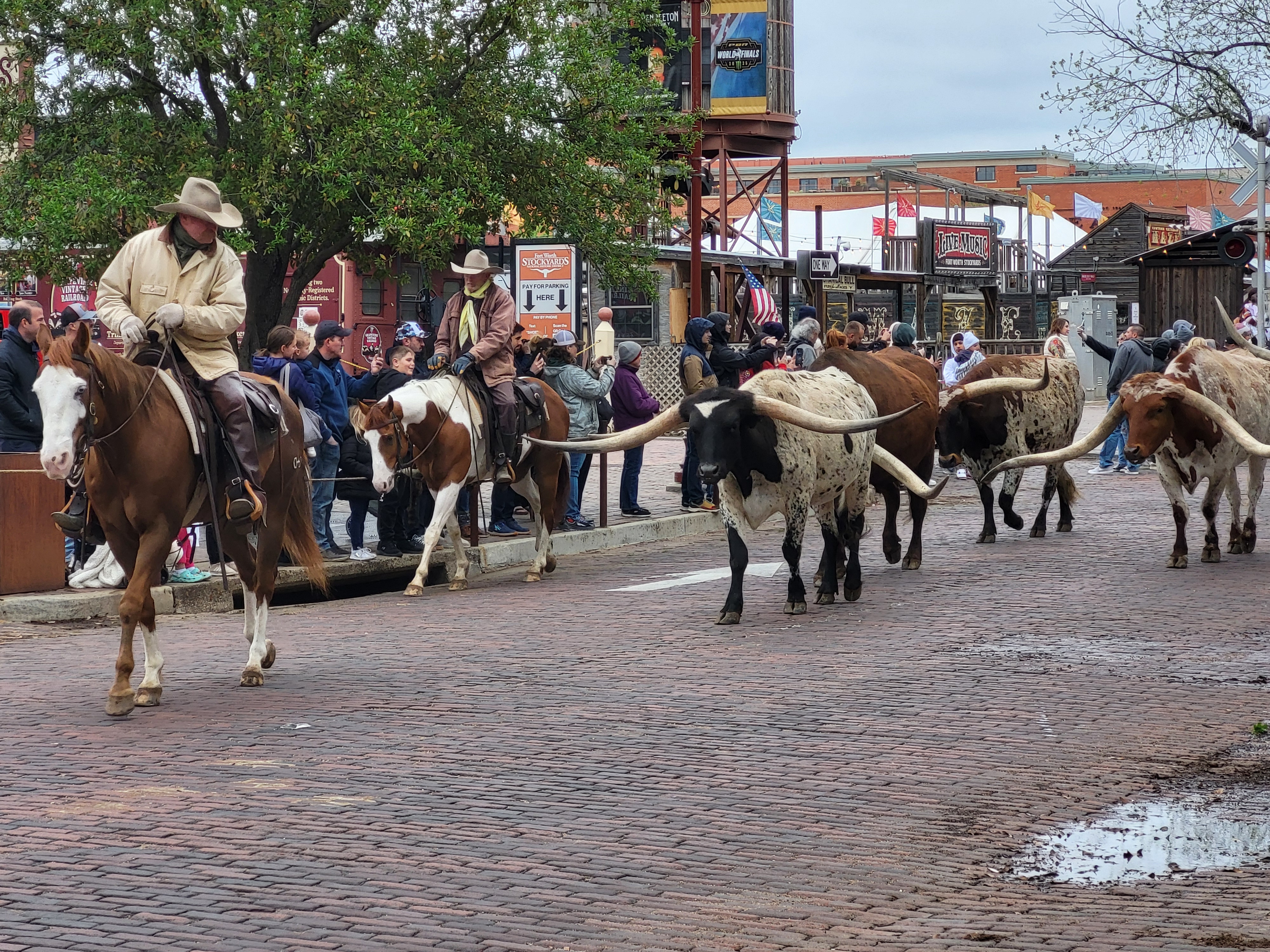
The real highlight of the Stockyards happens twice a day with the cattle drive down the street. A large herd of longhorns is led from their pens by the skilled cattle drivers, making their way through the Stockyards. While it’s nothing like the historic drives of Fort Worth, it’s a fun and lively tribute to the city’s cowboy past.

Watching the longhorns walk side by side without injuring each other with their massive, twisted horns is fascinating. These incredible animals have learned to navigate carefully, and their horns are a marvel in themselves — a living reminder of the rugged history that shaped the Stockyards.


With that, we made our way back to the hotel to gather our things and continue our journey home. The Fort Worth Stockyards proved to be a wonderful place to spend a few hours — packed with history, cowboy culture, and unique experiences that are hard to find anywhere else. We loved learning about the city’s past, exploring the cattle pens and stables, and walking the streets where cowboys once drove cattle.
It was a happy accident that a canceled flight gave us this little taste of Texas, and it made our layover feel like an adventure in its own right. And really, nothing says Texas quite like the sight of longhorns trotting down the street, led by skilled cattle drivers keeping a centuries-old tradition alive. The Stockyards reminded us that sometimes the most memorable experiences happen when you least expect them.
If you enjoyed this post, you may be interested in these:
Thanks for coming along on this visit to the Fort Worth Stockyards. May you always be as strong and steady as a longhorn.

Read more from:
Follow along for more adventures near and far!


Leave a Reply to leightontravelsCancel reply