Our European Christmas vacation began in the Eternal City of Rome. I’ll admit—Rome had never been on my travel bingo card. I’ve always felt a little intimidated by it: the layers of history, the art, the empire, the sheer magnitude of the city itself. Even though I love learning about those things, Rome felt unapproachable to me. Where do you even begin to grasp a place that has shaped so much of the world?
What I learned on this first visit to the Eternal City, though, is that you’re not really meant to grasp Rome all at once. You’re not meant to fully understand or appreciate it in a single visit. That, in many ways, is what makes it eternal—there is no end to what you can learn, see, or experience here. Rome was never meant to be taken in one giant bite. It’s more like a long, lingering feast, enjoyed in courses, with space in between to savor each moment.
Our time in Rome was exactly that: a small first taste of understanding. We saw a lot in the few days we were there, yet somehow it still felt like we had barely scratched the surface. We wandered through the city, taking in iconic landmarks alongside the steady flow of fellow travelers, all of us trying to make sense of this remarkable place. Rome is a city that invites return visits—slower ones, deeper ones—where each trip peels back just one more layer.
Roaming in Rome
- Vatican City
- Castel Sant’Angelo & Bridge of Angels
- Mausoleum of Augustus
- Spanish Steps
- Trevi Fountain
- Pantheon
- Piazza Navona Christmas Market
- Vittoriano
- The Roman Forum
- Colosseum


Vatican City
Our hotel was just up the street from St. Peter’s Basilica in Vatican City, which meant that each day began and ended with sweeping views of the square and the stunning architecture that surrounds it. We happened to be in Rome not only at the start of the Christmas season, but also during a Jubilee year — a time that draws pilgrims from around the world. The area buzzed with a mix of visitors and worshippers, and while we would come to understand the significance of the Jubilee more deeply later on, its presence was already unmistakable.

We spent time walking up and down the long approach leading to St. Peter’s Basilica, a path that has guided believers for centuries. The tall colonnades lining the way felt both grand and welcoming, gently funneling people toward the heart of Vatican City. Along the route, we enjoyed wandering past small shops and cafés, soaking in the everyday life unfolding alongside such an extraordinary place.


Castel Sant’Angelo & Bridge of Angels
Following the curve of the Tiber River, we came to Castel Sant’Angelo. This fortress-like structure was originally commissioned by the Roman Emperor Hadrian as a mausoleum for himself and his family, constructed between 134 and 139 AD. After Hadrian’s death, emperors continued to be laid to rest here until 217 AD. Deep within the structure, the treasury once held the urns of imperial emperors and their families.
Over the centuries, the building took on many new roles. It was transformed into a fortress and later served as a castle and refuge for the popes during times of unrest. Today, Castel Sant’Angelo functions as a museum, offering visitors both a layered history of Rome and sweeping views across the city.
The name Castel Sant’Angelo—Castle of the Holy Angel—comes from a medieval legend. By that time, the mausoleum had fallen into decline, but in the year 590 a remarkable vision was said to have occurred: the Archangel Michael appeared atop the fortress, sheathing his sword as a sign that the plague devastating the city had come to an end. From that moment on, the building took on its present name and spiritual significance.

In front of the castle stands the Ponte Sant’Angelo, or Bridge of Angels. This bridge was also commissioned by Hadrian, designed as a direct ceremonial path from the city center to his mausoleum. For centuries it served as part of pilgrim processions traveling toward St. Peter’s Basilica and was once known as the Bridge of St. Peter. Today, angels line the bridge, each holding symbols of the Passion of Christ, creating one of the most evocative and beautiful approaches in all of Rome.


Mausoleum of Augustus
We came upon the Mausoleum of Augustus, built by the Roman emperor himself in 28 BC as the final resting place for him and members of the imperial family.
For centuries, the mausoleum was completely covered by earth. During the medieval period, a story began to circulate that Augustus had decreed that after his death, a basketful of soil from every province of the empire should be placed upon his tomb, allowing him to rest upon the very lands he once ruled.
Over time, the mausoleum has undergone numerous restoration efforts, helping to preserve the legacy of Rome’s first emperor and offering a quiet reminder of the reach, power, and impermanence of even the greatest empires.

Spanish Steps
We came upon the Spanish Steps, arguably one of the most romantic and iconic spots in Rome. All 135 steps cascade gracefully from the Piazza di Spagna below up to the Trinità dei Monti church at the top, creating a dramatic and elegant connection between the two spaces.
Over the years, these beautiful steps have endured their share of wear, damage, and restorations. Because of this, city officials have put strict rules of decorum and security in place to help protect the structure. Sitting, eating, drinking, or otherwise mistreating the steps is prohibited, and the regulations are actively enforced. Fines apply to anyone—locals and tourists alike—who endangers the integrity of this historic landmark.

Trevi Fountain
Another iconic and endlessly romantic stop in Rome is the Trevi Fountain. While the city is home to more than 1,800 fountains scattered throughout its streets and piazzas, this is by far the most famous and most visited of them all.
Built at the meeting point of three roads—tre vie—this location has long been significant, marking where important routes and water systems converged to supply the city. The fountain itself was the work of many artists over several centuries, eventually culminating in the spectacular Baroque masterpiece we see today. A blend of classical mythology and elegant design, the Trevi Fountain centers on the theme of the “taming of the waters,” a fitting tribute to its role within Rome’s ancient aqueduct system.
Each year, millions of visitors gather here, most of them taking part in the well-known tradition of tossing a coin into the fountain to ensure a return to the Eternal City. It’s estimated that roughly €3,000 worth of coins are thrown into the fountain every single day. If you want to follow tradition properly, be sure to stand with your back to the fountain and toss the coin with your right hand over your left shoulder. Only then, they say, will the magic work—and Rome will call you back once more.

Pantheon
We passed by the Pantheon, its massive portico surrounded by a steady tide of people. This remarkable structure is one of Rome’s oldest surviving buildings and has endured for nearly two thousand years largely because it has been in continuous use since its creation.
The Pantheon was commissioned by Emperor Hadrian and built on the site of an earlier temple originally ordered by Augustus. It was likely completed around AD 126, though the exact date remains uncertain, as the inscription on the façade references the earlier structure that was destroyed by fire. Despite this confusion, the building that stands today is unmistakably Hadrian’s achievement.
The Pantheon’s dome is what has made it one of the most architecturally significant buildings in the world. Its perfect proportions and ingenious engineering influenced Roman architecture and continued to inspire builders, artists, and designers through the Renaissance and into modern times. Even now, it feels impossibly modern for something so ancient.
There is still debate over the original purpose of the building. The name Pantheon is often interpreted as “temple of all the gods,” but there is no clear historical evidence to confirm this. While Roman religion absorbed many elements from Greek mythology, worship was typically centered on individual deities, each with their own shrines or temples. A single structure devoted to all gods at once would have been unusual.
Over the centuries, the Pantheon’s function evolved. It began as a pagan temple and was later converted into a Christian church, a transformation that ultimately saved it from destruction during the Middle Ages. During the Renaissance, it also became the final resting place for some of Rome’s most celebrated figures, further layering the building with meaning and history.

Piazza Navona Christmas Market
Italy isn’t typically at the top of the list when it comes to famous Christmas markets like those found in Germany or Austria, but Rome does host one of its own in Piazza Navona. We wandered through the stalls, lingering over giant sugar-dusted donuts piled high beside colorful assortments of candy. We even took a few turns on the carousel set up in the center of the beautiful square, letting ourselves enjoy the simple, festive atmosphere.

Piazza Navona is built on the ancient site of the Stadium of Domitian, and its long oval shape still follows the footprint of the original stadium. In Roman times, crowds would have gathered here to watch athletic competitions. Centuries later, the space transformed into a showcase of Baroque art and architecture, layered with history from every era.


One of the most interesting aspects of the Christmas market was the abundance of nativity scenes for sale. These weren’t limited to the traditional Holy Family alone. Instead, everyday people were woven into the scenes — figures representing different professions, shopkeepers, and even characters that looked like family members — creating scenes that reflect daily life alongside the nativity.


Another striking feature of the market was the sheer number of witch figures for sale. Witches and brooms filled stall after stall. This tradition is tied to the Italian legend of La Befana. According to the story, the Three Wise Men stopped at the home of an old woman while searching for the Christ child and invited her to join them. She declined, but later regretted her decision and set off after them. To this day, she is said to leave small gifts for children, just in case one of them might be the baby Jesus. Her broom symbolizes sweeping away the troubles of the old year and welcoming good luck in the new one.

Vittoriano
This towering monument is fondly known as the Altare della Patria, or Altar of the Fatherland. It was built to honor Italy’s first king, Victor Emmanuel II, and to commemorate the unification of Italy. Rising above Piazza Venezia, the monument feels both monumental and symbolic, anchoring the modern city to its national identity.
The brilliant white marble structure is richly detailed with intricate carvings, columns, and sculpted figures. Standing at its forefront is the imposing equestrian statue of King Victor Emmanuel II, leading the eye upward toward the grand terraces above.
The architecture was designed as a modern interpretation of what ancient Roman Capitol Hill might have looked like in its prime. Throughout the monument, allegorical figures representing virtues, regions, and victories appear again and again — the only non-allegorical figure being that of the king himself.
Today, the Vittoriano stands as a powerful national symbol of Italy. Each year, political leaders and citizens alike gather here to pay their respects at the Tomb of the Unknown Soldier, and the monument serves as a focal point for national ceremonies, celebrations, and remembrance.

The Roman Forum
We walked through the heart of ancient Rome — the Roman Forum. This was the center of daily life in the ancient city, where everything from market sales and political debates to ceremonial processions and public gatherings took place. It has often been called the most celebrated meeting place in the world. Today, this sprawling complex of ruins draws around 4.5 million visitors each year.
One of the most fascinating things about the Forum is that it wasn’t developed according to a strict master plan. Instead, it grew piece by piece, evolving organically alongside the people who lived and worked there. It’s remarkable how much of it is still standing — still being studied, still revealing new insights, and still inspiring awe at the scale and sophistication of the city it once supported.

According to legend, the Forum emerged because it sat in the valley between the rival strongholds of Romulus, the first king of Rome, on Palatine Hill, and Titus Tatius on Capitoline Hill. This low-lying space became an important neutral ground where negotiations, agreements, and compromises could take place between the two groups.
Today, the Forum offers millions of visitors a glimpse into ancient Rome and the rhythms of everyday life that once unfolded at the very center of the empire.


Colosseum
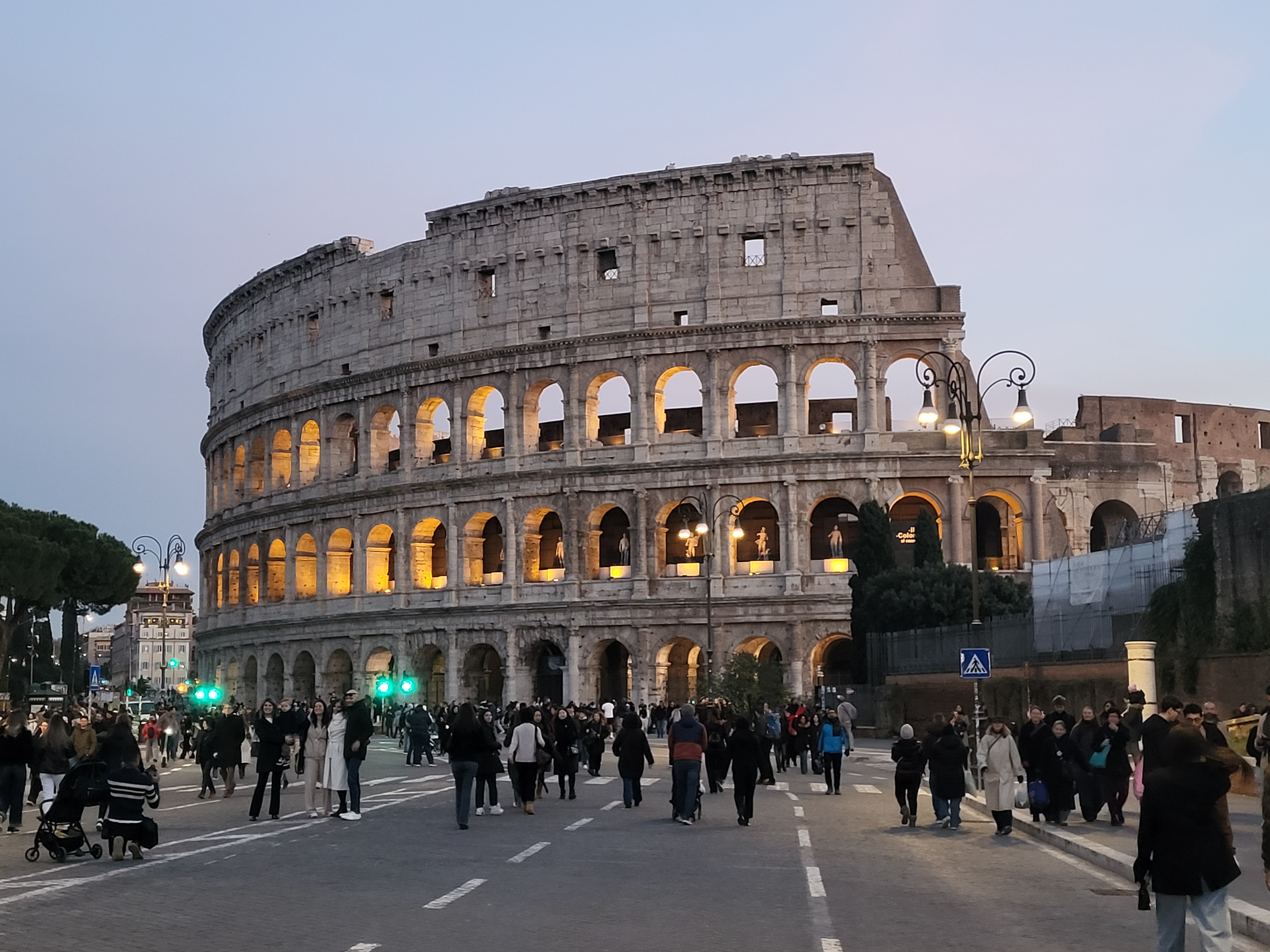
We walked down from the Forum and ended our day with an incredible view of the Colosseum, glowing softly in the fading light. The oldest standing amphitheater in the world, this iconic structure is undeniably beautiful — and carries with it a deeply grisly history.
Construction began in AD 72 under Emperor Vespasian and was completed in AD 80 by his successor, Titus. At its height, the Colosseum could hold between 50,000 and 80,000 spectators. It became infamous for public executions, animal hunts, gladiatorial combat, and elaborate reenactments of famous battles and mythological stories, all designed to entertain and impress the masses.
Though it has suffered significant damage over the centuries from earthquakes, stone robbing, and time itself, the Colosseum still stands in remarkable condition. Today, it remains one of the most recognizable symbols of Ancient Rome and is considered one of the New Seven Wonders of the World — a powerful reminder of both the grandeur and the brutality of the empire that built it.

This first taste of Rome was filled with iconic sights, breathtaking architecture, and a depth of history that’s almost impossible to fully comprehend. The city still intimidates me a little—even after being there—but that feeling is part of the awe and wonder of a place that has seen centuries rise up around it, and in many ways, because of it. Layers of history, innovation, and a deep human desire to be remembered have shaped Rome into what it is today. I’m grateful to have walked its streets and witnessed even a small piece of what makes this city so truly extraordinary.
If you enjoyed this, you may be interested in these other iconic cities in Europe:
Thanks for coming along on this visit to the Eternal City of Rome. May you build a life to be remembered.

Coming Up Next:
For More Information:
Read More From:
Follow along for more adventures near and far!


Leave a Reply to travelling_hanCancel reply