Content Note: The history shared in this post deals with difficult aspects of the American Civil War, including battle casualties, slavery, and the experiences of families caught in the conflict. While this post does not contain graphic descriptions, it does explore the human cost of war and may be more difficult to read.
The greatest education I’ve received about the American Civil War hasn’t come from a textbook. It has come from living in Tennessee and visiting the places where history unfolded. There is something different about standing in the fields, homes, and communities that experienced the conflict firsthand. The stories become more personal, the consequences more tangible, and the history far more complicated than the simplified versions often taught in school.
Tennessee offers a particularly unique perspective on the Civil War. As the last state to join the Confederacy and the first to rejoin the Union, Tennessee stood at the crossroads of competing loyalties and beliefs. Communities, neighbors, and even families found themselves divided by the conflict. Visiting historic sites throughout the state has given me a greater appreciation for the nuance and complexity of this period and the difficult realities faced by those who lived through it.
Few places illustrate those realities more clearly than Franklin. On November 30, 1864, what began as a confrontation between two armies became one of the bloodiest and most devastating battles of the war. In the span of a single evening, thousands of lives were forever changed. Today, sites like Carnton and the Carter House preserve the stories of that terrible night and the people who experienced it. Visiting them offers not only a lesson in military history, but also a powerful reminder of the human cost of war.
- The Battle of Franklin
- Touring the Carter House
- Carnton Farm and the Aftermath of Battle
- The McGavock Family Cemetery and Confederate Cemetery
- Preserving the Stories of Franklin
- Know Before You Go
Quick Facts: Carter House & Carnton
- Location: Franklin, Tennessee
- Sites: Carter House & Carnton Farm
- Historical Event: The Battle of Franklin (November 30, 1864)
- Tour Length: Half day
- Best For: Civil War history, Tennessee history, preservation sites


The Battle of Franklin
On November 30, 1864, the quiet town of Franklin became the setting for one of the bloodiest battles of the Civil War. As Union forces under Major General John Schofield retreated south toward Nashville, they paused in Franklin to repair bridges and prepare for the next stage of their withdrawal. Confederate General John Bell Hood, hoping to prevent the Union army from escaping, ordered a direct assault against the fortified Union position.
The attack began in the late afternoon and continued into the darkness. Confederate soldiers advanced across nearly two miles of open ground toward strong Union defensive works. What followed was a devastating five-hour battle that resulted in enormous casualties on both sides. More than 9,500 soldiers were killed, wounded, captured, or missing by the end of the night.
The Battle of Franklin is often remembered not only for its staggering losses but also for the number of Confederate generals who were killed or wounded during the fighting. The Confederate Army of Tennessee suffered losses from which it would never fully recover. While the Union army continued its retreat to Nashville, the Confederate defeat at Franklin helped set the stage for the decisive Union victory at the Battle of Nashville just two weeks later.
Today, visitors can still walk the ground where the battle unfolded. Sites such as the Carter House and Carnton preserve the stories of the soldiers, families, and townspeople whose lives were forever changed during one long and tragic night.


Touring the Carter House
Our visit began at the Carter House, which sat at the very center of some of the fiercest fighting during the Battle of Franklin. Before we even entered the house itself, our guide led us to a small office building on the property. At first glance it seemed unremarkable, but a closer look revealed hundreds of bullet holes still visible in the walls.
Standing in front of that building immediately changed my perspective on the battle. It is easy to read casualty numbers in a book or hear statistics about a conflict, but seeing the physical evidence still preserved nearly 160 years later made the violence of that night feel much more real. The bullets scarred the walls from every direction, a sobering reminder of just how intense the fighting became as Confederate and Union soldiers clashed around the property.

From there, we learned about the Carter family and their life in Franklin before the war arrived at their doorstep. As the battle approached on November 30, 1864, the family sought shelter in the basement of their home. Above them, thousands of soldiers fought across their fields and around their buildings. For hours, the sounds of gunfire, artillery, and shouting raged outside while the family waited in the darkness below.
One of the things I found most fascinating was how the Carter family reflected the complicated reality of Tennessee during the war. It can be tempting to think of the Civil War as a simple division between North and South, Union and Confederate. But families were often far more divided than that. Within the Carter family itself were differing opinions about the conflict and children who would ultimately serve on opposite sides. Their story mirrors the experience of Tennessee as a whole—a state caught between loyalties and identities during a deeply turbulent time.
The tour also did not shy away from discussing the enslaved people who lived and worked on the property. One detail that especially stayed with me was learning that Union lines were only about a mile away. Freedom was, in many ways, physically close. Yet the decision to leave was far more complicated than simply crossing a line on a map. Family ties, uncertainty about what awaited them, concerns for loved ones, and the dangers of wartime all shaped the choices people made. It was another reminder that history is often far more complex than it first appears.


Walking through the house today, it is difficult to imagine the fear and uncertainty they must have felt. The home is beautifully preserved, but the story it tells is not one of grand military strategy. Instead, it is the story of an ordinary family caught in the path of extraordinary events. The Carter House serves as a powerful reminder that battles are not only fought by armies. They are also experienced by the civilians whose homes and lives are forever changed by them.
Carnton Farm and the Aftermath of Battle
If the Carter House tells the story of the battle itself, Carnton tells the story of what came after.
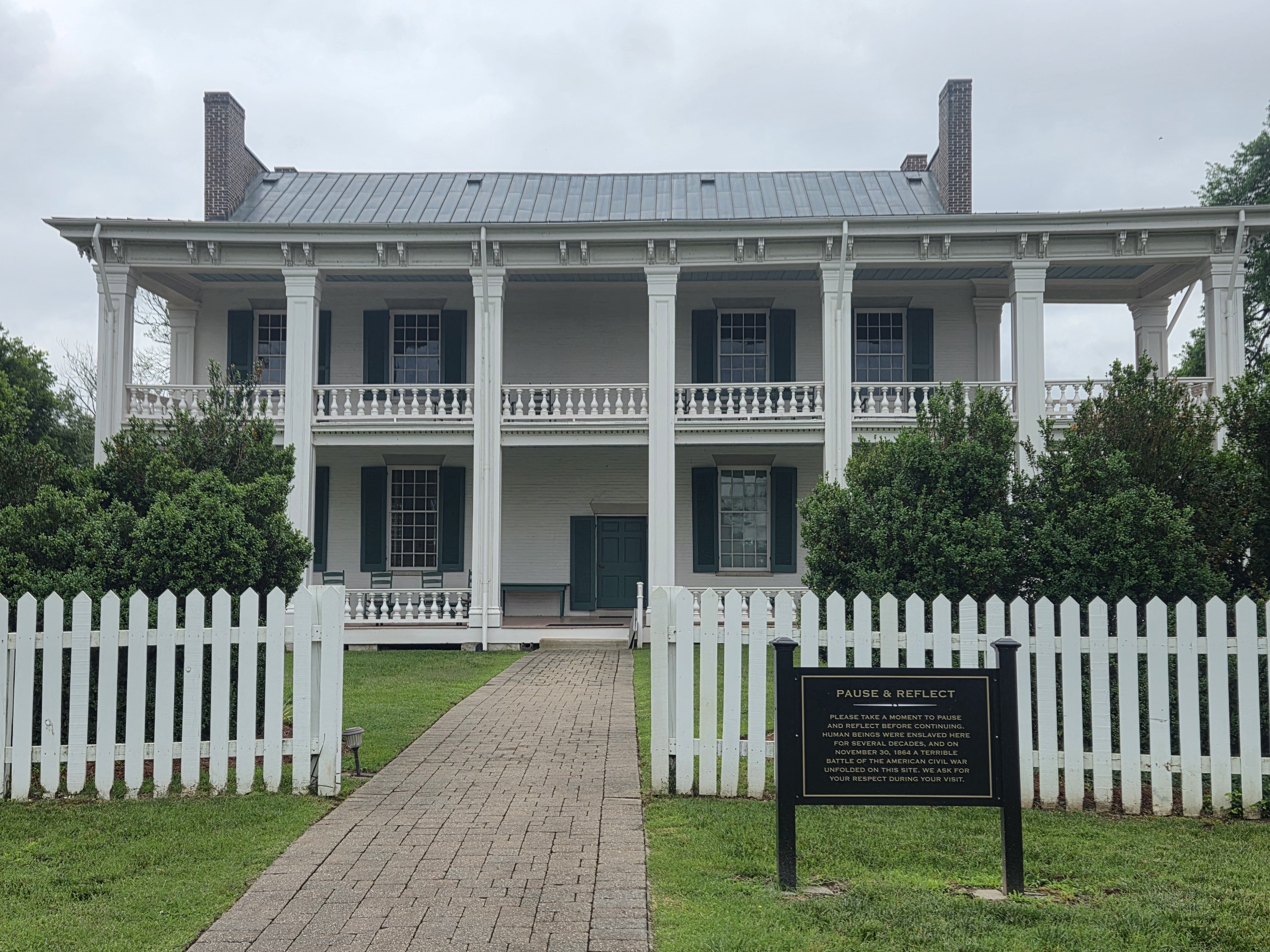
Even before entering the property, visitors are greeted by a sign asking them to pause and reflect on the people who lived here, worked here, fought here, and were treated here. It is a simple request, but an important one. Before seeing any artifacts or hearing any stories, it encourages visitors to remember that this was first a home and a workplace before it became part of one of the bloodiest battles of the Civil War.

As the wounded poured in following the Battle of Franklin, Carnton was transformed into the largest field hospital in the area. The family living there had only a short warning of about fifteen minutes to prepare. Furniture was hastily moved, rooms were cleared, and the home was suddenly filled with wounded Confederate soldiers. The family found themselves thrust into the middle of a tragedy they had no power to stop. They tore sheets into bandages, carried water, and did whatever they could to help the injured men who filled nearly every available space.
Walking through the house today, the reminders of those events are still visible. Each room bears evidence of the role it played during those desperate hours and days following the battle. This was not a hospital designed for war. It was a family home. The rooms where people gathered, celebrated, and lived their daily lives suddenly became places of suffering, surgery, and death.
It is difficult to imagine the trauma of witnessing such scenes unfold around you. The family had no choice but to adapt as thousands of lives were forever altered on their doorstep. Standing in those rooms, I found myself thinking about the ordinary people who were forced to confront the horrors of war in the most personal way possible.
The McGavock Family Cemetery and Confederate Cemetery
One of the most moving parts of our visit was the cemetery behind Carnton. The small McGavock family cemetery was already on the property before the battle, but in the years afterward it became something much larger.
Following the Battle of Franklin, thousands of Confederate soldiers were buried in hastily dug graves across the battlefield. Many lay where they had fallen, while others were buried in temporary locations. Unlike Union soldiers, whose remains would eventually be reinterred with military honors at the national cemetery in Murfreesboro, there was no organized effort to gather and care for the Confederate dead.
That reality changed because of the determination of local citizens and preservation efforts. The McGavock family offered land adjacent to their family cemetery, and volunteers worked to identify, recover, and rebury the Confederate soldiers who had been scattered across the battlefield. Their efforts created what is now one of the largest private Confederate cemeteries in the United States.

Walking among the rows of markers today is a sobering experience. The cemetery is quiet and beautifully maintained, but it is impossible not to think about the lives represented there. Many of the soldiers were far from home when they died. Some were identified and returned to rest beside men from their home states, while others remained unknown.
What struck me most was not simply the size of the cemetery, but the care that went into creating it. The battle ended in a single night, but the work of recovering the dead and preserving their stories continued for years afterward. Standing among the graves, I found myself reflecting on the people who chose to take on that responsibility and the generations who have continued the work of preservation. Their efforts ensure that the human cost of the Battle of Franklin is not forgotten.
Preserving the Stories of Franklin
One of the most encouraging parts of our visit was learning that these historic sites almost did not survive. As ownership passed from the families who lived here, development slowly began to change the landscape. New buildings and businesses were constructed on portions of the battlefield, and for a time it seemed possible that important pieces of this history would be lost beneath the growth of a modern city.
Fortunately, preservationists recognized the significance of these places and began the long work of protecting them. Our guide shared stories of how land was purchased, modern buildings were removed, and efforts were made to restore portions of the battlefield to better reflect how it looked in 1864. Standing on these grounds today, it is difficult to imagine that some of the open spaces were once covered by commercial development.
That preservation is about far more than saving old buildings. It is about protecting the stories connected to them. Historians, archaeologists, volunteers, and researchers continue to study the Battle of Franklin and the people whose lives were touched by it. New discoveries are still being made about the soldiers who fought here, the families who sheltered in these homes, the enslaved people who lived and worked on these properties, and the ways the events of that single night shaped the years that followed.
Visiting the Carter House and Carnton is a reminder that history is not a finished story. It is an ongoing effort to understand the past more completely. Thanks to the work of preservation organizations and researchers, future generations will have the opportunity to stand in these same places, ask new questions, understand more deeply, and continue learning from the people who experienced one of the most devastating nights of the Civil War.


Know Before You Go
- Plan for several hours. To fully experience both the Carter House and Carnton, allow at least 3-4 hours for guided tours and time to explore the grounds and cemetery.
- Take the guided tours. The stories shared by the guides add tremendous depth and context that would be easy to miss when visiting on your own.
- Photography is not permitted inside the houses. Visitors are welcome to take photos of the grounds and exterior buildings, but photography is prohibited inside both the Carter House and Carnton.
- Prepare for a heavy topic. These sites deal with difficult aspects of the Civil War, including battle casualties, slavery, and the experiences of civilians caught in the conflict. The tours are thoughtful and respectful, but the subject matter can be emotionally challenging.
- Visit both sites for the full story. The Carter House helps visitors understand the battle itself, while Carnton tells the story of the wounded, the aftermath, and the lasting impact on the community.
- Spend time in the cemetery. The McGavock Family Cemetery and Confederate Cemetery are among the most moving parts of the experience and provide an important perspective on the human cost of the battle.
- Wear comfortable shoes. While the sites are not large, there is walking between buildings, across the grounds, and through the cemetery.
- Check tour schedules in advance. Guided tours operate at specfic times and may vary throughout the year.
Visiting the Carter House and Carnton was far more than a lesson in military history. It was an opportunity to see the Civil War through the lives of the people who experienced it—the families caught between armies, the enslaved people navigating an uncertain future, the soldiers who fought and died, and the communities left to care for the wounded and remember the fallen.
Places like these remind us that history is rarely as simple as we want it to be. Here in Tennessee, where loyalties were often divided and the lines between North and South were not always clear, the stories are filled with nuance, contradiction, and humanity.
Standing in the rooms where families sheltered, walking among the graves of those who never went home, and hearing the stories preserved here left me with a deeper understanding not just of the Battle of Franklin, but of the profound human cost of war. These sites are difficult to visit at times, but they are also important ones, preserving the stories of a single devastating night and the people whose lives were forever changed by it.
The more we explore Tennessee, the more we discover how deeply history is woven into the landscapes, communities, and stories that still shape the state today.
Thank you for coming along on this visit to learn about the Battle of Franklin and preserving the stories of those who were there. May we always pause and reflect on moments of history.

Upcoming Destination:
Philadelphia
Read More From:
Follow along for more adventures near and far!


Leave a Reply