During a visit to Indiana to spend time with friends, they asked us what we most wanted to see while we were there. Without hesitation, one of the top choices was touring the Kokomo Opalescent Glass factory. Kokomo Opalescent Glass is considered the oldest art glass company in the United States.
I have always loved the artistry of stained glass. There is something mesmerizing about the way light passes through the colors, transforming ordinary windows into something glowing and alive. Churches, historic buildings, and old homes filled with stained glass have always drawn my attention, but I had never really stopped to think about how the glass itself was actually made.
That is what made visiting Kokomo Opalescent Glass so fascinating.
Stepping inside the factory, it quickly became clear that creating stained glass is far more physical and industrial than I had imagined. The heat, noise, dust, and sheer labor involved stood in sharp contrast to the delicate beauty of the finished pieces. It was amazing to watch something so artistic emerge from work that was simultaneously so hard, gritty, and precise.
And somehow, that contrast only made the finished glass feel even more beautiful.
- A Legacy of American Glass Making
- Inside the Factory
- Rooms of Color
- The Rainbow Room
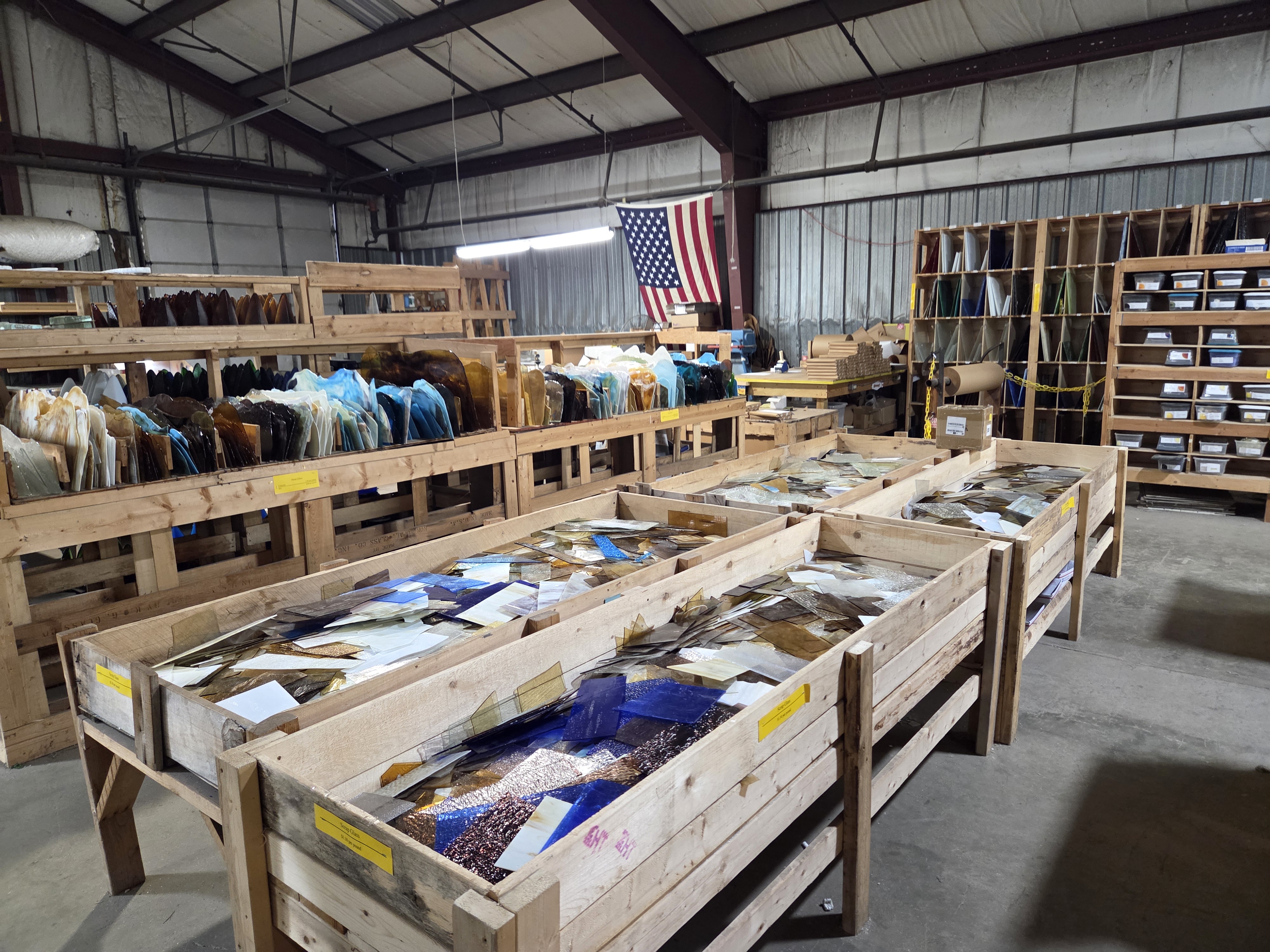
- The Most Beautiful Junk Pile
- Shipping Glass Around the World
- The Artists’ Studio
- Know Before You Go: Kokomo Opalescent Glass


A Legacy of American Glass Making
Part of what makes visiting Kokomo Opalescent Glass so interesting is the incredible history behind the company itself.
The factory was founded in the late 1800s after its founder moved from New York to Indiana during a time when land opportunities were drawing people westward. What began as a glass company eventually became something much more influential in the world of stained glass artistry.
Kokomo Opalescent Glass is considered the oldest art glass company in the United States and became known for developing a new style of opalescent glass that transformed stained glass design in America.
Perhaps most famously, the company received the first stained glass order placed by the legendary Tiffany Studios. Knowing that artists and craftsmen here helped supply glass for some of the most famous stained glass creations in the country made walking through the factory feel even more special.
The history adds another layer to the experience because this is not simply a demonstration space created for tourists. It is an active working factory where generations of craftsmanship, experimentation, and artistry have continued for well over a century.


Inside the Factory
As soon as we stepped into the factory floor at Kokomo Opalescent Glass, we were immediately hit by the intense heat pouring from the rows of blazing furnaces.
The air inside felt heavy and hot, carrying the smell of heated minerals and machinery while the constant sounds of metal, movement, and shifting glass echoed throughout the building. Along the factory floor stood large ovens, each glowing with a different color of molten glass inside. Reds, blues, greens, and amber tones waited in separate furnaces, each one heated to incredible temperatures.
Our guide pointed out one of the original ovens once used by the company—an enormous structure capable of holding twelve different colors at the same time. While impressive, the system eventually proved too risky for the equipment, and the factory later transitioned to individual furnaces for each color instead.

Watching the glassmaking process unfold was fascinating.
Workers moved carefully but efficiently through the heat, scooping massive amounts of molten glass from the furnaces and carrying it across the factory floor to the pressing tables. The glowing glass almost looked like thick honey as it poured and stretched from the containers.
At the press, colors were mixed together by hand and spread across large metal slabs where the patterns and swirls that make stained glass so distinctive began to take shape. As the sheets moved through the machinery, the glass slowly cooled, flattened, and transformed from something fiery and liquid into the delicate colorful panels that would later become windows, lamps, and artwork.


Seeing the process firsthand made the artistry of stained glass feel even more impressive. Every finished piece begins here in heat, noise, and exhausting physical labor before eventually becoming something people admire for its beauty and light.
Rooms of Color
In the next room, the atmosphere shifted from roaring heat and machinery to something that felt almost like stepping inside an artist’s palette on an industrial scale.
Rows and rows of barrels lined the space, each one filled with broken pieces of colored glass waiting to be melted down and used again in future creations. Looking across the room, it felt impossible not to stop and stare at the sheer range of colors.


Some barrels held warm amber tones that seemed to glow even without light shining through them. Others were filled with brilliant greens, deep ruby reds, cobalt blues, and chunky fragments of turquoise that looked almost like scattered gemstones. The pieces varied in size and shape, rough edged and imperfect, but beautiful all the same.
We found ourselves especially drawn to the amber glass, the vivid greens, the chunky turquoise pieces, and the dark reds stacked inside the barrels.


There was something oddly satisfying about seeing these fragments waiting for a second life. What looked at first like leftover scraps were actually part of the ongoing cycle of creation inside the factory—glass broken down, melted again, and transformed into something entirely new.
After watching the intense labor of the furnace room, this space offered another reminder that stained glass is not only about finished beauty, but about color itself—handled, stored, recycled, and carefully shaped long before it ever catches sunlight in a finished window.
The Rainbow Room
From there, we moved into another section of the factory where rows upon rows of finished glass sheets were carefully organized by size, color, and texture. Towering racks stretched through the room, each one holding delicate panels waiting to be shipped off to artists, churches, studios, and restoration projects around the country.
Some sheets were smooth and translucent while others were rippled, marbled, or heavily textured, designed to catch and scatter light in completely different ways. Walking past them felt a little like walking through a library made entirely of color.


One especially massive room held the largest pieces of finished glass. Inside, enormous sheets stood side by side in towering rows of reds, blues, greens, golds, and swirling opalescent patterns. The employees affectionately referred to it as the “Rainbow Room,” and the name fit perfectly.
Even from a distance, the room was stunning.
Our guide explained that visitors once used to walk directly through the aisles to get a closer look at the glass. But after one visitor casually leaned against a rack and accidentally created a domino effect of falling glass—causing roughly $60,000 worth of damage—the tour route changed permanently.
Now visitors admire the Rainbow Room safely from one end of the space.

Honestly, after seeing how massive yet fragile the sheets were, it was easy to understand why. The room carried this strange balance of industrial storage and delicate artistry at the same time. Every sheet represented hours of labor, heat, color mixing, and craftsmanship, all standing quietly together in rows of glowing color.
The Most Beautiful Junk Pile
Outside the factory sat another area filled with what, at first glance, looked like enormous piles of colorful rubble.
But even the discarded glass at Kokomo Opalescent Glass was beautiful.
The heaps were made up of broken fragments considered either too imperfect or too small to be reused in the regular production process. Piles of shattered reds, greens, blues, amber tones, and milky opalescent pieces glittered in the sunlight like giant gemstone fields scattered across the ground. It was impossible not to stop and stare.


Our guide explained that once each year the company opens this area to the public, allowing visitors to arrive with buckets, rakes, and containers to gather as much discarded glass as they would like for only about a dollar per pound.
The idea of people enthusiastically digging through piles of broken glass somehow felt perfectly fitting for a place like this.
Artists, hobbyists, and stained glass enthusiasts come searching for unusual colors, textures, and fragments that can still be transformed into something beautiful. Standing there looking over the shimmering piles, it was easy to understand the appeal.
Honestly, it may have been the most beautiful junk pile I have ever seen. Even the scraps here still carried color, light, and possibility.
Shipping Glass Around the World
One of the final stops on the tour was the shipping department, where finished sheets of glass are carefully prepared to be sent to customers all over the world.
After seeing the intense heat, heavy labor, and delicate artistry involved in creating the glass, it was fascinating to realize how much care must also go into simply getting the finished pieces safely to their destination.
At Kokomo Opalescent Glass, the team builds many of their own custom shipping crates designed specifically to protect the fragile glass during transport. Each sheet is packed and handled with incredible care before making its journey to artists, restoration projects, churches, and studios across the country and beyond.


Our guide proudly explained that despite shipping such large and delicate pieces worldwide, the company maintains an impressively low rate of breakage. And honestly, after seeing the towering sheets of finished glass ourselves, that felt pretty remarkable.
It was another reminder that every stage of the process—from the molten furnaces to the shipping crates—requires precision, patience, and craftsmanship. Even getting the glass safely out the door is treated as part of the art itself.
The Artists’ Studio
The tour ended in one of the most fitting places possible—the artists’ studio.
After spending the afternoon watching molten glass poured from blazing furnaces, stacked in towering rainbow-colored rows, and carefully packed for shipment around the world, it was wonderful to finally see the place where those sheets of glass become finished works of art.
The studio space was filled with projects in various stages of completion. Some artists were creating entirely new stained glass pieces while others carefully restored older works that had been sent in for repair and preservation. Seeing the craftsmanship up close gave an even greater appreciation for how much patience and precision stained glass work requires.
There was something quieter about this room compared to the intensity of the factory floor. Instead of roaring furnaces and heavy machinery, the studio felt focused and creative—a place where all the hard industrial labor finally transformed into artistry.

Our guide explained that Kokomo Opalescent Glass also offers classes where visitors can learn stained glass techniques for themselves.
By the end of the tour, we were already saying that we would absolutely love to come back someday and try one of the classes ourselves.
After seeing the incredible process behind every sheet of glass, it felt impossible not to leave inspired by the artistry, craftsmanship, and history that fill every corner of the factory.
Know Before You Go: Kokomo Opalescent Glass
- Tickets: Tour Tickets can be purchased on-site at the factory
- Footwear Requirement: All visitors are required to wear closed-toed shoes during the tour
- Eye Protection: Prescription glasses or the factory’s provided safety glasses must be worn at all times while on the factory floor.
- Tour Environment: The factory can be extremely warm due to the heat from the furnaces, so lightweight clothing and water are helpful.
- Photography: Be prepared for colorful photo opportunities throughout the factory, especially in the famous ‘Rainbow Room’.
- Best Part of the Tour: Watching molten glass transformed into finished sheets of stained glass in real time.


Leaving Kokomo Opalescent Glass, it was impossible not to look at stained glass differently. What once felt like something simply beautiful to admire in churches, windows, and historic buildings now carried an entirely new weight. We had seen the heat, the effort, the precision, and the patience behind every sheet of glass, and it made the final product feel even more extraordinary.
There is something remarkable about a place where raw materials are transformed—through fire and craftsmanship—into something that eventually fills the world with color and light.
If you are interested in other artisan kind of places, then you may be interested in these:
Lowe Mill Arts & Entertainment, Alabama
Thanks for coming along on this tour through the Kokomo Opalescent Glass company. May the hard work of today give you the beautiful things of tomorrow.

Coming Up Next:
For More Information:
Read More From:
Follow along for more adventures near and far!


Leave a Reply