After spending a day walking through the streets of Philadelphia and standing in the places where the American Revolution was debated and the country began to take shape, we weren’t quite finished with Revolutionary history. Our next stop was Valley Forge.
We spent hours here, and I’m glad we did. Valley Forge isn’t a place that feels like something you can simply drive through, snap a few pictures, and check off a list. The more time we spent moving through the park, the more the story seemed to settle in. We started at the visitor center, where we watched the introductory film and learned more about what happened during the winter encampment of the Continental Army.
Then we set out to explore the park itself. The weather happened to be cloudy and a little gray that day, and somehow it seemed fitting. There was something about the muted sky and the quiet landscape that made it easier to imagine this place as it must have felt during that difficult winter.
We drove the park’s loop, stopping at the places that told pieces of the story: the soldiers’ huts, brigade markers and monuments, the National Memorial Arch, Washington’s Headquarters, and the statue of Washington overlooking the valley. Some stops gave us history. Others gave us perspective. And one, in particular, gave me a reason to stop and think about the person at the center of it all.
After spending the previous day in Philadelphia, Valley Forge felt like the natural next chapter. In Philadelphia, we had stood in the rooms where the Revolution’s ideas were debated. At Valley Forge, we could see what those ideas demanded from the people who had to fight for them.
Valley Forge
- Understanding the Winter at Valley Forge
- The Soldiers Huts
- Remembering the Brigades of the Continental Army
- The National Memorial Arch
- George Washington’s Headquarters
- Looking Out Over the Valley
- Valley Forge Was More Than a Winter Camp
- Planning Your Visit to Valley Forge National Historical Park


Understanding the Winter at Valley Forge
Valley Forge was the site of the Continental Army’s winter encampment from December 19, 1777, until June 19, 1778.
More than 12,000 soldiers and hundreds of civilians arrived at Valley Forge in December 1777. They built an enormous military camp, including more than 1,500 log huts and miles of fortifications. The encampment eventually became essentially the fourth-largest city in the American colonies at the time.
But the numbers don’t really tell you what it was like to live there. That became much easier to understand once we started seeing the places where the soldiers actually lived.
Today, the landscape is surprisingly peaceful. Rolling hills, open fields, trees, and quiet roads make it easy to forget that this was once a massive military encampment. That contrast made our visit even more striking. The same hills that now feel calm once held thousands of soldiers…

The Soldiers Huts
One of the first things that struck us was the soldiers’ huts. From the outside, they don’t look particularly large. Then you learn that a typical enlisted men’s hut housed a squad of up to twelve soldiers- twelve men, in a hut measuring roughly 14 by 16 feet. Suddenly, the little log cabin feels very different.
The huts were built to provide shelter during the winter, and they were certainly better than having no shelter at all. But standing there and imagining twelve people sharing that small space made the physical reality of the encampment much easier to grasp.
These weren’t abstract numbers in a history book. They were people who were cold, hungry, sick, tired, and trying to live together in an incredibly difficult situation. And they were expected to keep going.
At Muhlenberg’s Brigade, we could walk among reconstructed soldiers’ huts and see the layout of the encampment. The site includes nine reconstructed huts along a gravel company street, along with a reconstructed redoubt. Walking through the rows made the scale of the encampment feel much more real.

Remembering the Brigades of the Continental Army
As we continued around the park, we saw monuments and plaques commemorating the different brigades of the Continental Army that had been stationed at Valley Forge. I liked these small markers because they kept bringing the story back to the people who actually made up the army.
It would be easy to remember Valley Forge simply as a story about George Washington. But thousands of people experienced this place. They built the huts. They endured the winter. They drilled and trained. They became sick. They struggled with shortages. They waited. And eventually, they marched away.
The National Park Service describes the Valley Forge encampment as a diverse community that included soldiers, civilians, women and children, free and enslaved African Americans, Indigenous people, European immigrants, and people of different religions and backgrounds.
The plaques and monuments throughout the park helped us remember that this wasn’t just the setting for one famous person. It was a place inhabited by thousands of people whose experiences became part of the larger story of the Revolution.

The National Memorial Arch
The National Memorial Arch was another stop that made the scale of the story feel bigger. The arch stands as a monument to the Continental Army and its time at Valley Forge, but seeing it in the landscape was more meaningful after we’d already spent time learning about the encampment.
By then, we weren’t just looking at a monument. We had walked among the huts. We had seen the locations of the brigades. We had started to understand what those six months represented. The arch became another marker of the army’s endurance and of what eventually came after Valley Forge.

George Washington’s Headquarters
I was especially looking forward to seeing Washington’s Headquarters. Unfortunately, when we visited, the building was covered in scaffolding while restoration work was underway. So this was one of the few moments when Valley Forge didn’t quite live up to what we’d hoped to see.
The Isaac Potts House served as Washington’s headquarters during the winter encampment, making it one of the park’s most significant historic buildings. Still, even though we couldn’t experience the building the way we had imagined, its presence was a reminder of the role Washington played here.
And that led us to one of my favorite moments of the entire visit.

Looking Out Over the Valley
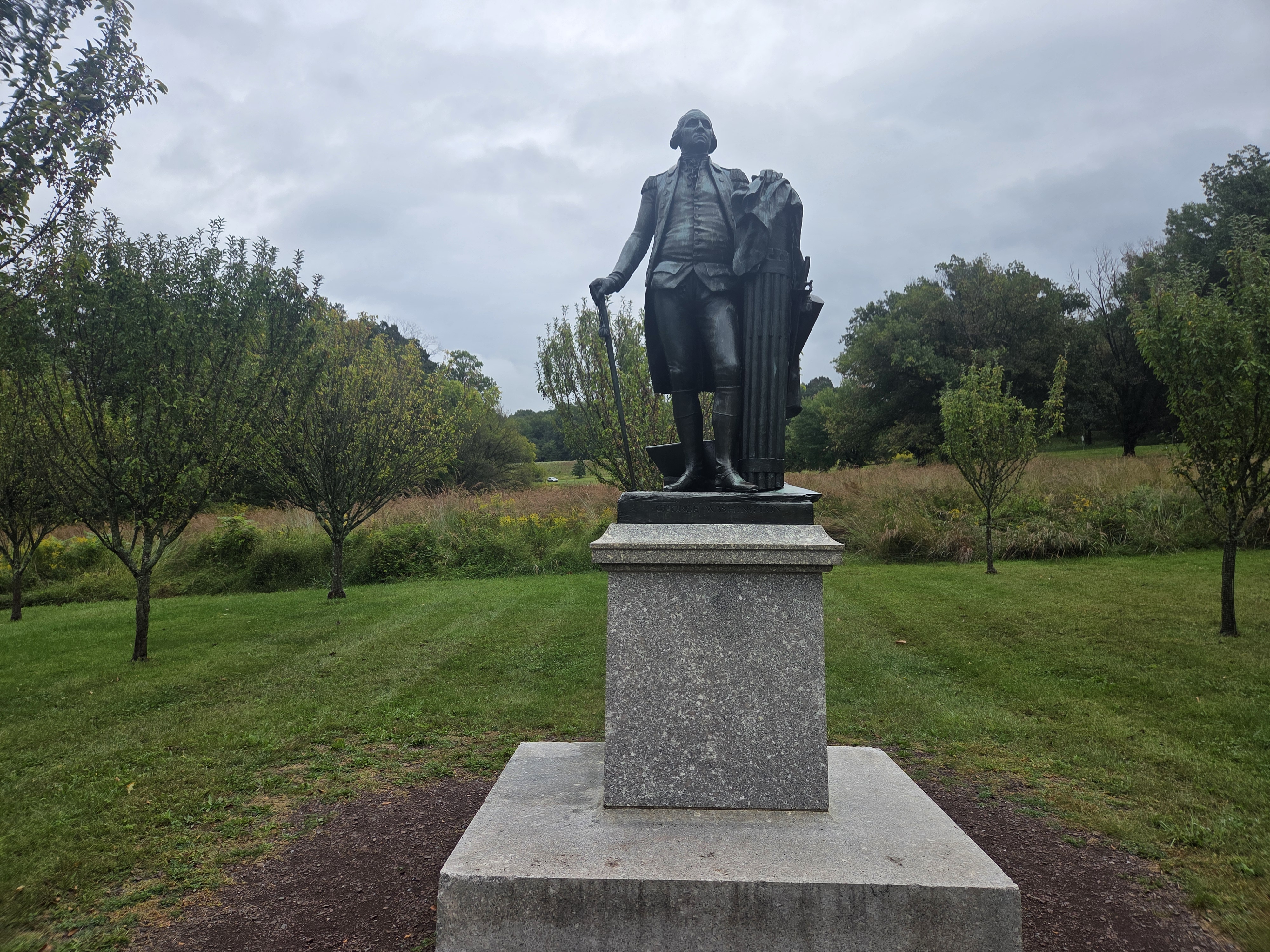
Near Washington’s Headquarters stands a statue of George Washington looking out over the landscape. We stopped there for a while. The statue itself is a bronze replica of the famous statue by Jean-Antoine Houdon, and the Valley Forge copy was created in 1932.
But I didn’t spend much time thinking about the history of the statue- I was thinking about the man. Standing there and looking out over the valley, I couldn’t help but wonder what Washington must have carried with him during that winter.
He wasn’t simply responsible for his own survival. He was responsible for an army. These were people who were struggling with shortages, illness, hunger, and brutal conditions. And beyond the people physically gathered at Valley Forge was an entire revolution whose future was uncertain.
There was no guarantee that the cause would succeed. There was no guarantee that the army would survive. There was no guarantee that the sacrifices being made would lead to the country they were hoping to create. And yet Washington stayed. He continued to lead and he continued to serve.
That moment made me think about what it takes to answer a call to leadership when you don’t know how the story will end. Washington couldn’t see the future from that hillside. He couldn’t know whether the Revolution would succeed. He could only decide what he was willing to do in the middle of the uncertainty.
And for me, that statue became one of the most powerful moments of our entire Pennsylvania trip.

Valley Forge Was More Than a Winter Camp
One of the things I appreciated most about Valley Forge was that the story doesn’t end with suffering. The six-month encampment was difficult, but it was also a period of transformation. The Continental Army trained, reorganized, and became a more disciplined fighting force. When the army left Valley Forge on June 19, 1778, it marched toward another season of fighting, including the coming Battle of Monmouth.
That makes Valley Forge feel less like a story about defeat and more like a story about endurance and preparation. The army arrived tired and struggling. It left changed. And walking through the park, I found myself thinking less about the famous battles of the Revolution and more about the quieter moments in between them—the months of waiting, working, training, building, enduring, and deciding to keep going.

Planning Your Visit to Valley Forge National Historical Park
Valley Forge is much larger than a single historic building or monument, so give yourself time to explore.
The park’s Encampment Tour is a 10-mile driving loop with nine major stops, along with additional monuments, statues, and historic sites. The National Park Service notes that driving the route can take anywhere from about 20 minutes to two or three hours depending on how often you stop.
Start at the Visitor Center
I highly recommend beginning at the visitor center. The museum exhibits help introduce the story of the encampment before you head out into the park, and the free orientation film gives useful context for what you’re about to see. The film is currently shown every half hour beginning at 9:30 a.m., with the last showing at 4:30 p.m.
Drive, Walk, Bike, or Take the Trolley
You don’t have to experience Valley Forge from a car. The park offers a number of ways to explore, including the self-guided driving loop, hiking and biking opportunities, and seasonal bicycle rentals. Ninety-minute trolley tours also leave from the visitor center on scheduled dates. For our visit, driving worked well because we wanted to see several areas of the park without rushing. If you have more time, walking or biking would allow you to experience more of the landscape at a slower pace.
Give Yourself More Time Than You Think
We spent hours at Valley Forge, and I wouldn’t want to have experienced it any other way. There is a lot to see, and the story becomes more meaningful as you move from the visitor center to the huts, monuments, brigade sites, and headquarters area. If you’re visiting as part of a larger Philadelphia trip, resist the temptation to treat Valley Forge as a quick stop. It’s worth giving it room.
Know Before You Go
Valley Forge National Historical Park is open year-round, the grounds are open from 7 a.m. until dark, and there is no entrance fee. The park encompasses roughly 3,500 acres and has about 35 miles of trails.
One important current note: Washington’s Headquarters is closed for a restoration project that began in May 2026 and is expected to remain closed until 2027. A virtual tour is available through the National Park Service while the work is underway.
Check the official NPS website before your visit for current building hours, trolley schedules, ranger programs, trail conditions, and any temporary closures.

I expected Valley Forge to be an important historical stop. I didn’t necessarily expect it to be such a reflective one. Maybe it was the gray sky that day. Maybe it was standing inside the small soldiers’ huts and realizing how many people had shared those spaces. Maybe it was seeing the names of the brigades scattered throughout the landscape.
Or maybe it was simply standing beneath Washington’s gaze and thinking about the weight of being asked to lead when you don’t know whether the thing you’re fighting for will ever become reality.
Valley Forge didn’t give us another grand moment like standing inside Independence Hall. It gave us something quieter. A chance to walk through the landscape, slow down, and think about the people who had once stood there wondering what would happen next. And sometimes, those are the historical places that stay with you the longest.
If you enjoyed this post, follow along on the other places we visited on this Pennsylvania weekend:
A Day in Philadelphia
Exploring Bucks County
Bethlehem Steel Stacks (coming soon)
Thanks for coming along on this visit to Valley Forge National Historical Park. May you reflect on the weight carried during a time of uncertain change.

Coming Up Next:
Bethlehem Steel Stacks
For More Information:
Read More From:
Follow along for more adventures near and far!


Leave a Reply