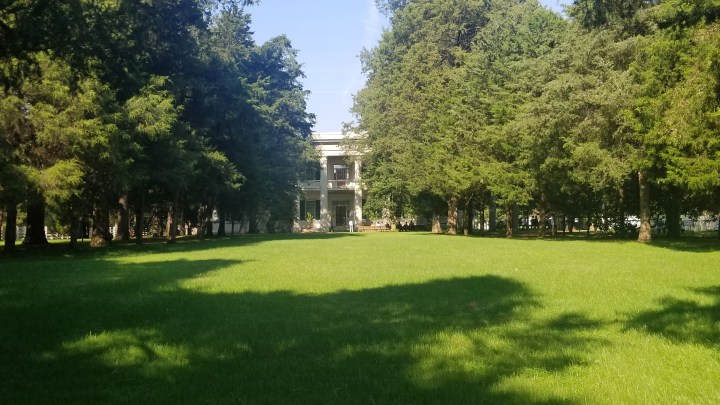
Just outside Nashville, Tennessee, sits The Hermitage, the former home of Andrew Jackson, America’s seventh president. With its stately white columns, sweeping lawns, beautiful gardens, and historic buildings, it’s easy to see why the estate attracts visitors interested in American history. But behind the elegance of the mansion lies a much more complicated story.
We spent the day exploring the house and grounds, walking through the gardens, visiting the family cemetery, and learning about the people who lived and worked on the plantation. The Hermitage offers a glimpse into the life of one of America’s most influential presidents, but it also raises questions about the people whose lives were shaped by his decisions and the wealth he accumulated.
A visit here is more than a chance to tour a historic mansion. It’s an opportunity to explore the contradictions of early American history and consider the many lives that made up this remarkable place.
The Hermitage
- Walking Through Andrew Jackson’s Home
- The Gardens and the Family Cemetery
- Beyond the Mansion: The Enslaved Community
- Alfred Jackson: A Life Connected to the Hermitage
- Understanding Andrew Jackson’s Legacy
- Why the Hermitage is Worth Visiting
- Know Before You Go: The Hermitage


Walking Through Andrew Jackson’s Home
Our visit began at the visitor center, where we purchased tickets for the mansion and grounds. From there, we made our way across the sweeping green lawn toward the house. Standing in front of the white mansion, with its tall columns and deep green shutters, it was easy to understand why the property has become one of Nashville’s most recognizable historic landmarks.
The mansion looks much as it did during Jackson’s lifetime, although it has undergone extensive restoration. Its elegant architecture and carefully preserved rooms offer a glimpse into the life of a wealthy nineteenth-century family. We joined a guided tour led by an interpreter dressed in period clothing and made our way through the rooms, each offering another glimpse into the Jackson family’s life.
Before the mansion was built, the family lived in a much simpler log home on the property. As Jackson’s military and political careers progressed, so did his wealth and the scale of his estate. The house we see today reflects that transformation, as well as the prosperity of a plantation sustained by enslaved labor.
Walking through the rooms, I found myself thinking about how different everyday life must have been during Jackson’s time. The furniture, furnishings, and architecture provide a tangible connection to the past, making the history feel much closer than it does when reading about it in a book.
But the mansion is only one part of the story. To understand The Hermitage, it’s important to step beyond its elegant rooms and explore the grounds surrounding it.

The Gardens and the Family Cemetery
One of my favorite parts of visiting The Hermitage was wandering through the garden. Located just beyond the mansion, the garden offers a peaceful contrast to the grand house, with winding pathways, shady trees, open spaces, and inviting places to pause.
The garden was a place Rachel Jackson particularly enjoyed, and it remains one of the loveliest parts of the estate. As we walked along the paths, I found myself imagining what it must have been like for the Jackson family to spend their afternoons here. It’s easy to see the appeal of having such a beautiful space just steps from home, particularly in a time when gardens and ornamental landscaping were luxuries associated with wealth.
We enjoyed exploring the paths and the quiet corners of the garden. It was one of those places where I could easily imagine spending an afternoon, simply wandering beneath the trees and enjoying the surroundings.
At the far end of the garden is the Jackson family cemetery, where Andrew and Rachel Jackson are buried, along with other members of their family. Their graves are enclosed by an elaborate stone structure, with a gazebo-like design that makes the cemetery a distinctive feature of the grounds.
Rachel died shortly after Andrew Jackson won the presidency in 1828 and never saw him take office. Her death deeply affected him. The story of their relationship adds a personal dimension to the history of the estate, reminding visitors that the people who lived here experienced the same grief and loss that shape families today.
The cemetery is a quiet place to pause and reflect. Yet even here, the story of The Hermitage extends beyond the Jackson family. The nearby graves of people who once lived and worked on the estate remind visitors that many others are part of its history.


Beyond the Mansion: The Enslaved Community
After exploring the mansion and garden, we followed a dirt path along the creek toward the area where enslaved people once lived. The modest wooden cabins we had imagined from the historical descriptions were no longer standing, leaving the landscape to tell only part of the story.
It was a striking contrast to the beautiful mansion we had just toured. The Jackson family lived in comfort, surrounded by expansive grounds and carefully maintained gardens, while the people whose forced labor sustained the plantation lived under very different circumstances.
Andrew Jackson enslaved people throughout much of his adult life. By the time he died in 1845, approximately 150 people were enslaved by him, and the Jackson family had enslaved at least 325 men, women, and children over the course of its history. Their labor extended far beyond agricultural work. Enslaved people cooked, cleaned, cared for horses, maintained equipment, raised children, and performed the many tasks necessary to operate the estate.
The people who lived here also had families, skills, traditions, and lives of their own. Their experiences were shaped by the constant threat of being sold or separated from loved ones, and their work helped make the mansion and the plantation what they were.
Walking through the grounds, I found it difficult not to think about the contrast between the lives represented by the mansion and those represented by the quarters. The wealth and comfort of one depended on the forced labor of the other.
Today, archaeological discoveries, historical documents, and interpretive exhibits help bring more of these stories to light. Although many individual experiences remain unknown, the people who lived here deserve to be recognized as an essential part of The Hermitage’s history.

Alfred Jackson: A Life Connected to the Hermitage
One of the most memorable stories associated with The Hermitage is that of Alfred Jackson, whose life was closely tied to the estate for nearly nine decades.
Alfred was born into slavery around 1812 and spent his early life working at The Hermitage. His responsibilities included caring for horses, maintaining wagons and farm equipment, and driving wagons. After emancipation, he remained on the property as a freedman, becoming a tenant farmer and working as a handyman.
When The Hermitage opened to the public as a museum in 1889, Alfred became one of its earliest tour guides. He shared his knowledge of the property with visitors and helped preserve the connection between the historic home and the people who had lived there.
His story is especially significant because it offers a glimpse into the lives of people whose experiences were often overlooked in the historical accounts of prominent families. Alfred lived through slavery, emancipation, and the transformation of The Hermitage into a historic attraction. His life spanned an extraordinary period of change in American history.
Alfred died in 1901 and was buried in the garden near Andrew and Rachel Jackson’s tomb. His burial place reflects the enduring connection he had to the estate, although it is important to remember that remaining there after emancipation was not the same as having enjoyed freedom during his years of enslavement.
His story adds a deeply human dimension to a place so often associated with a president. It also reminds us that the history of a home is never limited to the people whose names are on its front door.


Understanding Andrew Jackson’s Legacy
Andrew Jackson’s influence on American history is difficult to separate from the controversies that surround his presidency. His rise from a relatively modest background to the highest office in the country helped shape the image of a president who represented ordinary white Americans rather than the established political elite.
Jackson served as a military commander before entering politics, and his victory at the Battle of New Orleans during the War of 1812 made him a national figure. He later served in Congress and was elected president in 1828, becoming the seventh person to hold the office.
Supporters admired his military reputation, his opposition to certain financial institutions, and his appeal to white voters who felt excluded from political power. His presidency helped expand political participation for many white men, but the opportunities he championed were not extended equally.
His legacy also includes the forced removal of Native American nations from their ancestral lands. The Indian Removal Act of 1830, which Jackson supported and signed, helped lead to the displacement of thousands of Native Americans. The Cherokee removal, known as the Trail of Tears, resulted in immense suffering and loss of life.
Jackson was also a slaveholder who profited from the labor of enslaved people. These were not incidental details of his life; they were central to his wealth and political world.
Standing at The Hermitage, it’s difficult to consider Jackson’s accomplishments without also confronting the consequences of his actions. The estate provides an opportunity to explore both the man who shaped the presidency and the people who lived with the effects of his decisions.
Understanding that history requires looking beyond the traditional image of a president and considering whose lives were improved, whose were restricted, and whose were profoundly damaged.


Why the Hermitage is Worth Visiting
The Hermitage offers something more than a tour of a presidential mansion. Its buildings, gardens, archaeological sites, and interpretive exhibits provide a way to explore an important period in American history through the place where much of it unfolded.
The mansion gives visitors a glimpse into the life of a wealthy plantation family. The garden and cemetery reveal something of the family’s personal history, while the sites associated with the enslaved community offer a very different perspective on life at the estate.
What stayed with me most was the contrast between these different experiences. It’s easy to admire the architecture, the beautiful grounds, and the carefully preserved rooms. But the history becomes more meaningful when we also consider the people whose labor made that prosperity possible.
The Hermitage is a reminder that historic places rarely tell just one story. The same landscape can represent comfort and hardship, power and powerlessness, and personal achievement alongside profound injustice.
For anyone interested in American history, visiting The Hermitage provides an opportunity to explore those complexities in a tangible way. It’s a place that encourages curiosity, reflection, and a more complete understanding of the past.

Know Before You Go: The Hermitage
Location: The Hermitage is located in Hermitage, Tennessee, approximately 15 miles east of downtown Nashville.
Hours: The site generally operates daily, but hours and tour availability can vary. Check the official website before visiting.
Admission: Visitors can choose between mansion-and-grounds admission and a grounds-only pass. Specialty tours may require separate tickets.
How much time to allow: Plan at least two to three hours for the mansion, garden, cemetery, and other major historic areas. Allow additional time if you want to explore more of the grounds or take a specialty tour.
Mansion tours: The mansion is explored through an interpreter-led tour. Photography restrictions and other visitor requirements may apply.
Walking: The property covers extensive acreage, and visiting the historic sites involves walking outdoors. Comfortable shoes are a good idea.
Accessibility: The grounds include uneven and unpaved paths. The mansion’s upper floor is not wheelchair accessible. Contact the site in advance for current accessibility options.
Additional tours: Visitors interested in the experiences of enslaved people can consider the In Their Footsteps specialty tour, which explores their lives, labor, resistance, and stories through the historic landscape.


The Hermitage is a beautiful historic estate, but its significance goes far beyond its architecture and the life of the president who once called it home. Walking through the mansion, wandering the gardens, and exploring the places where enslaved people lived offers a much broader view of the world that existed here.
I enjoyed the peaceful garden paths and the opportunity to step inside a home that played a role in American history. But it was the contrast between the different lives represented across the property that made the visit especially thought-provoking.
History is rarely as simple as the stories we first learn in school. At The Hermitage, the lives of a president, his family, and the people they enslaved intersect in ways that are both fascinating and difficult to contemplate. Visiting gives us an opportunity to look at those stories together and to remember that understanding the past means acknowledging all the people who shaped it.
If you would like to read more on places connected to US presidents, you may enjoy reading these other posts:
Thanks for coming along with me on this tour of The Hermitage, home of President Andrew Jackson. May we remember the layered and complicated stories of the past.

Coming Up Next:
Bryce Canyon National Park
For More Information:
Read More From:
Follow along for more adventures near and far!


Leave a Reply