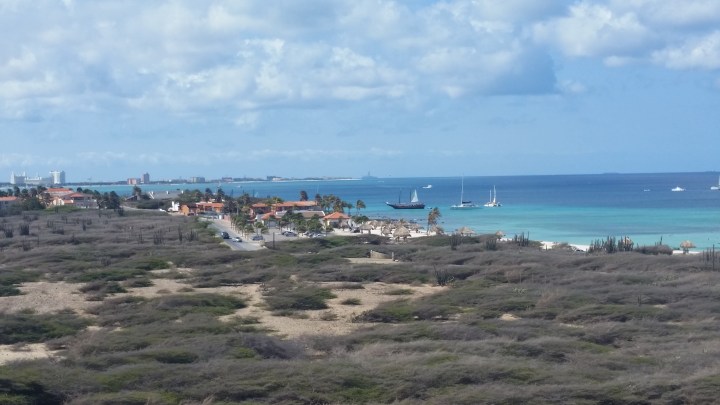
When most people picture Aruba, they imagine powdery white sand, turquoise water, and palm trees swaying in the breeze. I certainly did.
So when our cruise docked in Oranjestad, I expected we’d spend the day hopping from one postcard-perfect beach to the next. Instead, we found ourselves driving through a landscape of towering cacti, volcanic rock formations, rugged coastlines, and colorful island history.
By the end of the day, I realized Aruba is so much more than its famous beaches. It’s an island full of unexpected landscapes that completely changed the way I think about this Caribbean destination.
Aruba Island Tour
- Aruba Wasn’t What I Expected
- Aruba’s Unexpected Desert Landscape
- Climbing the Casibari Rock Formations
- Aruba’s Rugged Coastline
- A Glimpse Into Local History
- California Lighthouse
- The Beaches Everyone Imagines
- Planning Your Visit to Aruba
- FAQ: Aruba
At A Glance: Aruba Island Tour
- Location: Aruba, southern Caribbean
- Best For: cruise visitors, first time travelers, scenic island tours
- Time Needed: one full day
- Highlights: Casibari Rock Formations, Arikok National Park, Natural Bridge, California Lighthouse, Eagle & Palm Beachs
- Worth It? Absolutely. Exploring beyond the resorts gives you a much fuller picture of the island
Aruba Wasn’t What I Expected
When most people picture Aruba, they imagine endless stretches of white sand, swaying palm trees, and brilliant turquoise water. I certainly did.
So when our cruise ship docked in Oranjestad, I assumed we’d spend the day hopping from one beautiful beach to another. Instead, we climbed aboard an island tour that immediately headed away from the coast and into a landscape of towering cacti, volcanic rock formations, and rugged desert scenery.
By the end of the day, I realized Aruba is so much more than its famous beaches. It is an island of remarkable contrasts where desert meets Caribbean coastline, and that unexpected combination made me appreciate Aruba even more.

Aruba’s Unexpected Desert Landscape
Leaving Oranjestad behind, our guide drove us toward the Casibari area. Out the window stretched a landscape that looked nothing like the tropical paradise I had imagined.
Instead of palm trees and white sand, we found rocky hillsides covered with giant cacti and hardy desert plants.
Our driver proudly announced over the microphone,
“Now here’s a real treat for you—cacti!”
Being from Utah, my friends and I couldn’t help but laugh. Cacti were probably the one thing we had plenty of back home. As my friend Candice summed up what we were all thinking, she asked,
“Where’s the beach?”
Our guide simply smiled and promised we’d get there later.
At first we were slightly disappointed. Looking back now, I’m grateful the day unfolded the way it did because Aruba turned out to be far more interesting than the single image I had built in my mind.

Climbing the Casibari Rock Formations
The Casibari Rock Formations are some of Aruba’s most recognizable natural landmarks. Massive rounded boulders seem to rise unexpectedly from the otherwise flat desert landscape.
Walking paths and staircases weave between the rocks, making it easy to climb to several viewpoints overlooking the island.

From the top we could see Hooiberg, Aruba’s second-highest point. Its name means “Haystack” in Dutch, an appropriate description for the distinctive volcanic hill that can be seen from much of the island.
As we wandered among the giant boulders, I found myself appreciating Aruba’s desert beauty. The cacti, wind-shaped trees, and enormous rock formations created scenery unlike anywhere else I’d visited in the Caribbean.

Aruba’s Rugged Coastline
Our guide kept his promise. “Now we go to the beach!” We piled back onto the bus, only to continue driving through more desert. Eventually the brilliant blue Caribbean Sea appeared on the horizon, and we pulled alongside the coast.
Technically, it was a beach. Just not the white sandy beach we’d imagined. Instead, dramatic lava rock cliffs met crashing waves as the Caribbean pounded against the shoreline. The scenery was completely different from Aruba’s famous resort beaches, yet equally beautiful.
This stretch of coastline lies within Arikok National Park, which protects nearly twenty percent of the island.
One of the area’s most famous landmarks is the Natural Bridge. At one time this formation was part of a cave system before the roof collapsed, leaving a narrow span of rock overlooking the sea below. Standing nearby, we watched the waves crash into the rocks while looking out across the endless blue water.

Another feature that caught our attention was the countless stacks of small stones balanced on larger rocks.
Some believe these cairns serve as trail markers. Others see them as symbols of prayers, wishes, or simply a way for visitors to leave a small reminder that they had been there.
Whatever their meaning, they added another layer of curiosity to an already fascinating landscape.

A Glimpse Into Local History
As we continued around the island, we passed one of the most unusual cemeteries I’ve ever seen.
Rather than traditional headstones, colorful above-ground family tombs filled the landscape, each decorated in bright colors and unique architectural styles. From a distance it almost looked like a tiny village rather than a cemetery.
It was another reminder that every stop on the island revealed something completely different from the last.

California Lighthouse
Our final major stop was the California Lighthouse on Aruba’s northwestern tip.
The lighthouse takes its name from the steamship California, which wrecked offshore in 1891 before the lighthouse itself had even been completed.
During our visit the lighthouse was undergoing restoration, but from the surrounding grounds we enjoyed sweeping views across Aruba.


Looking south, we could finally see the Aruba we had originally imagined.
A ribbon of brilliant white sand stretched along the coast beside crystal-clear turquoise water.
The famous resort beaches were every bit as beautiful as the postcards promised.
What surprised me most, however, was realizing they represent only a small portion of the island.

The Beaches Everyone Imagines
We eventually ended our day exactly where we’d expected to begin—relaxing on Aruba’s famous white sand beaches.
The powdery sand, calm Caribbean water, and gentle ocean breeze made it easy to understand why Aruba is considered one of the premier beach destinations in the Caribbean.
Yet sitting there, I couldn’t stop thinking about everything we’d seen before arriving.
Without the tour, I would have assumed Aruba was simply another beautiful beach destination.
Instead, I’d discovered a volcanic desert landscape, fascinating rock formations, dramatic coastlines, colorful local history, and one of the most diverse islands I’ve visited.

Planning Your Visit to Aruba
If Aruba is a cruise stop, consider taking an island tour rather than spending your entire visit at the beach. While the beaches are stunning, seeing the rest of the island provides a much deeper appreciation for its history and geography.
Wear comfortable walking shoes for places like the Casibari Rock Formations and Arikok National Park, where you’ll encounter uneven surfaces and stairs. Bring plenty of water, sunscreen, sunglasses, and a hat, as Aruba’s sunshine and steady trade winds can make it easy to underestimate how much sun you’re getting.
If you have extra time after your tour, finish your day relaxing on one of Aruba’s beautiful beaches before returning to your ship.
FAQ: Aruba Island Tour
- Is Aruba worth visiting on a cruise?
Absolutely. Even if you only have one day, Aruba offers beautiful beaches, fascinating natural landscapes, and unique cultural sites that make it an excellent cruise destination.
- Is Aruba only beaches?
Not at all. Much of Aruba has a desert climate filled with cacti, volcanic rock formations, and rugged coastline. Exploring beyond the resorts reveals a completely different side of the island.
- Is Arikok National Park worth visiting?
Yes. Arikok protects nearly twenty percent of Aruba and showcases the island’s dramatic rocky coastline, desert scenery, caves, and unique wildlife.
- How long should you spend exploring Aruba?
A full day is enough to combine an island tour with time to relax on the beach. Visitors staying longer can easily spend several days exploring different parts of the island.
- Can you visit Aruba without booking a tour?
Yes. Rental cars, taxis, and guided excursions are all available, though organized tours are a convenient way for cruise passengers to experience several highlights in one day.

We boarded the tour expecting Aruba to be all beaches. Instead, we discovered an island of contrasts.
Yes, the white sand beaches are every bit as beautiful as the travel brochures promise. But what surprised me most were the towering cacti, volcanic rock formations, rugged coastline, and quiet landscapes that tell a different story about Aruba.
Sometimes the places that leave the biggest impression aren’t the ones that meet our expectations—they’re the ones that completely rewrite them.
Aruba did exactly that for us, and I’m so glad we ventured beyond the beach to discover the rest of the island.
If you enjoyed this post, then you might be interested in these other Caribbean stops:
Thanks for coming along to explore Aruba beyond the beaches. May you find rocky shores and white sand beaches for one amazing day.

Coming Up Next:
For More Information:
Read More From:
Follow along for more adventures near and far!


Leave a Reply