There are some trips that leave you feeling completely ready to go home, and then there are the ones where you find yourself looking for any excuse to stay just a little longer.
Our winter getaway to the Canadian Rockies was one of those trips. Every day had brought another unforgettable experience—from walking across a frozen Lake Louise to hiking through the icy beauty of Johnston Canyon—and neither of us was quite ready for it to end.
Before driving back to Calgary for our flight home, we decided to make one final detour. Just across the provincial border in British Columbia lies Yoho National Park, one of the four national parks that make up the Canadian Rocky Mountain Parks UNESCO World Heritage Site.
We knew we only had a few hours to explore, but we couldn’t pass up one last chance to soak in the snow-covered peaks and quiet mountain valleys that had made this trip so unforgettable.
It turned out to be the perfect way to say goodbye to the Canadian Rockies—even if it also left us dreaming of coming back.
Yoho National Park
- The Drive to Yoho National Park
- Exploring the Town of Field
- Winter in Yoho National Park
- The Emerald River in Golden
- Places I’d Love to Return For
Quick Facts: Yoho National Park
- Location: Southeastern British Columbia, immediately west of of Banff National Park
- Established: 1886 (Canada’s second or third national park, depending on who you ask)
- Drive Time from Banff: about 30-40 minutes to the park entrance; about 1 hour to the town of Golden
- Best Known For: Emerald Lake, Takakkaw Falls, Natural Bridge, Burgess shale fossils, alpine hiking, and dramatic mountain scenery
- Winter Note: Many roads leading to trailheads and attractions close seasonally because of snow and avalanche conditions, so check current conditions before your visit

The Drive to Yoho National Park
With our time in Banff coming to an end, we wanted to squeeze in one last adventure before heading back to Calgary. The Canadian Rocky Mountain Parks are made up of four national parks—Banff, Jasper, Kootenay, and Yoho—all recognized together as a UNESCO World Heritage Site for their spectacular landscapes and ecological significance.
Originally we had hoped to visit Kootenay National Park, but seasonal road closures changed our plans. Jasper deserved far more time than we had left, so we pointed the car west toward Yoho National Park instead.
The drive itself became part of the adventure, winding through snow-covered valleys and towering peaks that seemed to grow larger around every bend.

Exploring the Town of Field
Like Banff, Yoho has a small community at its heart.
The tiny community of Field feels worlds away from the bustle of Banff. Nestled quietly among the mountains, it has just a handful of streets, a visitor center, and a few local businesses. Rather than feeling like a destination filled with attractions, it feels like a place that exists because of the mountains around it.
Long before visitors arrived by train or highway, the Secwépemc and Ktunaxa peoples traveled these mountain passes to reach hunting grounds on the eastern plains. Their history stretches back thousands of years, making these mountains not just a place of recreation but a place of deep cultural significance.
In 1886, after traveling through the Rockies by rail, Prime Minister John A. Macdonald officially established Yoho National Park, helping preserve this remarkable landscape for future generations.

Winter in Yoho National Park
Visiting in winter meant accepting that much of the park would remain hidden. Seasonal closures had already closed access to many of Yoho’s famous lakes, waterfalls, and hiking trails, and road crews were taking advantage of the quieter season to complete major construction projects.
At first I was disappointed. It’s hard to drive past signs pointing toward beautiful places knowing you can’t reach them.
But somewhere along the drive, that disappointment quietly disappeared.
The mountains themselves became enough. Every curve in the highway revealed another dramatic ridge dusted with fresh snow. The forests stretched endlessly toward the peaks, and every now and then the clouds would lift just enough to reveal another glacier tucked high in the mountains.
Sometimes travel isn’t about checking attractions off a list. Sometimes it’s simply about slowing down enough to appreciate the landscape unfolding outside your window. Yoho became that kind of place for us.

The Emerald River in Golden
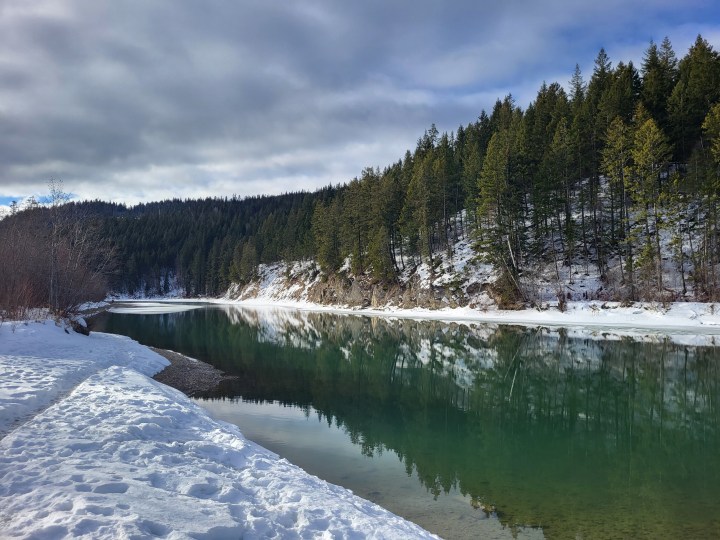
After leaving the park, we continued west to the town of Golden, where we stretched our legs along the river before beginning the long drive back. Even here, the scenery continued to surprise us.
The water glowed with that unmistakable emerald color the Canadian Rockies are famous for. Against the white snow and dark evergreen trees, it almost looked unreal. It was quiet and peaceful—the perfect way to end our final afternoon surrounded by these incredible mountains.

Places I’d Love to Return For
Winter introduced us to the quieter side of Yoho, but it also reminded me that every season offers a different experience. While we enjoyed the snow-covered peaks from the highway, these are the places that have me dreaming of coming back.
Emerald Lake
Perhaps the most iconic destination in Yoho National Park, Emerald Lake is known for its brilliant green water, surrounded by towering mountain peaks. In summer, visitors can rent canoes or walk the scenic trail that circles the shoreline. In winter, the frozen lake becomes a peaceful snow-covered landscape perfect for cross-country skiing and quiet walks.
Takakkaw Falls
One of the tallest waterfalls in Canada, Takakkaw Falls plunges more than 1,200 feet down a sheer cliff, fed by the Daly Glacier above. The name “Takakkaw” comes from the Cree language and means “it is magnificent,” which seems like the perfect description. The road to the falls is typically only open during the warmer months, making it a destination I’ll have to save for another trip.
Natural Bridge
Near Field, the rushing waters of the Natural Bridge have carved a dramatic rock formation that now spans the river like a bridge. It’s one of those places where the power of water is on full display and a reminder that landscapes are constantly changing over time. It’s also one of the easiest natural attractions in the park to visit.
Wapta Falls
Although less famous than Takakkaw Falls, Wapta Falls is one of the largest waterfalls on the Kicking Horse River. A relatively easy hike leads visitors to the base of the falls, where they can experience the impressive width and power of the cascading water. It seems like one of those places that would be just as beautiful in autumn as it would be in summer.

FAQ: Yoho National Park
- Is Yoho National park worth visiting in winter?
Yes! While some roads and attractions close seasonally, winter offers beautiful mountain scenery, quiet roads, and a peaceful alternative to the busier areas of Banff National Park.
- Can you visit Yoho National Park as a day trip from Banff?
Absolutely. Yoho National Park is just west of Banff and makes an easy and scenic day trip, whether you’re driving the Trans-Canada Highway or exploring nearby attractions.
- What is Yoho National Park known for?
Yoho National Park is famous for Emerald Lake, Takakkaw Falls, Natural Bridge, the Burgess Shale fossil beds, and its dramatic Rocky Mountain landscapes.

The word Yoho comes from a Cree expression of astonishment and wonder.
It couldn’t be a more fitting name.
Even though we only experienced a small piece of the park—and never even set foot on one of its trails—it still left me with a deep sense of awe. Sometimes a place doesn’t need hours of hiking or a long itinerary to make an impression. Sometimes all it takes is a winding mountain road, fresh snow, and the quiet realization that you’ve found somewhere you’ll simply have to return to.
If you have enjoyed this visit to Yoho National Park, you may be interested in these:
Thanks for joining me for a drive through Yoho National Park in British Columbia. May you be filled with amazement, wonder, and awe at the views before you.

Coming Up Next:
For More Information:
Read More From:
Follow along for more adventures near and far!


Leave a Reply