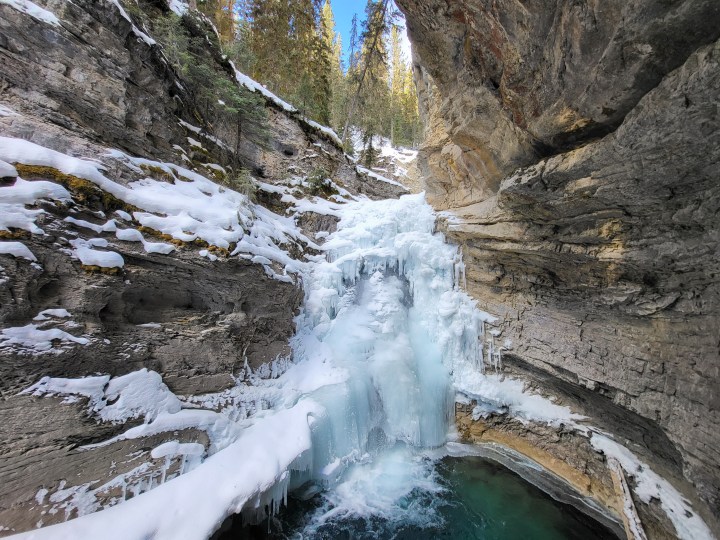
While in Banff National Park, we joined a guided ice walk through Johnston Canyon—one of the most popular winter hikes in the Canadian Rockies.
Winter transforms the canyon into something entirely different. What is normally a flowing waterway in summer becomes a frozen passage of ice, stone, and snow, with narrow catwalks that wind between towering rock walls. We don’t often choose guided tours when hiking, but for this experience, it felt like the best way to safely explore the canyon while also learning more about the landscape from someone who knew it deeply.
From the very beginning, it felt less like we were simply going on a hike—and more like we were stepping into a frozen world carved by time itself.
Johnston Canyon Ice Walk
- Johnston Canyon Ice Walk: Walking Though the Canyon in Winter
- Trail Guide: Johnston Canyon
- Know Before You Go: Johnston Canyon Ice Walk
- FAQ: Johnston Canyon Ice Walk
Quick Facts: Johnston Canyon Ice Walk
- Location: Banff National Park, Alberta, Canada
- Trail Type: Out-and-back canyon hike (lower falls + upper falls)
- Distance: ~2.7kn (lower falls) / ~5.4 km rountrip (upper falls)
- Difficulty: easy to moderate (winter conditions add traction requirements)
- Best Time to Visit: December – February for peak ice formations
- Gear Tip: ice cleats or spikes are highly recommended (often provided on guided tours)
- Access: Shuttle tours available from Banff, limited parking fills quickly in peak season


Johnston Canyon Ice Walk: Walking Though the Canyon in Winter
We met our group at the Banff train station and boarded a shuttle with a small group of fellow travelers. There was an immediate sense that this would be more than just a hike—it felt like sharing an experience with people who were just as excited to be there as we were. Our guide, who grew up in the area and had worked in land management before leading tours, brought the canyon to life in a way that made every stop along the trail feel meaningful.


At the canyon, we were fitted with ice spikes for our boots and set off along the path that follows the frozen stream carved between towering rock walls. Even in winter, water still rushed beneath the ice in places, creating deep blue pools that hadn’t fully frozen. The contrast between rock, ice, and snow made the entire canyon feel almost otherworldly.

Banff National Park—and the surrounding parks of Jasper, Yoho, Kootenay, and others—are part of a UNESCO World Heritage Site, recognized for their natural beauty, geological significance, and long human history. It was interesting to walk through a place where so much effort is made to balance preservation with access, protecting the landscape while still allowing visitors to experience it.

As we continued through the canyon, our guide pointed out a fossil embedded in the rock beside the trail—remnants of ancient marine life from long before the mountains formed. It was one of those small details that makes you stop and think about just how old this landscape really is.

Eventually, we reached the lower falls, where the canyon narrows and visitors can pass through a small tunnel to view the frozen waterfall up close. Only a few people are allowed inside at a time, so we waited our turn before stepping into the icy chamber.

Inside, the falls were completely frozen into layers of blue ice, yet still visibly moving beneath the surface in places—a phenomenon often referred to as “peekaboo ice.”

We didn’t spot much wildlife along the way—no deer, no birds, not even a single squirrel. Our guide laughed and told us that years ago the canyon was full of them, but after overfeeding and changes in the environment, the population had moved elsewhere. It was a small reminder that even familiar ecosystems shift and adapt over time.

Farther up the canyon, we reached the upper falls just in time to watch ice climbers scaling the frozen wall. It was incredible to see them moving slowly upward across the vertical ice before carefully rappelling back down. We stood there completely absorbed in watching them, barely noticing how cold we had become.

At one point, our guide handed out cups of hot chocolate and maple cream cookies, which felt like the perfect contrast to the scene in front of us—warmth in our hands while watching people climb a frozen waterfall.
From the upper falls, the canyon stretched out below us in layered blues, whites, and grays. The ice formations clung to the rock walls in thick pillars, and the scale of the place was even more impressive from above than it had been on the way up.


On the return hike, we slowed our pace, taking in the quiet beauty of the canyon one last time. Snow softened the edges of everything, and the sound of the river beneath the ice followed us all the way back.
It’s easy to understand why Johnston Canyon is such a popular winter hike. It offers something rare: a place where you can walk through a frozen landscape while still feeling the movement of water, stone, and time beneath your feet.
By the time we reached the trailhead again, I don’t think any of us were ready to leave. If I’m honest, I think I left a small part of my heart in Banff National Park that day.

Trail Guide: Johnston Canyon
The Johnston Canyon hike is one of the most popular winter walks in Banff National Park, and it can be customized depending on how far you want to go.
Lower Falls ( Most Popular Section)
This is the most accessible and frequently visited part of the canyon. The trail follows a series of suspended catwalks through the narrow canyon walls before reaching the frozen Lower Falls. In winter, this section often features dramatic ice formations and the chance to step into a small cave for an up-close view of the waterfall.
- Distance: ~2.7 km round trip
- Time: 1–2 hours
- Difficulty: Easy (with winter traction recommended)
- Highlight: Ice cave viewpoint of the frozen falls
Upper Falls (Longer Hike, Fewer Crowds)
Continuing past the Lower Falls, the canyon opens up into a longer forested section before reaching the Upper Falls. This part of the hike feels quieter and more immersive, with fewer crowds and a stronger sense of winter wilderness.
At the Upper Falls, the scale of the canyon becomes even more impressive, especially when ice climbers are on the wall.
- Distance: ~5.4 km round trip
- Time: 2–3 hours
- Difficulty: Moderate (longer + more elevation)
- Highlight: Ice climbing views and dramatic frozen waterfall
Guided Tour vs Self-Guided
We chose a guided ice walk, which added both safety and context to the experience. In winter, this can be a great option if you want traction gear provided and a deeper understanding of the canyon’s geology and history.
However, the trail can also be done independently if conditions are safe and you are properly equipped.
Winter Tips
- Ice cleats are essential for safe walking
- Dress in warm layers- temperatures in the canyon stay cold
- Expect shaded, slippery conditions even on clear days
- Arrive early to avoid crowds, especially on weekends


Know Before You Go: Johnston Canyon Ice Walk
- Weather can change quickly-dress in warm, layered clothing.
- Trails can be icy even when they look packed down.
- Guided tours are a great option if you want context and added safety.
- Lower falls is accessible year-round; upper falls conditions vary more in deep winter
FAQ: Johnston Canyon Ice Walk
- Is Johnston Canyon worth visiting in winter?
Yes—it’s one of the most popular and accessible winter hikes in Banff National Park, known for frozen waterfalls and dramatic canyon scenery.
- How difficult is the Johnston Canyon Ice Walk?
The Lower Falls section is easy and family-friendly, while the Upper Falls extension is moderate due to distance and winter conditions.
- Do you need a guide for Johnston Canyon in winter?
No, but guided tours are helpful for safety, traction gear, and learning more about the canyon’s geology and history.


By the time we made our way back down through the canyon, everything felt quieter than when we had started. The crowds had thinned, the sound of rushing water echoed beneath the ice, and the snow seemed to soften every edge of the landscape around us.
We had come for a hike, but what we experienced was something closer to stepping inside the natural history of Banff itself—walking through layers of ice, stone, fossils, and flowing water all at once.
Between frozen waterfalls, narrow canyon walls, and the unexpected thrill of watching ice climbers scale the cliffs above us, Johnston Canyon felt like a place that constantly shifted between beauty and awe.
Of all the places we explored in Banff, this is one I know I will return to in memory again and again. And maybe one day, in person too.
Explore other parts of Banff National Park in winter:
Walking Across Frozen Lake Louise
Thanks for coming along on this ice walk through Johnston Canyon in Banff National Park. May your feet be warm and the skies be blue as you take a walk in the snow.

Coming Up Next:
For More Information:
Read More From:
Follow along for more adventures near and far!


Leave a Reply