Some places are beautiful enough to stop you in your tracks. Lake Louise is one of those places.
During the summer, visitors travel from around the world to see its famous turquoise water reflecting the surrounding peaks. But we arrived in the middle of winter, when the lake had transformed into something completely different. Instead of sparkling water, an enormous sheet of ice stretched across the valley beneath snow-covered mountains. It felt less like visiting a lake and more like stepping into another world.
Banff National Park was the first of Canada’s national parks, established in 1885, and today protects more than 2,500 square miles of some of the most spectacular scenery in the Canadian Rockies. It didn’t take long for us to understand why so many people return here year after year.
Frozen Lake Louise
Quick Facts: Frozen Lake Louise in Winter
- Location: Banff National Park, Alberta, Canada
- Trail Length: approximately 4 miles (round trip) across the frozen lake
- Best Time to Visit: January-March for reliable ice conditions
- Alternative Experience: horse-drawn sleigh rides

Walking Across the Frozen Lake
Walking out onto the frozen surface of Lake Louise was one of those travel moments I’ll never forget. Everywhere we looked, people were embracing winter in their own way. Families skated across the ice, hockey games broke out in the distance, curlers carefully slid stones across prepared lanes, and cross-country skiers quietly glided along marked trails.
The lake had become a gathering place instead of simply something to admire.

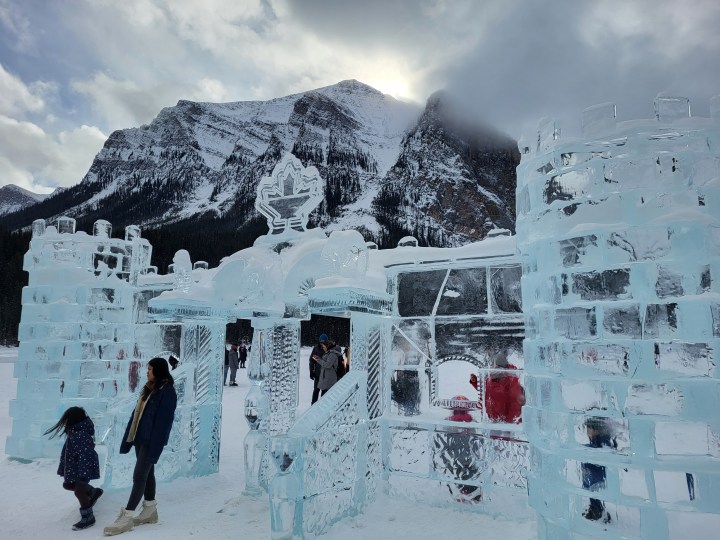
One of the first things that caught my eye was the incredible ice castle standing near the shoreline. Every detail had been carefully carved, from delicate maple leaves to twisting vines climbing the towers. It was a reminder that winter itself can become an art form.

We followed the walking trail across the frozen lake, taking our time as the mountains rose around us in every direction. The only sounds were boots crunching on packed snow, laughter drifting across the ice, and the occasional clip-clop of horses pulling sleighs across the frozen landscape.

The air was crisp enough that every breath reminded us it was winter, yet walking across the lake kept us surprisingly warm.
If walking across the lake isn’t your style, horse-drawn sleigh rides offer another way to experience the scenery. Wrapped beneath warm blankets, visitors are carried through the snow toward the far end of the lake. As tempting as it looked, I couldn’t pass up the chance to say I had actually walked across a frozen lake.


At the far end, a brilliant streak of blue caught my attention high on the mountainside. At first glance it looked like a glacier, but it was actually ice clinging to the rock face. Against the dark evergreen forest and white snow, the vivid blue almost didn’t seem real.

As we turned back toward the shoreline, the iconic Fairmont Château Lake Louise came into view. Rising above the frozen lake with the mountains behind it, it looked like something from a winter fairytale.
People often visit Lake Louise hoping to see its famous turquoise water. While I would love to return someday during the summer, I’m grateful my first experience was in winter. Walking across the frozen lake showed me a side of Lake Louise that few places in the world can offer—one where winter isn’t simply a season, but the main attraction.

Know Before You Go: Frozen Lake Louise
- Winter conditions vary from year to year, so always check current ice conditions before walking onto the lake.
- Arrive early if visiting on weekends or holidays, as parking fills quickly.
- Wear waterproof winter boots with good traction.
- Dress in layers- even on cold days you’ll warm up while walking.
- Allow at least 2-3 hours to enjoy the lake without rushing.
FAQ: Lake Louise in Winter
- Is it safe to walk on Lake Louise in winter?
When conditions are appropriate, walking on the frozen lake is a popular winter activity. Always follow current safety guidance and posted conditions before venturing onto the ice.
- When does Lake Louise freeze?
Lake Louise typically freezes in late fall and remains frozen through much of the winter, though conditions vary each year.
- Can you skate on Lake Louise?
Yes! During the winter, a large skating area is maintained on the frozen lake, making it one of the most iconic skating experiences in the world.
- How long does it take to walk across Lake Louise?
Most visitors should allow 2–3 hours to walk across the lake, enjoy the scenery, and return at a leisurely pace.


Walking across Lake Louise remains one of my favorite winter memories. It wasn’t just the mountains or the snow that made it unforgettable—it was the chance to experience such a familiar landscape in a completely unexpected way. Instead of admiring the lake from the shore, we became part of it, crossing its frozen surface beneath towering peaks and discovering that winter has a beauty all its own.
If you’re visiting Banff in winter, don’t just stop for the view. Step out onto the ice, take your time, and experience one of the most magical places in the Canadian Rockies from a whole new perspective.
If you enjoyed this post follow along on the rest of this visit to the Canadian Rockies.
Thank you for coming along on this winter walk across frozen Lake Louise in Banff National Park. May your castle by the lake give you beautiful views.

Coming Up Next:
For More Information:
Read More From:
Follow along for more adventures near and far!


Leave a Reply