My favorite way to spend a weekend is on a road trip with no strict plan—just a route, a few destinations, and the freedom to take the long way home.
This particular weekend took us into southeast Missouri, but instead of heading straight back, we decided to turn the drive into part of the adventure. We mapped out a winding route home that allowed us to stop at a mix of historic sites, scenic drives, and state parks along the way.
What started as a simple weekend trip turned into a journey through Missouri, Illinois, and along stretches of the Great River Road. Along the way, we explored river views, small historic towns, and unexpected stops that made the drive just as memorable as the destinations themselves.
There’s something special about road trips like this—you never quite know what you’ll find just off the highway, but it always feels like part of the story once you do.
Weekend Itinerary: Road Trip Through Missouri, Illinois, Tennessee
Perfect for travelers who enjoy a mix of scenic drives, small historic towns, and quiet outdoor stops along the Mississippi River corridor.
- Ozark National Scenic Riverways, Missouri
- St. Genevieve National Historic Park, Missouri
- Great River Road scenic drive, Illinois
- Paris Landing State Park, Tennessee
- Fort Donelson National Battlefield, Tennessee
Ozark National Scenic Riverways in Missouri
Our first stop on the drive toward home was the Ozark National Scenic Riverways, a protected area created to preserve an entire river system. It was also the first national park unit in the United States established specifically for river conservation. Within the park, the river stretches for 134 miles of slow-moving, crystal-clear water winding through the Missouri landscape.
For our visit, we explored two of its most well-known stops.
We began at Big Spring, one of the largest natural springs in the country and the source of the river itself. The first thing that stood out was the color—the water is an almost unreal shade of brilliant blue, blending with deep greens of moss and surrounding forest. A walking path leads along the rocky outcropping where the river emerges from a cave-like opening in the hillside, creating the feeling of a river flowing up and out of the earth rather than down from it.

As we followed the trail, we came across an old U.S. Geological Survey marker, one of the historic reference points used across the country since 1879. It was a small but fascinating reminder of how long this landscape has been studied and mapped.


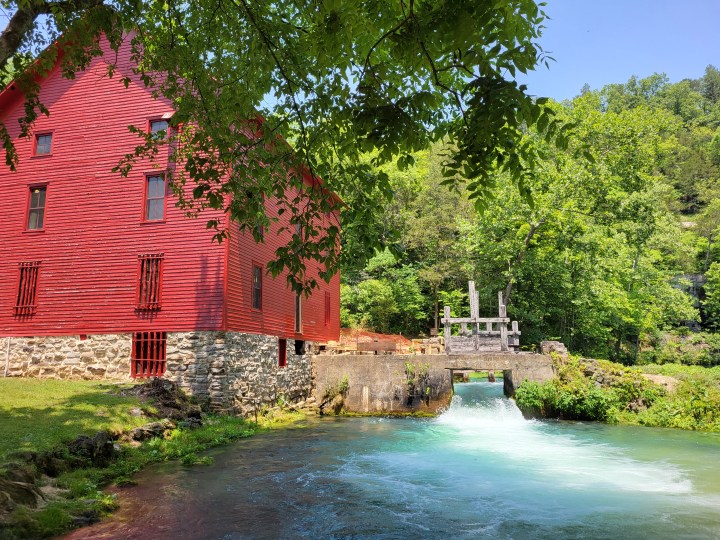
From Big Spring, we continued a short drive to Alley Mill, a historic grist mill once part of a small river settlement. The mill sits beside the water like something preserved in time, now functioning as both a museum and a glimpse into early rural life in the Ozarks.

The town itself went through several names before eventually being shortened to “Alley,” after local businessman John Alley—largely because the earlier names were considered too long for the post office to handle.
Inside the mill, visitors can still see the original machinery and wooden mechanisms used to grind grain. Some areas remain in need of restoration, and repairs must be done using historically accurate methods and tools, which makes preservation both challenging and slow. It’s a reminder that maintaining places like this requires not just funding, but specialized craftsmanship that is increasingly rare.

Together, Big Spring and Alley Mill offered two very different but connected perspectives on the river—one natural and timeless, the other shaped by human history along its banks.
Ste. Genevieve National Historic Park in Missouri
Our next stop was the charming Ste. Genevieve National Historical Park, one of the most historically significant towns along the Mississippi River.
Originally established in 1750 by French Canadian settlers, Ste. Genevieve is recognized as the first European settlement west of the Mississippi River and the earliest permanent European community in what would become the state of Missouri. At the time, the area was part of French Louisiana, serving as an important civic and agricultural center long before the Louisiana Purchase in 1803 shifted the region into American territory.

One of the most distinctive features of Ste. Genevieve is its preserved French colonial architecture, including the rare poteaux-en-terre style—buildings constructed with vertical wooden posts set directly into the ground. Many of these historic structures are now listed on the National Register of Historic Places, and the town itself became part of the National Park System in 2020.


Walking through Ste. Genevieve feels like stepping into another time. Quiet streets lined with historic homes and buildings reflect layers of French, German, and early American influence, each era leaving its mark on the town’s identity.


We stopped for dinner at The Old Brick House, believed to be the oldest brick building west of the Mississippi River, dating back to 1785. Over the centuries, it has served many purposes, but today it welcomes visitors as a local restaurant serving hearty Midwestern-style meals in a setting full of history.

More than anything, Ste. Genevieve offers a sense of continuity—of a place that has evolved through centuries of change while still holding onto the textures of its earliest beginnings. Walking through the town, it’s easy to imagine the generations who lived, worked, and built lives along this stretch of river long before it became part of the United States.

The Great River Road Through Illinois
As we left Missouri and crossed into southern Illinois, we found ourselves driving along a quiet stretch of the Great River Road. This scenic route follows the path of the Mississippi River through ten states, from Minnesota all the way down to Louisiana, weaving together small towns, river views, and historic landmarks along the way.
Designated as both a National Scenic Byway and an All-American Road, the Great River Road is less a single highway and more a collection of connected routes that trace one of America’s most important waterways.
Even this short stretch gave us a glimpse of what makes it so special—rolling farmland, glimpses of the river corridor, and quiet roads that feel deeply connected to the history of the region.

As we drove, I couldn’t help but think about how much more there is to explore here. The Great River Road also intersects with the Lincoln Heritage Trail, and much of Illinois is steeped in history connected to Abraham Lincoln’s life and legacy. That’s a road trip I already know we’ll need to come back for.
For now, though, we continued south, following the river and letting the road guide us toward our next stop.
Paris Landing State Park on the Tennessee River
We continued south through Kentucky along the western edge of the Land Between the Lakes National Recreation Area. We had visited Land Between the Lakes on a previous trip and absolutely loved exploring the long stretch of land nestled between Kentucky Lake and Lake Barkley.
As much as we were tempted to stop again, we decided to keep moving and followed the route down to the southern end of the peninsula, where we crossed into Tennessee and arrived at Paris Landing State Park.

Paris Landing sits along the banks of the Tennessee River and is a popular destination for boating, fishing, and waterfront recreation. For this visit, we made our way to the newly renovated lodge for lunch at the restaurant overlooking the water.
From our table, we watched the river stretch out beneath wide windows as dark clouds slowly moved across the sky. A gentle rain rolled in over the water, and we sat quietly watching it drift across the river landscape—a peaceful pause in the middle of a travel day.

It was one of those simple moments that makes a road trip feel unhurried, even when you’re covering a lot of ground.
Fort Donelson National Battlefield & National Cemetery in Tennessee
Our final stop before heading home was the Fort Donelson National Battlefield and National Cemetery.
Tennessee’s position between North and South made it a key region during the Civil War, and the state is filled with historic sites that reflect the conflict that shaped the nation. Fort Donelson, in particular, marked a turning point in the war and brought then–Brigadier General Ulysses S. Grant into national prominence, helping set the stage for his later role as commander of the Union Army.

The Battle of Fort Donelson was a major Union victory, securing control of the Tennessee River and nearby rail lines—both critical transportation routes. Union leaders understood that control of the Western rivers would determine much of the outcome of the war, and this victory helped push Confederate forces out of Kentucky and much of western Tennessee, opening the path deeper into the South.

As we drove through the park, remnants of the battlefield were still visible in the landscape, including marked Confederate trench lines in the hills and memorials honoring those who fought on both sides. While many historic sites emphasize Union victories, seeing monuments dedicated to Confederate soldiers as well added a layer of complexity and humanity to the experience. It served as a reminder that war leaves loss on all sides, regardless of outcome.


A short drive away, we walked through the national cemetery, where graves are organized in sections honoring soldiers from Fort Donelson as well as later conflicts including World War I and World War II. It was a quiet and humbling space—one that invites reflection on the long history of sacrifice tied to this land.


It is estimated that around 1,400 Confederate soldiers and 2,700 Union soldiers were killed during the Battle of Fort Donelson. While the Union victory helped shape the outcome of the war, standing in the landscape where it unfolded made the cost of that victory feel very real.
As we left the battlefield and turned toward home, it felt fitting to end the trip here—a place that reminded us not only of how history is made, but of the lives behind it, and the weight of the roads we had been traveling all weekend.
Looking back on this weekend, it felt less like a series of stops and more like a journey shaped by rivers, roads, and the stories that follow them. From the quiet springs of the Ozarks to historic river towns, scenic drives along the Great River Road, peaceful moments at Paris Landing, and the powerful history of Fort Donelson, each place added a different layer to the trip.
It was a reminder that some of the best road trips aren’t about getting somewhere quickly, but about everything you discover when you take the long way home.
If you enjoyed this post, here are some others that you might be interested in:
Tennessee State Parks: Our Family Journey to See All the Parks
Thank for coming along on this weekend road trip through Missouri, Illinois, and Tennessee. May your weekend be long and your gas tank be full as set out for adventures unknown.

Coming Up Next:
Follow along for more adventures near and far!


Leave a Reply