I am not much for the heat. Because I’m prone to heat exhaustion, you can usually find me planning trips around cooler temperatures rather than seeking out the hottest destinations on the map.
So when one of my closest friends invited me to spend a weekend in Phoenix in the middle of summer, I made a rare exception. Friendship has a way of convincing you to do things you might never choose on your own.
As soon as I stepped off the plane, I was reminded that Arizona’s heat is different. Having grown up in neighboring Utah, the dry desert air felt surprisingly familiar compared to the humidity I had grown accustomed to in the Southeast. On the drive into the city, I found myself captivated by the landscape. Palm trees stood alongside towering cacti, bright wildflowers lined the roads, and rugged mountains rose from the desert floor.
Phoenix may be known for its scorching temperatures, but over the next few days I discovered there is much more to the Valley of the Sun than the heat. From desert gardens and mountain views to local history and unforgettable food, it turned out to be the perfect place for a weekend getaway with friends.
This weekend showed us a completely different side of Phoenix—one filled with water, history, and desert beauty.
Weekend in Phoenix
- Lunch at Jalapeno Bucks
- Paddleboarding on Canyon Lake
- Lost Dutchman State Park & the Superstition Mountains
- Visiting Goldfield Ghost Town
- Desert Botanical Garden in Phoenix
- Hole-In-The-Rock at Papago Park
- Know Before You Go: Phoenix in Summer
Weekend Itinerary: Things to do in Phoenix, Arizona for 3 days
Day One: Arrival & Local Flavor
- Lunch at Jalapeno Bucks
- Explore local desert scenery and settle into Phoenix
Day Two: Water, History & Desert Landscapes
- Paddleboarding at Canyon Lake
- Views of Lost Dutchman State Park
- Visit Goldfield Ghost Town
Day Three: Desert Beauty & Scenic Views
- Phoenix Desert Botanical Garden
- Hike to Hole-in-the-Rock at Papago Park


Lunch at Jalapeno Bucks
Before any adventuring could begin, we needed lunch. Our first stop was a local favorite called Jalapeño Bucks, a casual roadside restaurant tucked beside an orange grove on the outskirts of Phoenix.
The restaurant is exactly the kind of place you hope to stumble across on a road trip. Funny signs and sayings cover the walls, picnic tables sit beneath misting fans, and there isn’t a formal dining room in sight. Instead, you place your order at the walk-up counter, find an open table, and settle in for a relaxed Arizona lunch.

Jalapeño Bucks serves everything from burritos and barbecue to burgers and sandwiches, but one menu item stands above the rest in both popularity and curiosity: the brisket peanut butter and jelly sandwich.
I’ll admit, I was skeptical. Brisket. Peanut butter. Jelly.
It sounds like a combination that shouldn’t work, and yet somehow it absolutely does. The smoky barbecue brisket pairs surprisingly well with the sweet and salty flavors of the peanut butter and jelly, creating one of the most unexpectedly delicious sandwiches I’ve ever eaten. If you’re visiting Jalapeño Bucks, this is the item to order.


With full stomachs and our first Arizona adventure already under our belts, we were ready to head into the desert and begin exploring everything the Phoenix area had to offer.
Paddleboarding on Canyon Lake
With temperatures soaring into the Arizona summer heat, it didn’t take long to decide where we wanted to spend the afternoon. Like many locals, we headed for the water and made our way to Canyon Lake, one of the most scenic lakes in the Phoenix area.
Nestled among rugged desert hills, Canyon Lake feels like a hidden oasis. The lake is divided into different areas, with motorboats enjoying the larger open water while quieter coves and inlets provide space for paddleboards, kayaks, and tubes.

This was my first experience paddleboarding, and I immediately understood why so many people love it. Once we found our balance, we slowly paddled away from the busier section of the lake and into a narrow passage lined with rocky cliffs, desert vegetation, and patches of green growing along the shoreline. The contrast between the blue water and the surrounding desert landscape was striking.


The water was gloriously cool and refreshing, a welcome break from the Arizona sun. Eventually we pulled our boards onto the shore beneath a shady spot and simply relaxed for a while, enjoying the quiet beauty of the lake.

For a few hours, Canyon Lake provided the perfect escape from the summer heat and a side of Arizona that I hadn’t expected to find.
Lost Dutchman State Park & the Superstition Mountains
As we drove through the desert landscape, we passed the rugged, jagged peaks of the Superstition Mountains, home to Lost Dutchman State Park. Even just driving by, the landscape feels dramatic—sharp stone rising from the desert floor in a way that immediately makes you understand why so many legends have grown out of this place.
Lost Dutchman State Park gets its name from one of the most famous tales of the American Southwest: the story of a hidden gold mine said to be somewhere in these mountains.

According to legend, a German immigrant discovered an incredibly rich gold deposit in the 19th century. The mine was supposedly so abundant that he could not move all of its wealth on his own. He shared its existence with others, but never revealed its exact location before his death.
Since then, people have been searching the Superstition Mountains for the lost mine. Over the years, various gold discoveries in the region have only added fuel to the legend, with many believing they are traces of the original hidden treasure. Despite countless searches, the true location—if it even exists—has never been confirmed.
Today, the Superstition Mountains remain a place of mystery, where desert beauty and old west legend sit side by side, and where the idea of hidden gold still lingers in the air.
Visiting Goldfield Ghost Town
We made a stop at Goldfield Ghost Town, a reconstructed 1890s mining town that offers a glimpse into life during Arizona’s early frontier days. Nestled near the Superstition Mountains, Goldfield once thrived as a bustling gold mining town during Arizona’s territorial period.
When gold was discovered nearby, prospectors poured into the area and the town quickly grew to around 4,000 residents at its peak. But by 1897, the mine had failed, and without its primary source of income, the town quickly emptied. What was once a lively mining community was soon abandoned, becoming one of Arizona’s many ghost towns.

Today, Goldfield has been carefully rebuilt as a historic attraction. Visitors can wander through wooden storefronts, visit small shops and cafés, and get a feel for what life in an Old West mining town might have been like. One of the highlights is the chance to try a glass of prickly pear lemonade while exploring the grounds.


Scattered throughout the town are remnants of its mining past, including an original 1890s narrow-gauge steam locomotive and a restored mine elevator—reminders of just how difficult and dangerous mining life once was in this region.

Even small details add to the experience, like the old jail where the posted rules read: No Complaining, No Profanity, No Loud Talk… Meals: beans, bread, water. It’s a simple reminder of how rough life could be for those passing through or serving time.
Goldfield also includes a small church, mining displays, and occasional reenactments that bring the Old West to life. While it leans a bit into the tourist side of things, it still offers a fun and atmospheric way to step back into Arizona’s frontier history.


After stepping into Arizona’s frontier past, our next stop showed us an entirely different side of the desert.
Desert Botanical Garden in Phoenix
We got up early one morning for a visit to the Phoenix Desert Botanical Garden, one of the most unique and beautiful places in the city. Originally founded in 1937 by the Arizona Cactus and Native Flora Society, the garden is now home to more than 50,000 plants and has been designated a Phoenix Point of Pride.


Roughly one-third of the garden showcases native Arizona plants, including nearly 400 species that are rare, threatened, or endangered. Its extensive collection of agave and cactus species is especially impressive, offering a closer look at the diversity of the Sonoran Desert.

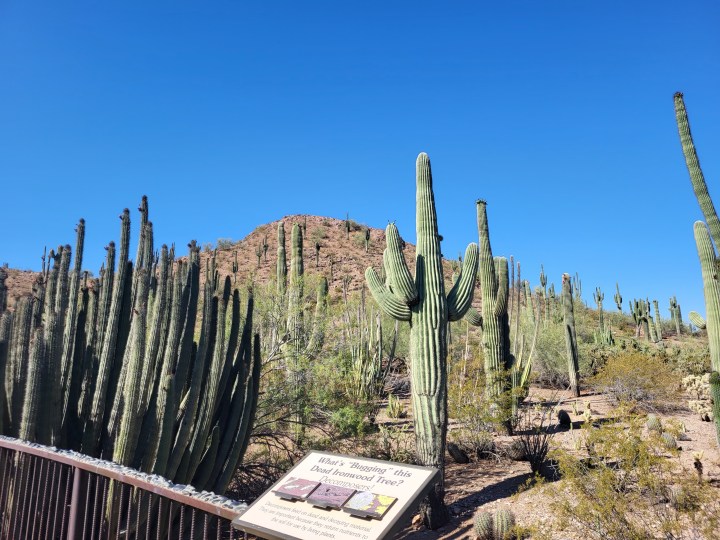
As we wandered the trails, we came across towering saguaro cacti stretching more than 20 feet into the air. Standing beside them made us feel incredibly small in comparison to these slow-growing giants of the desert. Across Arizona, saguaros are protected by law, and even naturally fallen cacti must be reported to the state agriculture department.


Throughout the garden, we noticed the many stages of a saguaro’s life—some standing tall and full, others slowly decaying back into the desert floor, and new growth emerging nearby. At one point, we saw a saguaro with a beautiful, almost sculptural flourish at its crown, while another stood nearby in its final stages, its thick form breaking down into thin, skeletal arms. It was a quiet reminder of how much life and change exists even in the desert.


The Desert Botanical Garden offered a completely different perspective on Arizona. Instead of seeing the desert as harsh or empty, we began to understand it as a living, evolving ecosystem filled with resilience, beauty, and surprising variety.

Walking through the garden, it became clear how much care and pride Arizona takes in preserving this landscape. It’s not just a collection of plants—it’s a way of telling the story of the desert itself.
Hole-In-The-Rock at Papago Park
After visiting the Desert Botanical Garden, we decided to end the day with a short hike to Hole-in-the-Rock. Pulling into the parking lot, we could immediately see the massive red rock formation with its natural opening and briefly wondered how we were supposed to get up there.

Thankfully, a clearly marked trail leads around the back of the formation. The hike is short and easy—about a quarter mile—with a gentle incline and rocky steps built into the path to help with the climb.

What stood out most was the contrast between the deep red sandstone and the bright blue desert sky. It felt like a classic Arizona scene, simple but striking.
At the top, you can look straight through the natural opening in the rock and out over the Phoenix valley below. Then, stepping through the hole itself places you inside the formation, with the city spread out behind you in every direction. It’s a quick hike, but one that offers some of the best views of Phoenix.


We took in one last look at the desert landscape from inside the rock before heading back down the trail. From there, we traded red rock views for something just as refreshing—joining the crowds at the city pool to cool off after a full day in the Arizona sun.
Know Before You Go: Phoenix in Summer
- the heat can be extreme- plan outdoor activities early in the morning or later in the evening
- hydration is essential (more than you think you’ll need)
- many locals escape to lakes like Canyon Lake in the summer
- sun protection is critical (hat, sunscreen, shade breaks)
- distances between attractions can be longer than expected
- despite the heat, the desert landscapes are worth experiencing year-round


Looking back on our weekend in Phoenix, I realized how much my expectations had been shaped by the desert heat rather than the experience itself. What I found instead was a place full of contrast—cool water hidden in canyon walls, old Western history tucked into the mountains, vibrant desert gardens, and views that stretched across an endless valley.
Phoenix surprised me at every turn, revealing a side of the desert that felt alive, varied, and far more beautiful than I ever imagined. It was a weekend made even better by good friends, shared experiences, and a landscape I would have never chosen on my own—but am so glad I did.
If you have enjoyed this visit to the desert, then you may be interested in these other places of the southwest:
Thanks for joining me on this weekend in Arizona. May the water be cool and the shade be plentiful as you spend the day in sun.

Coming Up Next:
For More Information:
Read More From:
Follow along for more adventures near and far!


Leave a Reply