Our journey from Salzburg to Munich did not exactly go according to plan.
What was supposed to be a simple two-hour train ride slowly turned into a long winter travel day full of unexpected transfers, freezing rain, and a great deal of standing around wondering what would happen next.
Not long after boarding the train, we were informed that maintenance work on the tracks near the German border meant everyone would need to disembark and continue the journey by bus instead. So along with dozens of other travelers, we followed the crowd through the cold rain toward the nearby bus station.
And there we waited.

For more than an hour, travelers stood huddled beneath umbrellas in the freezing rain watching buses come and go, each time wondering if it might finally be ours. No one wanted to step too far away for fear of missing the bus once it arrived, and there was an unspoken understanding that seats would likely be first come, first served.
When the correct bus finally did arrive, everyone hurried aboard as quickly as possible. Seats filled immediately, luggage piled into the aisles, and some passengers ended up standing for much of the ride.
By the time we finally reached Munich several hours later—and after additional train and subway transfers—we were cold, exhausted, and more than a little disoriented. What should have been a quick trip had stretched into nearly an entire day of travel.
Still, difficult travel days have a way of becoming part of the story too.
The next morning, bundled against the bitter cold, we set out to finally explore Munich.
First Impressions of Munich
We were still feeling the effects of the long travel day as we set off to see Munich the next morning. It didn’t help that the weather was bitterly cold, the kind that settles into your fingers and cheeks no matter how tightly you wrap your scarf.
To help get our bearings in the city, we signed up for one of Munich’s hop-on hop-off bus tours. But before we could even begin, we had to figure out where the bus actually stopped. So bundled up against the cold, we started walking through the city in search of the right place.
Our wandering took us down the beautiful Leopoldstraße lined with tall trees and grand buildings stretching into the distance. At one stoplight we paused to watch a group of men racing small go-karts down the street, an unexpected and oddly cheerful sight on such a gray winter day.


Further along we came to the Walking Man outside the Munich RE building. Created in 1995 as part of the the company’s art program, the towering statue stands 17 meters high and represents progress, dynamism, and disruption. It felt fitting somehow for a city that so seamlessly blends deep history with modern energy.

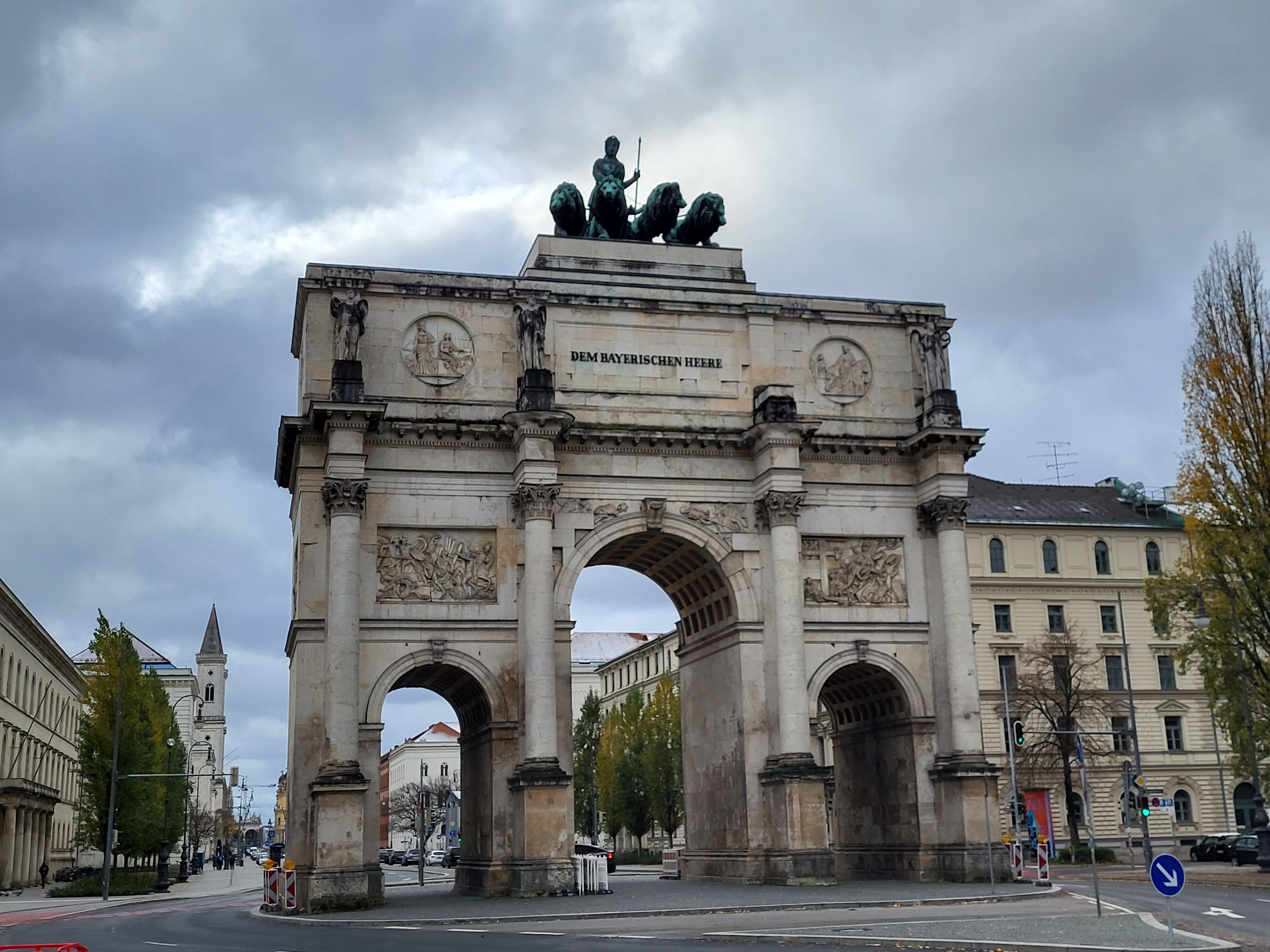
As we continued down the boulevard, we reached the Siegestor, the grand triumphal arch commissioned by King Ludwig I of Bavaria in 1852 to honor the Bavarian army. During World War II the arch suffered severe damage, and after the war there were discussions about tearing it down completely.
Instead, it was partially restored and inscribed with a powerful message that translates roughly to: “Dedicated to victory, destroyed by war, urging peace.” Standing beneath it, the monument felt less triumphant and more reflective—a reminder of how history can reshape even the meaning of architecture itself.

Churches & History in the City Center
Not far beyond stood the beautiful Ludwigskirche. Commissioned by King Ludwig I, the church immediately caught my attention because of the colorful patterned tiles along its roofline. I found myself staring upward more than at the building itself, fascinated by the contrast of colors against the gray winter sky.


Eventually we made our way to Odeonsplatz where another striking church rose before us—the mustard-yellow Theatine Church. Built beginning in 1663 to celebrate the long-awaited birth of a Bavarian heir, the church’s Baroque architecture and warm coloring made it unlike any church we had seen before.

But this square also holds more difficult history.
It was here that Adolf Hitler and his followers first violently clashed with police during the failed Beer Hall Putsch in 1923. Following the incident, Hitler was imprisoned, where he would later write Mein Kampf, laying ideological groundwork for the rise of the Nazi Party.
Throughout Munich there are reminders of how deeply the city’s history is intertwined with both cultural achievement and darker chapters of the twentieth century.

Christmas Market at the Residenz
Turning through the square once more, we arrived at the Munich Residenz, the former royal residence and seat of government. Inside the courtyard, a Christmas market glowed warmly against the cold afternoon. Wooden stalls filled the space with twinkling lights, evergreen garlands, and the smell of roasted nuts and mulled wine drifting through the air.

In one corner, animatronic displays told Christmas stories and fairy tales for children while visitors wandered between stalls selling ornaments, crafts, and winter treats. After the cold morning, the market felt especially welcoming, and somewhere between the lights and warm drinks, our mood finally began to thaw even if the weather did not.


Seeing Munich by Bus
At last, we located the central stop for the hop-on hop-off buses and happily climbed aboard to warm up while seeing more of the city. For the next several hours we rode through different parts of Munich listening to the history of the city while watching landmarks pass by the windows.


One of the highlights was seeing Nymphenburg Palace, the enormous summer residence of the former Bavarian rulers. The palace stretches so wide that its façade even surpasses the length of Versailles. Surrounded by sprawling parkland and gardens, it easily looked like a destination deserving an entire day on its own.

Later the distinctive tent-like roofs of Olympiapark Munich appeared in the distance. Built for the 1972 Summer Olympics, the complex still hosts concerts, sporting events, and cultural gatherings throughout the year. Someone sitting near us on the bus mentioned that a modern-style Christmas market was also being held there during the season.

Nearby stood the headquarters and museum of BMW, another symbol of Germany’s reputation for engineering and design. Even from the bus windows it was easy to see how deeply innovation and precision are woven into the country’s identity.

Munich After Dark
By the time darkness settled over Munich, the city had taken on an entirely different feeling from the one we arrived to the day before. The cold was still sharp, but the glowing lights, Christmas markets, and grand historic buildings made the city feel warm in a different kind of way.
We caught glimpses of the illuminated Opera House and the towers rising above Marienplatz, but by then we were tired from the cold and the long day of walking and sightseeing. We decided to leave those places for another day.
We were tired from the long travel day and the hours spent walking through the cold, but somewhere between the history-filled squares, the towering churches, and the festive markets tucked into courtyards, Munich had slowly begun to win us over.


Sometimes a city does not reveal itself all at once. Sometimes it takes a little wandering, a little patience, and a willingness to let the day unfold before its character begins to shine through.
What began as a frustrating arrival ended as a day full of history, beauty, and quiet moments of wonder—and by the end of the evening we found ourselves genuinely excited to keep exploring Munich the next day.
If you love Christmas travel in Europe, you can also read about our time exploring the festive streets and holiday markets
Christmas in Munich: Markets, Lights, & Holiday Magic
Thanks for coming along on this day around Munich. May you walk forward with progress, dynamism, and a willingness to disrupt the norm.

Coming Up Next:
For More Information:
Read More From:
Follow along for more adventures near and far!


Leave a Reply