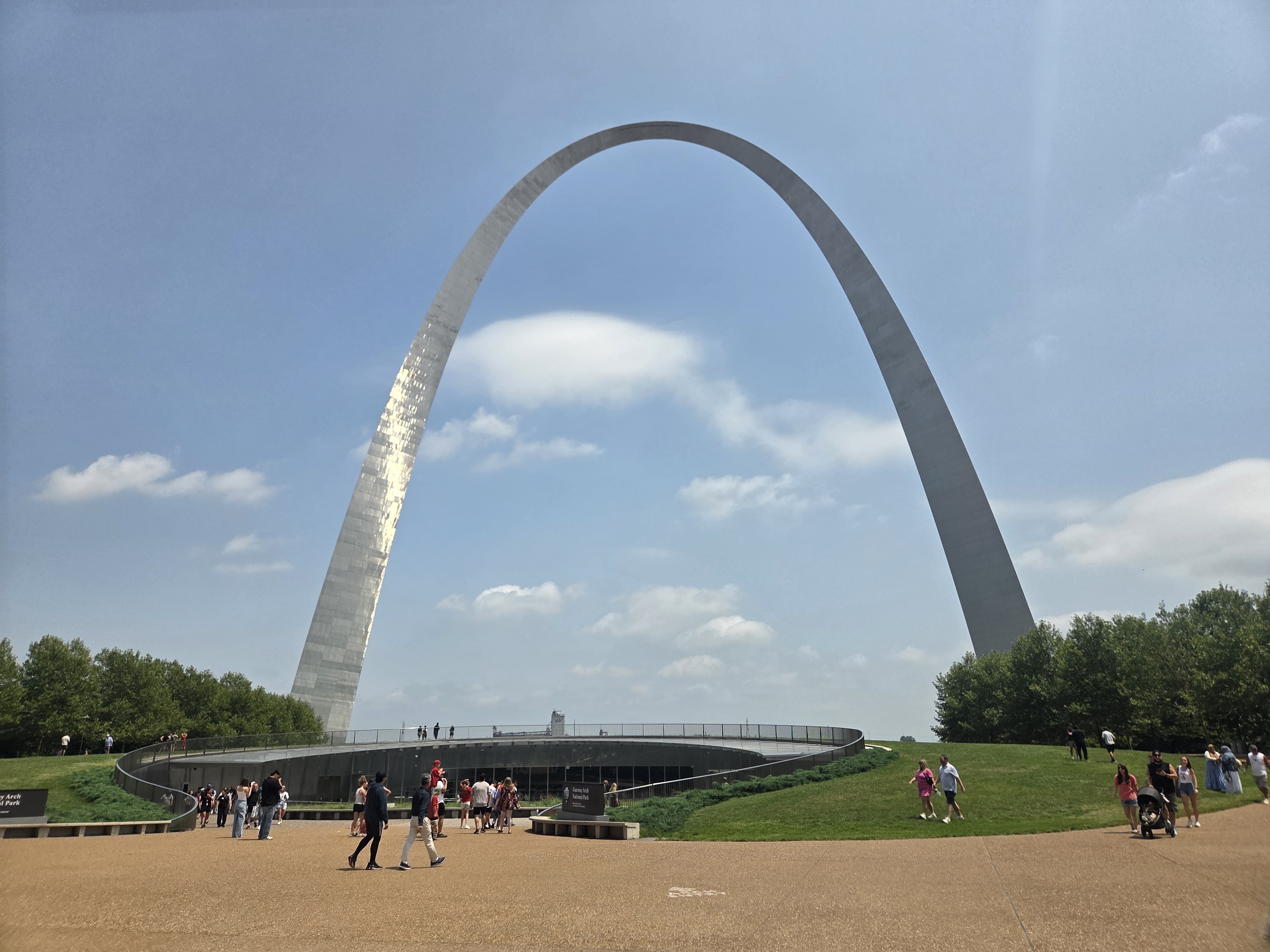
Our weekend in St. Louis wasn’t planned around sightseeing—it was planned around Irish dance. Our daughter was competing, and between competition times we found ourselves with just enough free time to explore one of America’s most recognizable landmarks.
We knew we wouldn’t be able to experience everything St. Louis had to offer, but there was one place we couldn’t leave without seeing: Gateway Arch National Park. Standing along the banks of the Mississippi River, the soaring stainless-steel arch has become a symbol of America’s westward expansion and one of the country’s most recognizable engineering achievements.
Like many trips, ours didn’t go exactly as planned. We didn’t realize that tickets to ride the tram to the top of the Arch often sell out in advance, and by the time we arrived, every ticket for the day was gone. At first, we were disappointed to miss what many consider the highlight of the park.
But as we explored the grounds, visited the museum, and stepped inside the beautifully restored Old Courthouse, we realized there was so much more to this national park than the view from the top. The stories told here—of westward expansion, Manifest Destiny, remarkable engineering, and the fight for freedom and equality—offer a fascinating look at the many layers of American history.
Even with only a few hours to explore, Gateway Arch National Park became much more than a quick stop between dance competitions. It became one of the most memorable parts of our weekend in St. Louis.
Gateway Arch National Park
- The History of Gateway Arch National Park
- Standing Beneath the Gateway Arch
- The Incredible Engineering of the Gateway Arch
- The Museum at the Gateway Arch
- Visiting the Old Courthouse
- Lunch at McGurk’s Irish Pub
- Planning Your Visit to Gateway Arch National Park
- FAQ: Gateway Arch National Park
At A Glance: Gateway Arch National Park
- Location: St. Louis, Missouri, along the Mississippi River
- Time Needed: 3-5 hours to visit the museum, Old Courthouse, Arch grounds, and ride the tram (if you have tickets)
- Entrance Fee: free to enter the park, museum, and Old Courthouse. A separate ticket is required to ride the tram to the top of the Gateway Arch (be sure to reserve tram tickets online before your visit as they often sell out day or even weeks ahead)
- Best For: history lovers, architecture enthusiasts, families, road trips, and first time visitors to St. Louis
- Best Time to Visit: spring and fall for comfortable weather, though the park is open year round

The History of Gateway Arch National Park
Long before the Gateway Arch became the defining symbol of St. Louis, this stretch of the Mississippi River was known as the “Gateway to the West.” During the early 1800s, the city served as an important starting point for traders, explorers, settlers, and immigrants heading into the vast lands of the Louisiana Purchase and beyond.
Following the Louisiana Purchase in 1803, President Thomas Jefferson envisioned an expanding nation stretching westward across the continent. St. Louis quickly became the launching point for many of those journeys, including the famous Lewis and Clark Expedition, which departed from the area in 1804 to explore the newly acquired territory.
As the nineteenth century progressed, millions of people traveled west in search of farmland, opportunity, and new beginnings. This movement became closely tied to the idea of Manifest Destiny—the belief that the United States was destined to expand from coast to coast. While this vision inspired exploration and settlement, it also came at an enormous cost to the Native nations who had lived on these lands for generations. As settlers moved west, Indigenous communities were displaced from their homelands, treaties were broken, and traditional ways of life were forever changed. Today, Gateway Arch National Park presents this history as a complex story of ambition, opportunity, innovation, conflict, and resilience.
By the 1930s, many of the historic buildings along the St. Louis riverfront had fallen into decline. Civic leaders began looking for a way to both preserve the city’s important role in American history and revitalize the waterfront. In 1935, Congress authorized the creation of the Jefferson National Expansion Memorial to commemorate St. Louis’ role in westward expansion.
The centerpiece of that memorial would become the Gateway Arch. Designed by Finnish-American architect Eero Saarinen, construction began in 1963 and was completed in 1965. Standing 630 feet tall and 630 feet wide, the stainless-steel Arch remains the tallest monument in the United States and one of the world’s most recognizable examples of modern engineering.
In 2018, the memorial was redesignated as Gateway Arch National Park, making it the country’s smallest national park. Today, the park invites visitors not only to admire the remarkable engineering of the Arch itself but also to explore the many stories—both inspiring and challenging—that shaped the nation’s westward expansion.


Standing Beneath the Gateway Arch
As we made our way across the park, the Gateway Arch seemed to grow taller with every step. It is one thing to see it in photographs, but standing directly beneath it is an entirely different experience. Looking straight up, the stainless-steel legs disappear into the sky until they meet 630 feet overhead in one graceful curve.
Like many visitors, we had hoped to ride the tram to the top. Unfortunately, by the time we arrived, every ticket for the day had already sold out. While we were disappointed at first, it gave us the opportunity to slow down and appreciate the monument from the ground instead.
Walking around the base of the Arch, we found ourselves marveling at its sheer scale. Despite being one of the tallest monuments in the world, there is an elegance to its design that makes it appear almost effortless. It seems to rise naturally from the landscape, framing the Mississippi River on one side and downtown St. Louis on the other.
Standing beneath the Arch also gives you a chance to reflect on what it represents. For many people, it symbolizes opportunity, exploration, and the hope of new beginnings as settlers looked westward. At the same time, it invites visitors to consider the more complicated history of that expansion and the many people whose stories are connected to it.
Even without reaching the top, simply standing beneath the Gateway Arch was an unforgettable experience.

The Incredible Engineering of the Gateway Arch
The more we looked at the Gateway Arch, the more we wondered how something so massive could have ever been built.
Designed by Finnish-American architect Eero Saarinen, the Gateway Arch is the tallest monument in the United States, standing 630 feet tall and spanning 630 feet wide. Its elegant shape is known as a weighted catenary arch, a design chosen for both its beauty and its structural strength.
Construction began in 1963 and required remarkable precision. The two legs of the Arch were built simultaneously, slowly rising toward one another over the course of two years. Engineers had to account for wind, temperature changes, and even the Earth’s curvature to ensure the two sides would meet perfectly at the top. When the final section was placed in October 1965, the legs aligned within a fraction of an inch—a remarkable achievement in engineering.
The Arch is clad in stainless steel and supported by a framework of carbon steel and reinforced concrete, allowing it to withstand high winds while maintaining its graceful appearance.
Inside each leg of the Arch is one of its most unique features: a tram system unlike a traditional elevator. The small, capsule-like cars rotate as they climb so that passengers remain upright while traveling through the curved interior to the observation deck at the top.
Even though we missed the chance to ride the tram on this visit, learning about the engineering behind the Gateway Arch only increased our appreciation for it. It is more than just a monument—it is a remarkable feat of architecture and engineering that continues to inspire visitors from around the world.

The Museum at the Gateway Arch
Beneath the Gateway Arch is a museum that tells the story behind the monument and the people who shaped the American West. Admission is free, and I would highly recommend taking the time to explore it, whether or not you plan to ride the tram to the top.
The museum walks visitors through hundreds of years of history, beginning with the Indigenous peoples who first called this region home before moving into the arrival of European settlers, the Louisiana Purchase, the Lewis and Clark Expedition, and the waves of westward migration that followed. Through interactive exhibits, artifacts, photographs, and personal stories, it explores how St. Louis earned its nickname as the “Gateway to the West.”
One of the things I appreciated most was that the museum doesn’t present westward expansion as a simple story of triumph. Instead, it acknowledges the many perspectives that shaped this period of American history. While westward expansion brought opportunity and innovation for many settlers, it also brought tremendous hardship for Native nations who were forced from their ancestral lands. Presenting these stories together gives visitors a fuller understanding of the people and events that shaped the country.
The exhibits also highlight the remarkable engineering and construction of the Gateway Arch itself. Models, photographs, and videos show how this iconic monument came together piece by piece, giving an even greater appreciation for the vision and precision required to build it.
Walking through the museum helped us realize that the Gateway Arch is much more than an impressive piece of architecture. It stands as a symbol of a defining period in American history—one filled with exploration, ambition, innovation, perseverance, and difficult questions that continue to shape the nation today.
Before visiting, I had expected the Arch itself to be the highlight of the park. Instead, I found that understanding the stories beneath it made standing under the monument even more meaningful.


Visiting the Old Courthouse
Just a short walk from the Gateway Arch stands one of the most important historic buildings in St. Louis—the Old Courthouse. While many visitors come to see the Arch, I think the courthouse is just as worthwhile and adds an important layer to understanding the history of Gateway Arch National Park.
Before we even stepped inside, we admired the beautiful architecture of the building. Its grand columns and stately exterior hint at the important events that took place within its walls. Once inside, we found ourselves immediately looking up at the magnificent rotunda. The colorful dome, ornate plasterwork, sweeping staircases, and elegant details make it one of the most beautiful courthouse interiors I have visited.


But the Old Courthouse is much more than an architectural landmark. It was here in 1846 that Dred and Harriet Scott filed lawsuits seeking their freedom after having lived for years in free territories where slavery was prohibited. Their legal battle eventually reached the United States Supreme Court, which ruled in 1857 that African Americans were not citizens of the United States and therefore could not sue in federal court. The decision also declared that Congress lacked the authority to prohibit slavery in U.S. territories, further deepening the divisions that would soon lead to the Civil War.
Standing in the courthouse where those first cases began was a powerful reminder that history is often far more personal than it seems in books. The courtroom represents both the injustices endured by Dred and Harriet Scott and the courage it took to challenge a system that denied them their freedom. Although the Supreme Court ruled against them, their case became one of the defining legal decisions in American history and helped intensify the national debate over slavery.
Today, the Old Courthouse encourages visitors to reflect on the many stories that shaped the nation. It reminds us that the same era celebrated by the Gateway Arch as a time of expansion and opportunity also included profound struggles over freedom, citizenship, and equality. Experiencing both sites together offers a more complete understanding of America’s past—one that recognizes both its remarkable achievements and its enduring challenges.
For me, the Old Courthouse was one of the most meaningful parts of our visit. It transformed the Gateway Arch from simply an impressive monument into a place where the many layers of American history come together in one unforgettable landscape.

Lunch at McGurk’s Irish Pub
After spending the morning exploring Gateway Arch National Park and the Old Courthouse, we made our way to the historic Soulard neighborhood for lunch. Since we were in St. Louis for an Irish dance competition, it seemed only fitting to eat at an Irish pub.
McGurk’s Irish Pub has been a St. Louis favorite for decades, and from the moment we walked through the doors, it was easy to see why. The cozy dining rooms, warm wood interiors, traditional Irish décor, and lively atmosphere made it feel like a place where people gather to linger over good food and conversation.
The food certainly lived up to its reputation. Between the fish and chips, corned beef and cabbage, and the potato soup- each dish was excellent. The fish was perfectly crispy on the outside and flaky on the inside, while the corned beef was tender and flavorful. After a morning spent walking through the park, it was exactly the hearty meal we were hoping for.
Although we only had time for lunch, McGurk’s gave us a wonderful introduction to the Soulard neighborhood, one of the oldest and most historic parts of St. Louis. Between the brick streets, historic buildings, and welcoming atmosphere, it quickly became one of those places we’d love to return to and explore more someday.
It was the perfect way to end our afternoon before heading back to the dance competition. After spending the morning learning about America’s westward expansion and the stories that shaped the nation, it somehow felt fitting to finish the day celebrating a little of our own Irish heritage through great food, good company, and the memories we were making together.


Planning Your Visit to Gateway Arch National Park
Gateway Arch National Park is easy to visit, but a little planning can make your experience even better. Whether you have a few hours or an entire day, here are a few tips to help you make the most of your visit.
Reserve Tram Tickets in Advance
If riding to the top of the Gateway Arch is on your bucket list, purchase your tickets before you arrive. We learned this lesson the hard way when every ticket for the day had already sold out. Even though we still had a wonderful visit, we’ll definitely reserve our tickets ahead of time the next time we’re in St. Louis.
Allow at Least Half a Day
Plan to spend at least three to five hours exploring the park. Between the Museum at the Gateway Arch, the Old Courthouse, walking the grounds, and (if you have tickets) riding the tram, there is much more to experience than simply seeing the Arch from the outside.
Don’t Skip the Old Courthouse
Many visitors come for the Gateway Arch and overlook the Old Courthouse, but we found it to be one of the most meaningful parts of the park. The beautiful architecture and the powerful history of the Dred and Harriet Scott cases add an important perspective to the story of America’s westward expansion.
Take Time to Explore the Museum
The free museum beneath the Arch provides valuable context for everything you’ll see throughout the park. The exhibits help explain the history of westward expansion, the engineering of the Arch, and the many people whose lives were shaped by these events.
Wear Comfortable Shoes
Although the park is easy to navigate, you’ll spend more time walking than you might expect. Between exploring the museum, the courthouse, the riverfront, and the Arch grounds, comfortable walking shoes will make your visit much more enjoyable.
Add a Meal Nearby
If your schedule allows, venture beyond the park for lunch or dinner. We enjoyed a fantastic meal at McGurk’s Irish Pub in the historic Soulard neighborhood, and it was the perfect way to round out our day in St. Louis.


FAQ: Gateway Arch National Park
- Do you need tickets to visit Gateway Arch National Park?
No. The Gateway Arch grounds, Museum at the Gateway Arch, and Old Courthouse are free to visit. However, tickets are required if you want to ride the tram to the top of the Arch. These tickets are separate from general park admission and should be reserved in advance, especially during weekends, holidays, and busy travel seasons.
- Is Gateway Arch National Park worth visiting?
Yes! While Gateway Arch National Park is very different from many of America’s other national parks, it offers a fascinating combination of history, architecture, and culture. The Arch itself is an incredible engineering achievement, while the museum and Old Courthouse provide a deeper understanding of the people and events that shaped American history.
- How much time do you need at Gateway Arch National Park?
Most visitors should plan for at least three to five hours to experience the highlights of the park. This gives you time to explore the museum, walk around the Arch grounds, visit the Old Courthouse, and ride the tram if you have tickets. If you only have a short amount of time, you can still see the Arch and explore the surrounding area in a couple of hours.
- Can you go to the top of the Gateway Arch without a reservation?
While same-day tickets may occasionally be available, it is best not to rely on them. Tram tickets often sell out, especially on busy days. Reserving your tickets ahead of time is the best way to guarantee you can experience the observation deck at the top of the Arch.
- What is the best thing to do at Gateway Arch National Park?
The best experience is combining the different parts of the park. Seeing the Gateway Arch is incredible, but visiting the museum and the Old Courthouse adds the historical context that makes the monument much more meaningful. Together, these sites tell a much fuller story about westward expansion, American innovation, and the ongoing conversations about freedom and equality.


When we arrived at Gateway Arch National Park, I thought the highlight of our visit would be standing on top of the Arch and looking out over the Mississippi River. Instead, our unexpected change of plans gave us the chance to slow down and discover a much deeper story.
The Gateway Arch is an incredible achievement of architecture and engineering, but the true power of this place comes from the many layers found beneath it. The Arch represents the ambition and determination that drove Americans westward, while the museum helps explain the people, ideas, and events behind that movement. The Old Courthouse reminds us that every chapter of history includes more complicated stories—stories of injustice, courage, and the ongoing struggle to define freedom and equality.
Standing beneath the Arch and walking through the courthouse, we were reminded that history is rarely just one simple story. It is made up of many voices, experiences, and perspectives that all deserve to be remembered.
Even though we didn’t make it to the top of the Gateway Arch on this visit, we left St. Louis with something we didn’t expect: a greater appreciation for the stories held within this remarkable place. Sometimes the unexpected moments of a trip become the ones that stay with you the longest, and our quick weekend stop in St. Louis became a meaningful reminder that there is always more to discover when we take the time to look deeper.
If you enjoyed this post, here are some others you might be interested in:
Celebrating America 250: National Park Sites that Tell the Story of America
A Historic Road Trip: Three Historic Sites that Changed a Nation
Thanks for coming along on this visit to Gateway Arch National Park and the Old Courthouse in St. Louis. May you marvel at the engineering and honor the stories behind it.

Upcoming Destination:
Read More From:
Follow along for more adventures near and far!


Leave a Reply