We spent a weekend down in Alabama, and our first stop was the U.S. Space & Rocket Center in Huntsville. While many people immediately think of Cape Canaveral when they hear “NASA,” Huntsville played an equally vital role in the space program—this is where the rockets were designed, built, and tested. It’s also home to the famous Space Camp, where aspiring young astronauts can get a taste of life among the stars.
Having lived in the heart of Florida’s Space Coast and been part of the excitement at Cape Canaveral, we’ve developed a deep love for the space program. It’s incredible to look back and see how far we’ve come—and even more thrilling to imagine how much farther we’ll go. What began as a distant dream has become reality, all thanks to those who dared to look up and dream big.

The Space Race
In the years following World War II, as the Cold War settled in, a fierce rivalry grew between the United States and the USSR. What began as a competition over nuclear capabilities—the “nuclear arms race”—soon expanded into something even more ambitious. Discussions about satellite reconnaissance led to a realization on both sides: whoever mastered spaceflight would gain a powerful strategic advantage. And with that, the race for space began.
The Space Race officially ignited in July 1955 when the United States announced its intention to launch a satellite into orbit. The Soviets quickly declared they would do the same. In the years that followed, the USSR leapt ahead with a series of historic firsts: the launch of the world’s first satellite, Sputnik, in October 1957, and then Yuri Gagarin’s trailblazing journey into space in April 1961.
Gagarin’s flight served as the spark that led President John F. Kennedy to deliver his famous challenge to Congress: the United States would send a man to the moon—and return him safely—before the decade was out. From that moment, both nations poured their efforts into developing the super heavy-lift launch vehicles needed to carry humans beyond Earth’s atmosphere.
Thousands of people across the U.S. worked tirelessly toward this goal—engineers, mathematicians, computer programmers, seamstresses, welders, and countless others. Their collective dedication culminated in July 1969, when the world watched Apollo 11 lift off from Cape Canaveral and make its historic voyage to the moon.
Neil Armstrong stepped onto the lunar surface with the now-immortal words: “That’s one small step for man, one giant leap for mankind.” The crew left behind an American flag, a disk of goodwill messages from world leaders, and a plaque that read: We came in peace for all mankind. President Kennedy did not live to see his vision realized, but on the night of the moon landing, someone left flowers and a note on his grave saying, “Mr. President, the eagle has landed.”
Many mark the symbolic end of the Space Race with the partnership that created the International Space Station. As Cold War tensions eased, cooperation replaced competition, and nations that once raced against each other began working together among the stars.


U.S. Space & Rocket Center
The U.S. Space and Rocket Center is made up of different areas and exhibits. Walking through and seeing everything can easily take a few hours, so be sure to give yourself enough time to enjoy everything there.
Space Station Exhibit Hall
The first exhibit we found on entering the building was a collection of pop culture items that have all come from a curiosity and love of the great unknown of space. Toys, games, dolls, books, shows and everything else fill the cabinets.

I heard one person say that this seemed very campy and kitschy for this kind of place. But I quite loved seeing that influence of space and what’s out there connect different generations of daydreamers.


There was an exhibit showing how the astronaut uniform has changed and adapted over the many missions into space. With each mission they worked to make the uniform not only safer but more comfortable.

There have been different designs and models of rovers that have been sent into space, gathering information about terrains and environments. It was so interesting to see some of them and get an idea about how they worked.


The main area of the exhibit hall is full of different parts of the spacecrafts as well as the daily living of the people who live there during the mission. From engine designs to what kind of food they eat in space, this area is full of the more technical side of life in space.


They have a really great kids area that is full of crafts, experiments, and activities all focused on creating sparks of creativity and science into young minds. If my daughter had her way we would have spent the entire day right here.

Rocket Park
We left the exhibit hall and wandered through the outdoor section, fondly called Rocket Park. The first view is the replica shuttle and fuel tank. Amazing to think that all the parts and pieces of the rockets are assembled here.

Further around the park stands a number of models of smaller, faster rockets. Some of them became realities, while others didn’t leave the drawing board. But all of them show the determination to make it to space easier and faster.

They have recreated the moon landing, complete with flag and landing modual. They even used pictures of the moon surface to give an accurate representation of what it looked like.

Saturn V Hall
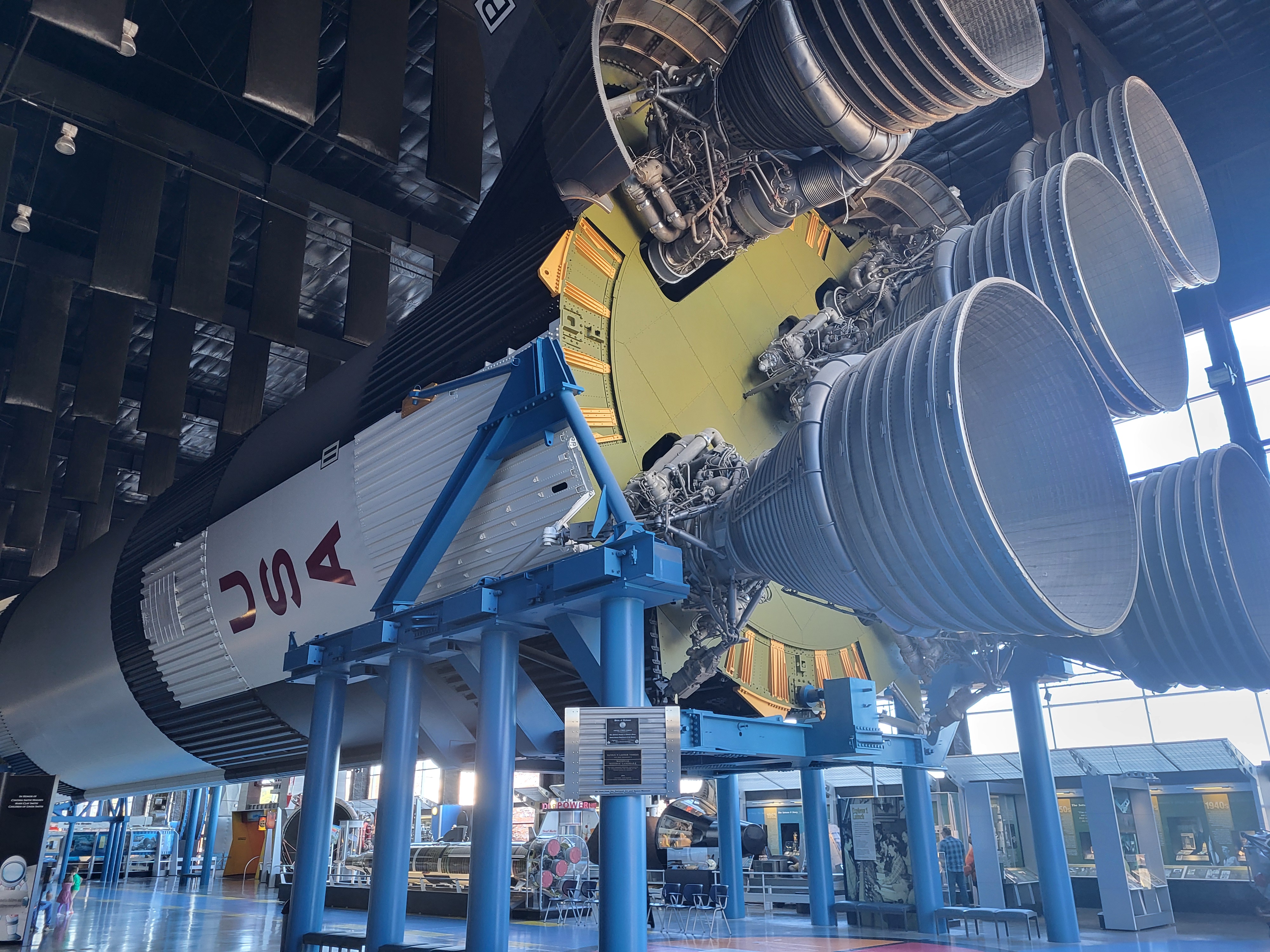
The most popular area is the Saturn V Hall, where sits the actual Saturn V rocket that completed many missions through space before retiring here. The rocket takes up the entire hall, with other exhibits surrounding it. It is absolutely incredible to walk beneath this space giant and think about all of space that is has seen.

Other exhibits talk about the Space Race and the long road that it took. There were many setbacks, many failed attempts, many times that people wondered if it ever going to happen. It was especially humbling to read about the Apollo 1, the first in the line of missions.


On one side is the computer of Saturn V. This computer is a massive ring of wires and hardware all designed to initiate different sequences of the rocket launch and landing.

And there is a recreated vehicles showing how an astronaut would land on the moon and then come back down to earth afterwards.


There is no way to really capture the magnitude of Saturn V in a picture as it is so large. You just have to see the different pieces of it and stand in awe at the size and power it has to have been through so many different missions into space.

Intuitive Planetarium & Other Attractions
Besides the exhibits, there are a few attractions that can be enjoyed for an additional cost. The most popular is watching one of the presentations in the Planetarium. We really loved the presentation we watched about the planets and the galaxy beyond.
They also offer a few different simulators that let you experience the Gforce, or the initial launch into space. Also space themed rides for any age and a playground for the younger ones are also a fun addition to the day.

Space Camp
For any aspiring astronaut, Space Camp is a bucket list item. They offer space, aviation, and robotics experiences for those ages 9-18. This is considered the ultimate hands-on learning experience.

Visitor Information
If you are planning at visit to the U.S. Space & Rocket Center, here are some things to keep in mind. For more information check the Rocket Center website.
- They are open every day of the week from 10:00-2:00 during winter hours
- general admission tickets are $30/adult, $20/child (additional costs for planetarium and other attractions)
- a visit can take anywhere from 1-5 hours depending on all you do
It was such an incredible experience to visit the Rocket Center and learn the history and see those rockets that have been to space. It really is amazing to think that ideas that were once a daydream about leaving earth and brushing the stars, not only became a reality but also led to going further and further into the galaxy. Nothing will make you feel so small as to realize just how big the galaxy is that we are all a part of.
Want more of the space program? Then you might be interested in these places:
Thanks for coming along on this visit to the U.S. Space & Rocket Center in Huntsville. May you always remember to look up and dream big.

Coming Up Next:
For More Information:
Read More From:
Follow along for more adventures near and far!


Leave a Reply to Coral WaightCancel reply