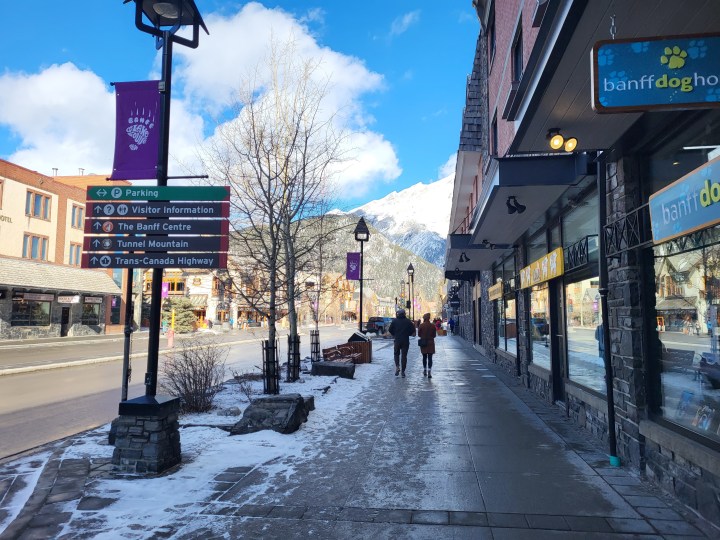
When most people think of Banff National Park, they picture soaring mountain peaks, frozen lakes, and endless outdoor adventures. What they don’t always realize is that nestled right in the heart of the park is the charming mountain town of Banff.
It’s unusual to find a thriving community surrounded by the protected wilderness of a national park, but Banff somehow strikes the perfect balance. It serves as both a gateway to the Canadian Rockies and a destination in its own right.
After spending our mornings exploring frozen lakes and snow-covered trails, wandering through Banff felt like the perfect way to slow down. Cozy cafés, welcoming restaurants, local shops, and mountain views around every corner made it easy to understand why so many visitors choose to stay here while exploring the park.
Winter adds another layer of charm. Snow blankets the rooftops, lights twinkle in the shop windows, and the entire town feels warm and inviting against the dramatic backdrop of the surrounding mountains. While the incredible scenery first draws you to Banff National Park, it’s the atmosphere of the town itself that makes you want to linger just a little longer.
Banff in Winter
- Banff Train Station
- Strolling Through Downtown Banff
- Banff Park Museum National Historic Site
- A Walk Along the Bow River
- The Parks Canada Administration Building
- Buffalo Nations Luxton Museum
- Cave and Basin National Historic Site
Banff Train Station
Our first stop in town was the historic Banff Railway Station. More than just a transportation hub, it feels like the front door to Banff National Park.
For well over a century, visitors have arrived here eager to experience the Canadian Rockies. The station still welcomes luxury rail journeys, and its designation as a Canadian Heritage Railway Station reflects the important role it has played in introducing generations of travelers to Canada’s first national park.

Inside, the station has been thoughtfully updated while still preserving touches of its past, including the original wooden train benches that remind visitors of an earlier era of rail travel. It’s easy to imagine what it must have felt like to step off the train here decades ago, seeing the snow-covered mountains for the very first time.
Today, the station continues to serve as a practical starting point for exploring Banff. It’s home to visitor services, public transportation, and one of the most convenient places to park before setting out on foot through town.
During the winter, the lawn outside takes on a new life as a small outdoor skating rink. Watching families lace up their skates with the mountains rising behind them felt like a fitting welcome to a town where winter isn’t simply a season—it’s part of everyday life.

Strolling Through Downtown Banff
One of my favorite parts of visiting Banff wasn’t checking attractions off a list—it was simply wandering through downtown.
The entire town is incredibly walkable, making it easy to spend hours exploring without any particular destination in mind. Every street seemed to reveal another inviting café, local boutique, or beautiful mountain view tucked between the buildings.

What struck me most was how well the town blends into its surroundings. Instead of towering hotels and modern high-rises, Banff embraces a mountain village feel. Many of the buildings are inspired by château architecture, with steep roofs, natural stone, and timber details that seem perfectly at home beneath the surrounding peaks.
That appearance isn’t accidental. Because Banff sits within Banff National Park, development is carefully regulated. Building height, architectural style, and growth are all managed to help preserve the character of the town and its relationship with the surrounding landscape.

Winter only adds to its charm. Throughout downtown, Adirondack chairs circle outdoor fire pits where visitors can warm themselves after a day in the snow. Stacks of firewood sit nearby, inviting anyone to add another log before settling in to enjoy the crisp mountain air. It felt like one of those small touches that perfectly captured Banff’s welcoming atmosphere.
One of the most interesting things I learned is that Banff isn’t simply a place where anyone can choose to live. Because it lies within a national park, residents must meet Parks Canada residency requirements by demonstrating a need to live and work in the community. Vacation homes aren’t permitted, helping the town remain a functioning mountain community rather than becoming solely a destination for seasonal visitors.
As we wandered from shop to shop with snow falling lightly around us, it became clear that Banff isn’t just a gateway to the Canadian Rockies—it’s a destination worth slowing down to enjoy all on its own.

Banff Park Museum National Historic Site
One of the most unexpected discoveries in downtown Banff was the Banff Park Museum National Historic Site.
At first glance, the small wooden building doesn’t seem particularly remarkable. But inside is one of Canada’s oldest natural history museums and a fascinating look at the wildlife that calls Banff National Park home.

Built in 1903, the museum is the oldest surviving federal building in Canada’s national park system and has been designated a National Historic Site. Its historic collection includes nearly 5,000 preserved plants, birds, mammals, fish, and insects, offering visitors a glimpse into the incredible biodiversity of the Canadian Rockies long before modern visitor centers existed.
Even if you don’t have time to explore the exhibits, the building itself is worth admiring. Its rustic log architecture feels perfectly at home in the mountain setting and serves as a reminder of the early days of conservation and scientific exploration in Banff National Park.
If you’d like to tour the museum, be sure to check current operating hours before your visit, as seasonal schedules can be limited, particularly during the quieter months.

A Walk Along the Bow River
Whenever the shops and streets became a little too busy, we found ourselves drawn back toward the Bow River.
Flowing through the heart of Banff, the river offers a peaceful escape just steps from downtown. Walking paths follow both sides of the water, while several pedestrian bridges connect the trails and provide beautiful views of the surrounding mountains.

Even in winter, there was something incredibly calming about standing along the river. Snow covered the banks, the water continued its steady journey through town, and the sounds of the rushing current replaced the bustle of the nearby streets.
It became clear that Banff isn’t a place you drive through—it’s a place you experience one small moment at a time.
It became one of my favorite places to simply pause for a while. Banff has plenty of attractions, shops, and restaurants, but sometimes the best way to experience the town is to step away from the crowds and spend a few quiet moments beside the river that has shaped this valley for centuries.


The Parks Canada Administration Building
Perched on the hillside above downtown, the Parks Canada Administration Building is one of the most striking buildings in Banff.
Built in a château-inspired style using local stone, the building feels perfectly at home among the surrounding mountains. It serves as the administrative headquarters for Parks Canada in Banff National Park, but its impressive architecture makes it a landmark in its own right.
While the offices aren’t open for sightseeing, visitors are welcome to wander through the beautifully maintained grounds surrounding the building. In spring and summer, the gardens burst into color with flowers and mountain landscaping. During our winter visit, the gardens rested beneath a blanket of snow, giving the entire property a quiet elegance that matched the peaceful atmosphere of the town.
Standing on the hillside, it was easy to appreciate how thoughtfully Banff has been designed. Even its government buildings seem to belong naturally within the landscape rather than competing with it.

Buffalo Nations Luxton Museum
Just a short walk from the Parks Canada Administration Building is the Buffalo Nations Luxton Museum, a space dedicated to sharing the history, culture, and lived experiences of the Indigenous peoples of the Rocky Mountains and Great Plains.
Inside, the museum brings together a wide range of artifacts, artwork, clothing, and historical objects that help tell the story of the First Nations who have called this region home for thousands of years. Rather than focusing only on history in the distant past, the exhibits also explore continuity—how culture, tradition, and identity have carried forward through generations.

The museum describes itself as a cultural space that “celebrates the richness, diversity, continuity and, above all, the resilience of the native peoples of this area,” and that message is felt throughout the experience.
Walking through the exhibits added another layer to our understanding of Banff. Beyond the mountains and architecture, it became clear that this landscape holds deep cultural meaning and history that long predates the town itself.

Cave and Basin National Historic Site
The second historic site within Banff is the Cave and Basin National Historic Site, a place that played a key role in the creation of Canada’s national parks system.
In 1883, three Canadian Pacific Railway workers discovered a series of natural hot springs here and immediately recognized the potential to attract visitors to the region. That discovery eventually led to the development of a small bathing and hotel facility, and over time helped spark the movement that resulted in Banff becoming Canada’s first national park.

Today, visitors can explore the site through boardwalks that wind around the steaming thermal waters. Even in winter, the rising mist and faint scent of sulfur in the air give the area a distinct atmosphere that feels both natural and historic.

While the cave itself—where the springs emerge—is closed during the winter months, the surrounding area is still open to explore. From the visitor center, a series of stairs leads upward to the historic bathhouse buildings, which overlook both the mountains and the modern pool area below.
The contrast between past and present is especially striking here, where a place once built for bathing and tourism has become a protected historic site.

But my favorite part of the visit had nothing to do with the hot springs at all.
It was finally seeing the iconic Parks Canada red chairs.
I had first noticed them through travel photos shared by fellow bloggers, and I had quietly hoped we would stumble upon them during our time in Banff. Scattered across national parks throughout Canada, these bright red chairs are placed at scenic viewpoints to encourage visitors to pause and take in the landscape. There are more than 200 sets across the country, each marked on the Parks Canada website for those hoping to find them.
Finding them here, tucked into a view overlooking Banff, felt like a small but meaningful moment—one of those simple travel details that ends up becoming a favorite memory.


After spending the day wandering through Banff, what stayed with me most wasn’t any single landmark, but the way everything seemed to belong together. The mountains weren’t just a backdrop to the town-they shaped it. The history wasn’t something confined to museums-it was woven into the streets, the buildings, and the landscape itself.
From quiet moments along the Bow River to standing inside centuries of history at the Cave and Basin, Banff felt layered in a way that asked you to slow down and pay attention. It’s a place where nature, history, and everyday life exist side by side, and where even a simple winter walk through town can feel like part of something much larger.
Banff in winter is not just about the scenery—it’s about the experience of moving slowly through a town shaped by the mountains around it.
If you enjoyed this tour of Banff, then you may be interested in these other cities:
Thanks for coming along to the town of Banff in Banff National Park. May you enjoy a moment of peace from the comfort of a red chair.

Coming Up Next:
For More Information:
Read More From:
Follow along for more adventures near and far!


Leave a Reply